
20 September 2025

Well may we say it's been 50 years ... MoAD prepares to commemorate the Dismissal

| By Chris Johnson
Join the conversation
33

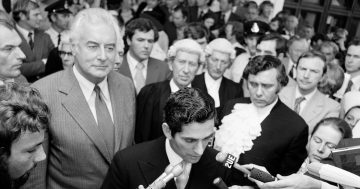
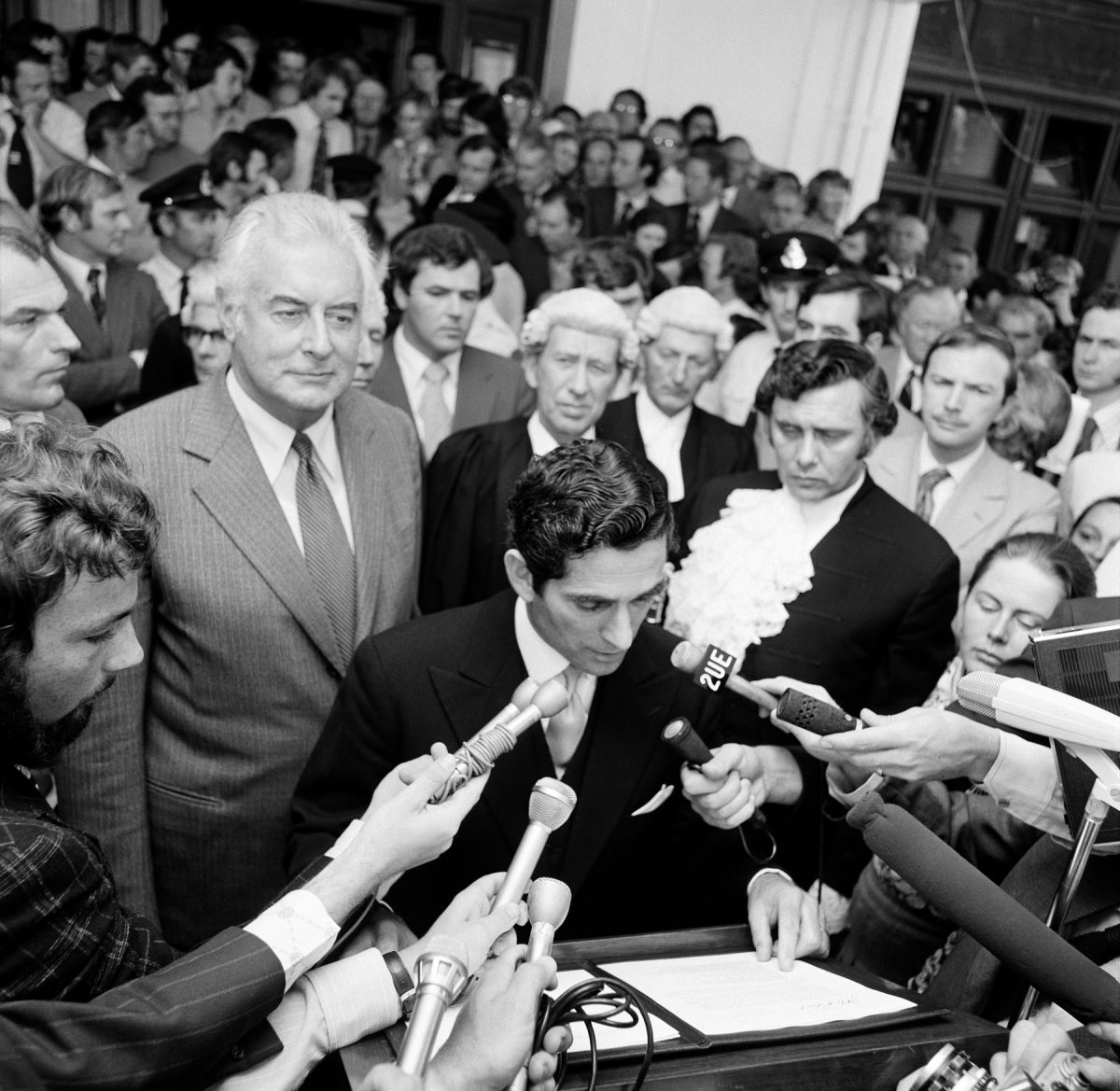
Gough Whitlam on the steps of Parliament House on 11 November 1975 as the Governor-General’s Official Secretary, David Smith, reads the proclamation dissolving parliament. Photo: National Archives of Australia.

“Well may we say ‘God save the Queen’, because nothing will save the Governor-General.”

Heard that line before? Maybe half a century ago?

The 50th anniversary of the Dismissal of Gough Whitlam’s Labor government is almost upon us, and the Museum of Australian Democracy (MoAD) at Old Parliament House is gearing up to commemorate it in style.

On 11 November 1975, the then Governor-General Sir John Kerr dismissed Gough and replaced him with Malcolm Fraser on the condition that he secured supply and went to an election.

Mr Fraser and the Coalition won the subsequent election in a landslide, and the rest, as they say, is history.

And what history it is.

The Dismissal remains the most controversial event in the nation’s political history and continues to loom large over the Australian psyche.

Old Parliament House featured prominently in the events of that fateful day, and this November it will mark this significant anniversary with a program of events, exhibitions and tours.

“The Dismissal shaped Australia’s history. Fifty years later, it remains one of the most debated moments in Australian political history,” said Chair of the Board at Old Parliament House, Barrie Cassidy.

“We’re proud to host engaging programming, encouraging conversation right here, at the place where history happened.”

MoAD will recognise the 50th anniversary with a special presentation on 11 November, but the commemoration will begin at the start of the month and continue into next year.

From November through to February 2026, MoAD will present a new exhibition titled The Dismissal: Words that made history.

It will invite visitors to look beyond the headlines and into the people, politics and power plays that defined the event.

The exhibition will bring together key documents from the period, many of which will be exhibited together for the first time, including the original letter of Dismissal handed by Sir John Kerr to Mr Whitlam.

On display also will be handwritten notes and official letters – documents that “didn’t just change a government, they changed the course of the nation”.

A free, Dismissal-themed tour will be offered daily, guiding visitors through the spaces where history unfolded.
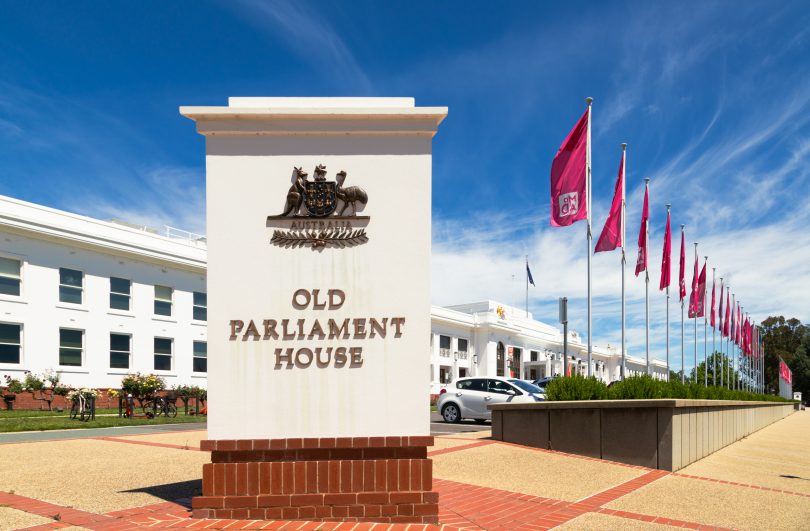
Old Parliament House

Old Parliament House will be recognising the 50th anniversary of the Dismissal in style. Photo: MOAD.

Across a day of live-streamed speeches and panel discussions, the program will feature analysis and personal reflections from a diverse range of speakers, including two former Australian prime ministers, Paul Keating and John Howard.

And that ‘little Aussie bleeder’ Norman Gunston, who was on the steps of Parliament House that day in 1975, will also be contributing to the anniversary discussions – well, actor Garry McDonald, who created the character, will be there (and probably without the tissue paper on his face).

READ ALSO Australia and PNG having difficulty getting mutual security pact across the line

Among the speakers will be Niki Savva, political commentator, author, and Board Member of Old Parliament House, who was reporting for The Australian from the building on the day of the Dismissal.

“People of my generation remember exactly where they were when John Kennedy was assassinated, when man walked on the moon and when Gough Whitlam was dismissed,” Ms Sava said.

“On November 11, 1975, I was on the front steps of Parliament House listening to his speech, and hearing the crowd roar.

“It was the most momentous day in Australian political history, condemned by many and welcomed by others.

“Please join us this November 11 to hear fascinating, never-before-told stories of that day, including from inside the Governor-General’s residence, as well as from some of the key players.”

Audiences across the country and around the world can watch the events online, while visitors to the museum can view them on multiple live screens throughout Old Parliament House.

The Dismissed tour will run daily at 11 am from 1 October until 31 January 2026. Admission is free. On the anniversary itself, 11 November 2025, MoAD will host a full day of events that it says will offer fresh perspectives from people who were there.


Join the conversation

33
All Comments
  • All Comments
  • Website Comments
LatestOldest
HiddenDragon10:25 pm 21 Sep 25

Understandably, Whitlam did his very best to frame the subsequent election as being about values, but the outcome of that election, and the following one, were largely determined by an overriding factor identified by a more pragmatic PM –

https://slll.cass.anu.edu.au/files/andc/WotM_September_2016.pdf

That same pragmatic reality is catching up with the current government, which paints itself as Hawke/Keating redux, but is now looking more like a Whitlam tribute act (on sedatives), with distinct signs of stagflation emerging in the Australian economy at the same time as it becomes painfully clear that it is much easier to expand a welfare state than it is to find politically palatable ways of paying for it.

Your pivot from a sensible point to the usual nonsensical, fact free, partisan whinge about the government is quite impressive…they literally waived through the Morrison government tax cuts and are slashing the NDIS.

Shame the current GG doesn’t do the same.

Why do you hate democracy Michael?

i was also near the steps of Old Parliament House on that day. Like others, it galvanised me to join the ALP and maintain the rage.

Peter Graves6:51 pm 20 Sep 25

It took Professor Jenny Hocking many decades to find out the conspiracy involving Fraser, Barwick (and one of his Justices), Kerr and the Palace to dismiss Whitlam on specious grounds. It’s technically complex, but worth reading in her book: “The Palace Letters: The Queen, the Governor-General, and the Plot to dismiss Gough Whitlam”.

Or, for those not obsessed with conspiracy theories, “The Truth of the Palace Letters: Deceit, Ambush and Dismissal in 1975” by Paul Kelly and Troy Bramston looks at the same source material and debunks claims of a conspiracy.

Peter Graves9:08 pm 21 Sep 25

They would, wouldn’t they ? Professor Hocking’s research was forensic and involved many years of stonewalling by the National Archives before she gained access to the relevant papers.

Good grief, Hocking didn’t prove a conspiracy at all! 😀 She came up with a stance without evidence, tried to find evidence in support of her political stance, and pig-headedly maintained that stance when the letters showed otherwise.

I highly commend Emerita Prof Anne Twomey’s “Constitutional Clarion” on YouTube; she is covering this topic over several videos to mark the anniversary.

The GG was entitled to do what he did, and similar action had occurred on multiple occasions at the state level. Twomey explains why it was harder to identify these past instances in the 1970s.

I also note that the immediate past GG was incorrect to blindly follow the advice of the then-PM regarding concurrent holding of multiple ministries, just as the current GG is also incorrect in her view that the role has nothing to do with the Sovereign. Sadly, many people remain ignorant of the rules.

Thanks Matt. Very Interesting.

I don’t think anyone seriously suggested the GG had the power to do what he did.

The point was his lack of honesty & integrity. He should have laid out the options for Whitlam & informed him of the possibility of the dismissal.

He should also have formally encouraged the senate to actually vote on the appropriation bills.

History disagrees with your comment franky. The GG had the power, and did use it.

If you’re suggesting Whitlam had no clue what was coming when he couldn’t achieve the most basic of governance requirements – pay the bills – well he shouldn’t have been there in the first place. Spending explosions aren’t a good idea. (note for current incumbents too).

Anyway the Australian public could read the tea leaves and promptly elected the Coalition and Fraser with 91 seats to Whitlam’s Labor 36. And while Gough maintained the rage and Labor couldn’t read the tea leaves, voters delivered an almost identical result in 1977.

Franky22, constitutional experts know Kerr had the power to do what he did.

Where in our Constitution does it give power to the GG to sack a democratically elected government?

Section 64. Cheers.

Section 64 MattWatts? Argue that with a Constitutional lawyer! The sheer uncertainty of these powers ensures that they are very rarely used and their influence lies only in their existence. These powers were not tested in the High Court despite the governor-general’s scandalous and secret collusion with serving justices, which only came to light many years after the crisis.

Most political conflicts are resolved politically. No other governing party in Australia’s history has been so comprehensively ambushed by an opposition party! Even Bob Menzies was on the side-lines at the time of the crisis urging the party to pass supply and John Howard revealed later his misgivings at his involvement!

A Labor government that had won a second election victory with a clear majority in the House of Representatives, constantly hampered by a deliberate strategy of obstruction from an opposition party in their desperation to hold government. Using their powers in the Senate which had been rorted by NSW and QLD to appoint enemies of the government to Labor vacancies, enabling the opposition to hamper business, holding them to ransom by denying supply and demanding an election. A flawed and dishonest GG whose allegiances were firmly with the right colluding with the opposition leader to bring down a government. A GG who was also receiving advice from serving high court justices, with the very real possibility that matters on which they advised Kerr would come before the court. Not to mention the GG’s discussions with the Palace during and after the crisis, conversations later designated as “personal correspondence” and locked away in our National Archives and embargoed by the Queen, denying the Australian people access to critical information pertinent to our history.

You clearly haven’t viewed Twomey’s videos, despite my suggestion.

You asked which power enabled such action. It was Section 64, without question. Cheers.

Daily Digest

Want the best Canberra news delivered daily? Every day we package the most popular Region Canberra stories and send them straight to your inbox. Sign-up now for trusted local news that will never be behind a paywall.

By submitting your email address you are agreeing to Region Group's terms and conditions and privacy policy.