

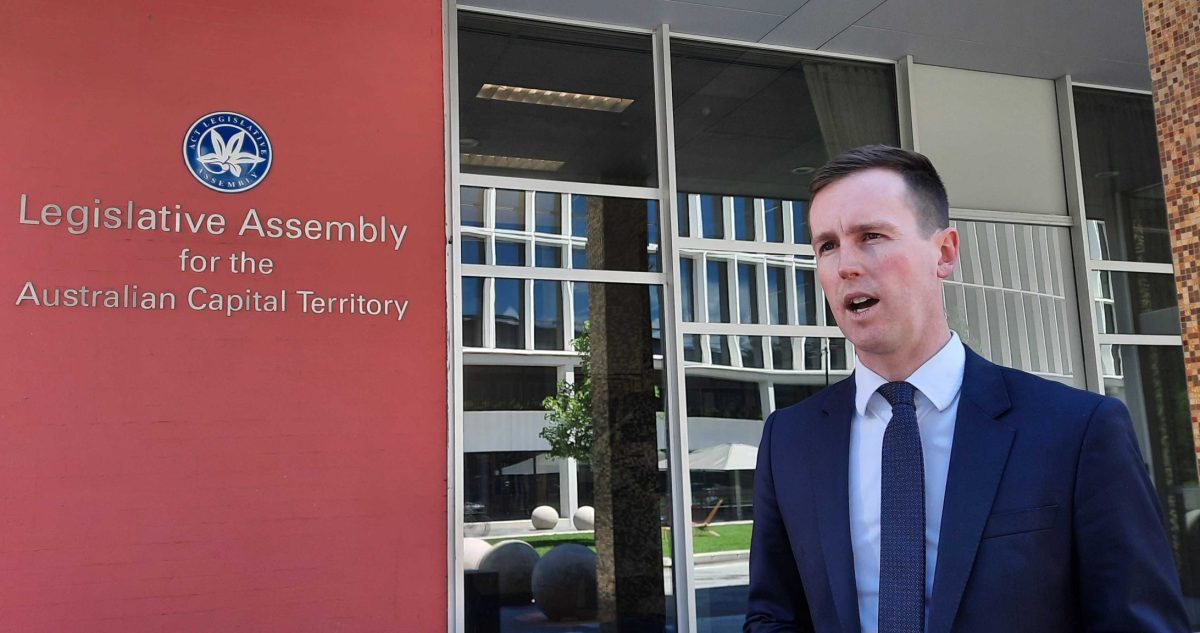
Planning Minister Chris Steel says the changes will support the rapid delivery of social housing for those most in need. Photo: Ian Bushnell.
Public and community housing projects have been placed on a faster track to development after new laws mean they can no longer be held up by appeals to the ACT Civil and Administrative Tribunal.
The Barr Government secured the passage of the Planning (Territory Priority Project) Amendment Bill 2025 in the Legislative Assembly late on Wednesday (3 December) after doing a deal with the Greens.
The contentious bill was a response to what the government called vexatious appeals to ACAT that were delaying and blocking vital housing developments for vulnerable people.
It will mean most public and community housing proposals will be declared Territory Priority Projects, making them exempt from third-party appeals.
Under the mix of government and Greens amendments agreed to, community housing will now be included.
Planning Minister Chris Steel said more work was needed to clarify the definition of genuine community housing projects before they could be included, and that consultation with community housing providers had been valuable in achieving this.
At least 15 per cent of a project must include community housing and have links to ACT or Commonwealth funding to qualify.
Only newly funded public housing will be eligible for TPP status, not projects from the previous term or the renewal program.
Projects will now only have to satisfy one of three criteria, not all three as was previously the case to qualify.
There are also environmental and heritage protections.
A sunset clause means the new laws expire on 31 December 2029, with a legislative review also to be conducted after 1 December 2028 and tabled in the Assembly by 30 June 2029 to ensure clear Assembly oversight.
Mr Steel said the amendments were a sensible compromise that would support the rapid delivery of social housing for those most in need.
He said the new laws brought the ACT into line with other NSW, Victoria, Queensland and Western Australia, where appeals were also not permitted for public and community housing projects.
Since 2019, there have been 20 appeals against public housing projects, mainly in the inner north and inner south, delaying the construction of more than 100 public homes.
More than 75 per cent of these saw ACAT uphold the original approval or specify very minor amendments, but the process delayed projects for up to a year, Mr Steel said.
Inner South resident groups opposed to the loss of appeal rights had argued that if the Planning Authority had done its job properly, they would not have had to challenge projects that breached planning rules.
Mr Steel said projects would still need to be assessed under the planning laws, but once approved, could proceed to development with certainty.
Housing and New Suburbs Minister Yvette Berry said the new laws would stop vexatious litigation by resident groups opposed to social housing nearby.
She cited the case of the YWCA proposal in Ainslie for women and children escaping family violence that had been delayed for more than a year due to ACAT action.
“I can’t say how happy I am that we will be able to build more homes quickly, and that more people are on our waiting list will have some have some hope of getting into a home within a reasonable timeframe,” she said.
The Canberra Liberals voted against the bill.
YWCA Canberra said the new laws streamline housing developments that have received prior planning approval, exempting them from costly and lengthy third-party appeals.
“Canberra is facing an unprecedented housing and homelessness crisis, and meaningful change is long overdue to address the critical need for housing for low-income earners,” it said.
Property Council ACT & Capital Region Executive Director Ashlee Berry said the changes would speed up delivery, send a strong signal to the market and reduce risk for developers.
“Fast-tracking public and community housing is the right call,” Ms Berry said.
“It means projects that deliver homes for people who need them most will spend less time tied up in appeals and more time on site. That’s exactly what industry has been calling for.”