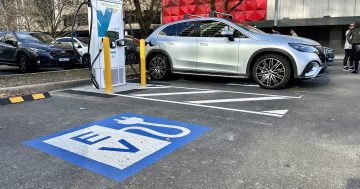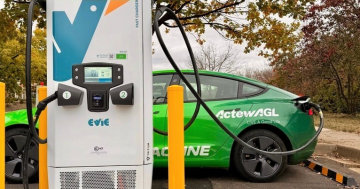

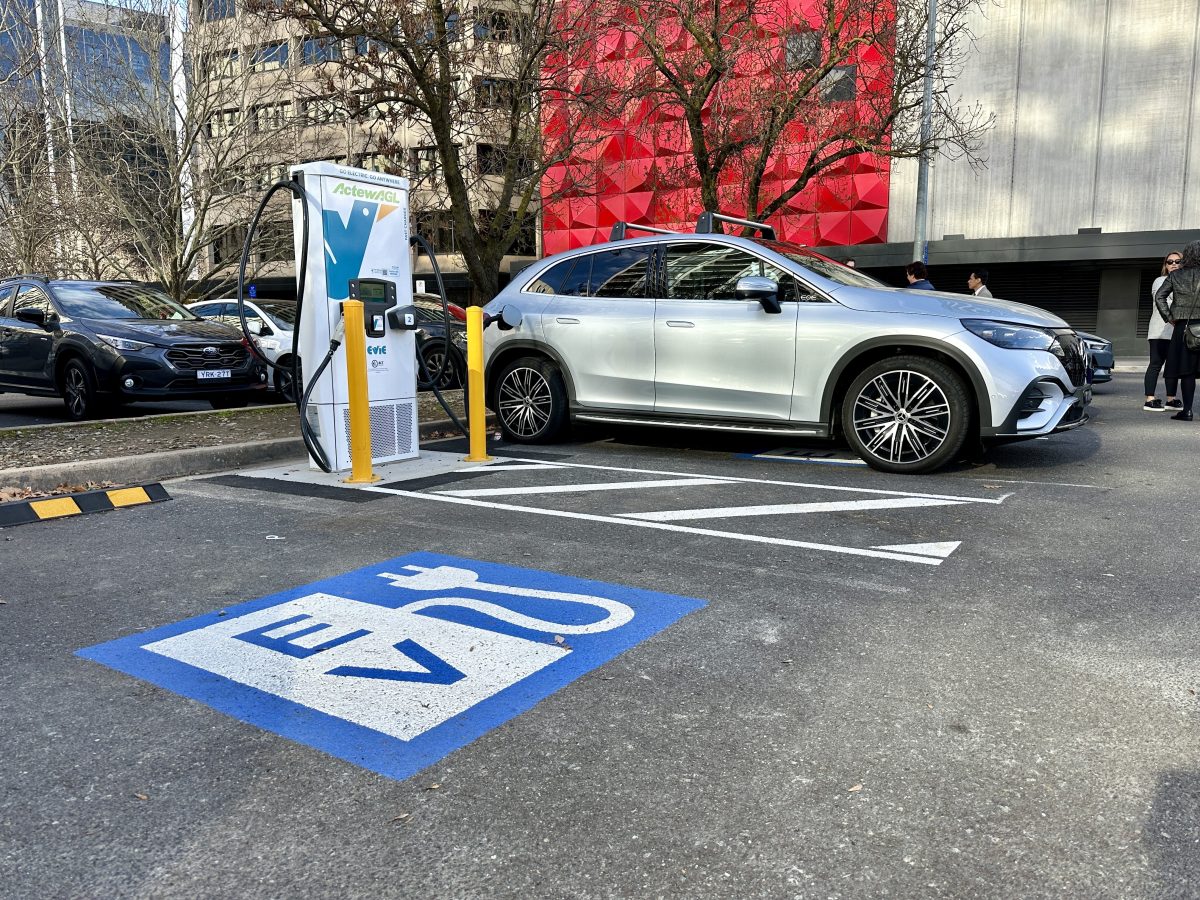
An EV charger in Hobart Place, Civic. Photo: James Coleman.
A second audit of Canberra’s public electric vehicle (EV) chargers has found the network remains largely the same as earlier this year, with AEVA ACT giving another “satisfactory” assessment.
The audit, conducted on 12 December by the ACT branch of the Australian Electric Vehicle Association (AEVA ACT), comes ahead of the busy Christmas and New Year holiday period.
Volunteers tested all 140 plugs across 34 public DC fast-charging sites, a 37 per cent increase since AEVA’s first audit before Easter, when the network was given an “A-minus” grade.
“AEVA considers this to be a satisfactory result ahead of the busy holiday period,” said AEVA spokesperson Dr Peter Campbell – which echoed almost word-for-word what he said in April.
Once again, the audit checked each station for physical condition, whether it was in service, its charging speed and accuracy of associated apps.
Six plugs were found out of service, including one that was damaged. One site had three of its four plugs unavailable, though AEVA noted the density of Canberra’s charging network gave drivers alternative options nearby.
Charging speeds were also tested on unoccupied stations to find out if they matched the claims.
“This gives us confidence that ample electrical power is being provided to the charging station, although drivers may see slower charging rates when stations are close to fully occupied,” Dr Campbell explained.
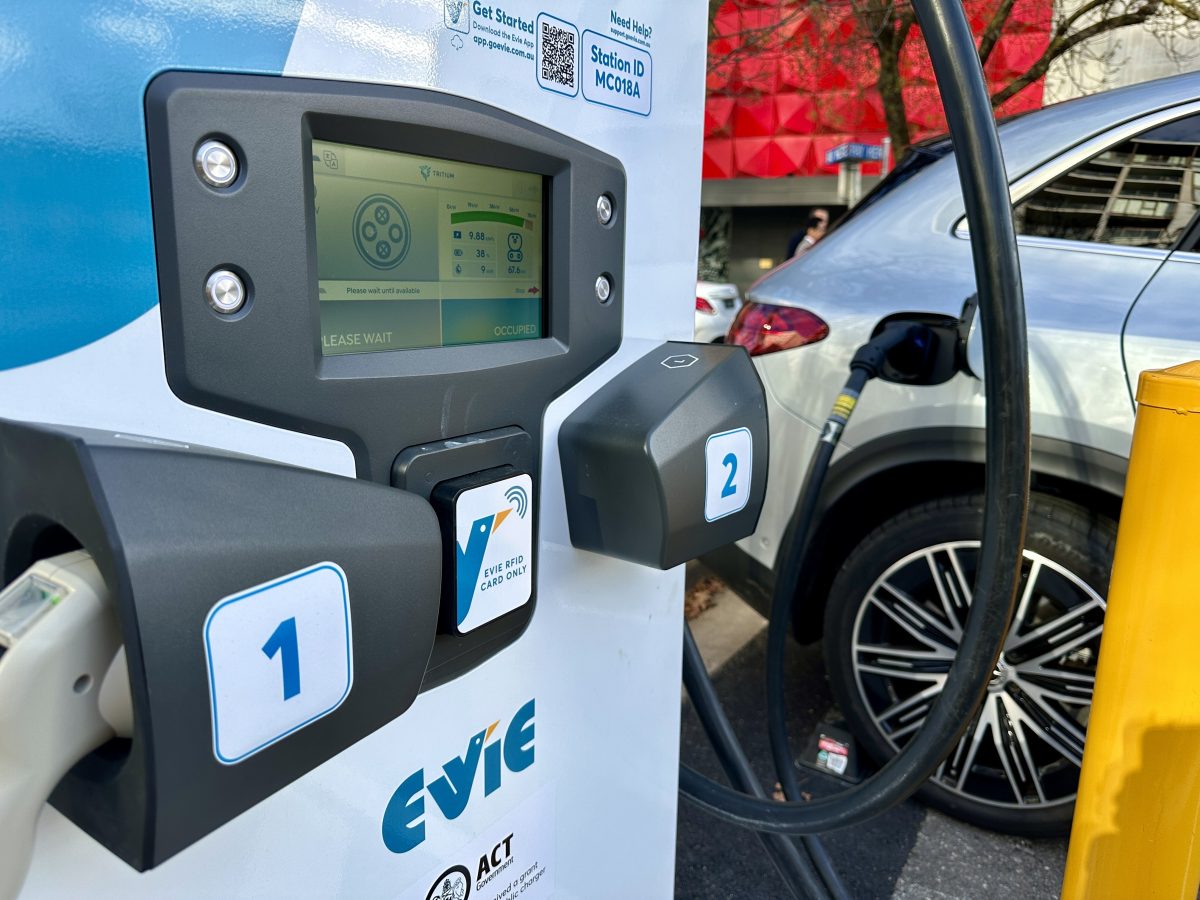
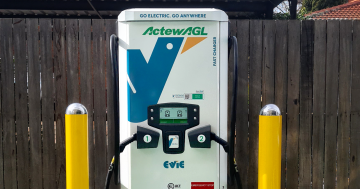
Six of the 140 DC plugs were found to be faulty. Photo: James Coleman.
However, many issues highlighted in the April audit remain.
The audit again noted a display screen difficult to read in daylight, poor directional signage and a broken kerb restricting access to a charging bay.
“AEVA has reported these problems to the relevant operators,” it said.
The ACT now has 249 public charging bays across 183 stations, slightly above the government’s original target of 180 stations by 2025.
But some areas are still undersupplied, according to AEVA ACT’s Ben Elliston.
“Belconnen continues to be undersupplied with charging infrastructure. There are the two fast charging sites at Jamison and Kippax and very little slower AC charging,” Mr Elliston told Region.
He also raised “equity issues” over the high proportion of DC fast chargers compared with cheaper AC chargers.
Apartment dwellers often have to rely on these public fast chargers, while homeowners with driveways are able to tickle-charge at a much lower cost. AEVA wants the ACT Government and charge point operators to install more slower, affordable AC chargers.
“DC fast chargers are really expensive and not every location needs that level of charging – you’re paying for speed you don’t necessarily need,” Dr Campbell told Region earlier this year.
“For similar money, you could put in many tens of slower AC chargers down one line of a car park, so that, if you’re in a nearby apartment, you could just leave your car to trickle charge all night.
“Or alternatively, if it’s a park-and-ride site, you could leave your car to trickle charge all day while you’re at work.”

A user spotted the EV charger hanging from its internal cables earlier this year. Photo: Canberra Notice Board Group, Facebook.
A plan to roll out streetlight-mounted EV chargers faced “engineering challenges” earlier this year, after a trial version on Eastlake Parade, Kingston, was found hanging from the pole by its cables.
The government said usage of the charger had been “consistent” and user feedback was “positive”, but added “power draw from the electrical network is a critical element that will need to be considered to determine the viability of a larger rollout”.
AEVA said it would continue to conduct audits periodically on behalf of Canberra’s EV drivers to make sure stations were being maintained.
“The idea is to keep track of it, so if someone says, ‘Oh, these chargers are always broken’, we can say, ‘Actually, no, they’re not’, or alternatively, if we found that’s true – they’re being badly maintained or they’re all dead – we can jump up and down on that, too,” Dr Campbell said.