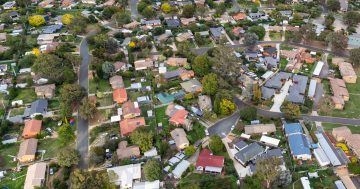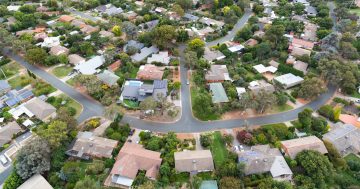


Further out but value for money: Tuggeranong Town Centre and surrounding suburbs. Photo: Glenn Schwinghamer.
2025 was a big year for property prices in the Tuggeranong Valley as homebuyers rediscovered the southern district, helping boost values there by nearly 7 per cent.
Lured by detached houses on big blocks, established gardens and mountain views, buyers saw great value in the Valley and were happy to trade off longer commutes for more space, potential and affordability.
According to Cotality’s Home Value Index, Tuggeranong prices finished the year 6.9 per cent up on 2024, with a median of $894,094.
That increase was 2 per cent higher than the ACT average.
The developing Molonglo Valley followed with a 6.1 per cent rise for the year and a median of $759,510, while Belconnen wasn’t far behind at 5.8 per cent and a median of $874,544.
Gungahlin recorded a 5.1 per cent increase and a median of $912,197, then Weston Creek a 4.9 per cent increase and a median of $978,795, and Woden Valley a 3.5 per cent increase to a median price of $1,013,638.
The expensive inner suburbs saw little movement over the year. Blue-ribbon South Canberra rose 3.2 per cent for a median of $858,671, while North Canberra edged up by just 1.9 per cent with a median of $740,807.
The other big feature of the year was Canberra’s two-speed market, with demand for detached houses not matching supply and a glut of units putting a lid on prices.
The Tuggeranong push helped ACT house prices to a 6.4 per cent rise in 2025, while the strata area was flat for the year.
In December, usually a quiet month due to Christmas and New Year, prices barely moved overall but house values continued their upward trajectory with a 0.5 per cent rise after a 1.3 per cent surge in November, making it 3 per cent for the quarter.
The median value of ACT houses finished the year at $1,040,1000.
Units, on the other hand, slumped -0.6 per cent in December and -0.4 per cent in the quarter, for a median of $592,000.
Nationally, the Home Value Index surged 8.6 per cent higher in 2025, adding about $71,400 to the national median dwelling value.
This was the strongest calendar year gain in home values since 2021, when the market rose a stunning 24.5 per cent amid emergency-low interest rates and a buyer frenzy.
Every capital city and rest-of-state region recorded an increase in dwelling values over the year, bookended by Darwin, up 18.9 per cent and Melbourne with a milder 4.8 per cent gain.
The year ended softer with the index recording the smallest gain in five months, with values rising 0.7 per cent in December.
The two big capitals, Sydney and Melbourne, were actually -0.1 per cent lower. Cotality said this subtle decline in values across Australia’s two largest cities marked the first month-on-month decline since January last year, prior to the February rate cuts.
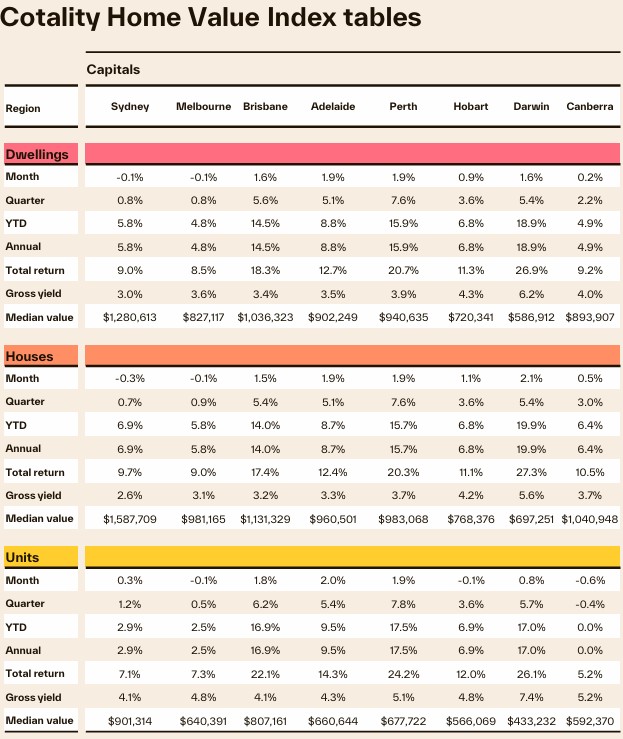
Darwin led the surge in house prices nationally. Image: Cotality.
Every other capital and broad rest-of-state region recorded a rise in values through December, although most saw some momentum leave the market.
Although December has its holiday hiatus, Cotality research director Tim Lawless said the softening hinted at a weaker start to housing trends in 2026.
“Renewed speculation that the rate-cutting cycle is over and the next move from the RBA could be a hike has dented housing confidence,” he said.
“A ‘higher for longer’ setting on interest rates, alongside a resurgence in cost-of-living pressures and worsening affordability pressures, looks to have taken some heat out of the market.”
Canberra’s gains were driven mainly in the more affordable districts, reflecting a national trend.
At a national level, upper quartile dwelling values were up 0.2 per cent in December, while values across the lower quartile and middle of the market were 1.1 per cent higher.
“This trend, where upper quartile values have recorded a lower rate of growth, has played out across every capital city through the year, as affordability and serviceability pressures deflect demand towards the lower price points,” Mr Lawless said.
Looking ahead to 2026, Cotality said uncertainty around inflation and interest rate settings was likely to weigh on housing confidence, along with ongoing affordability challenges and renewed focus on household debt and credit policy.
However, supply was likely to remain an issue in 2026, which should keep a floor under prices.