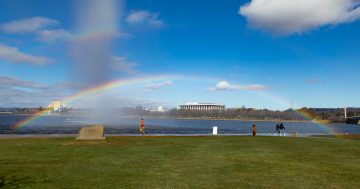

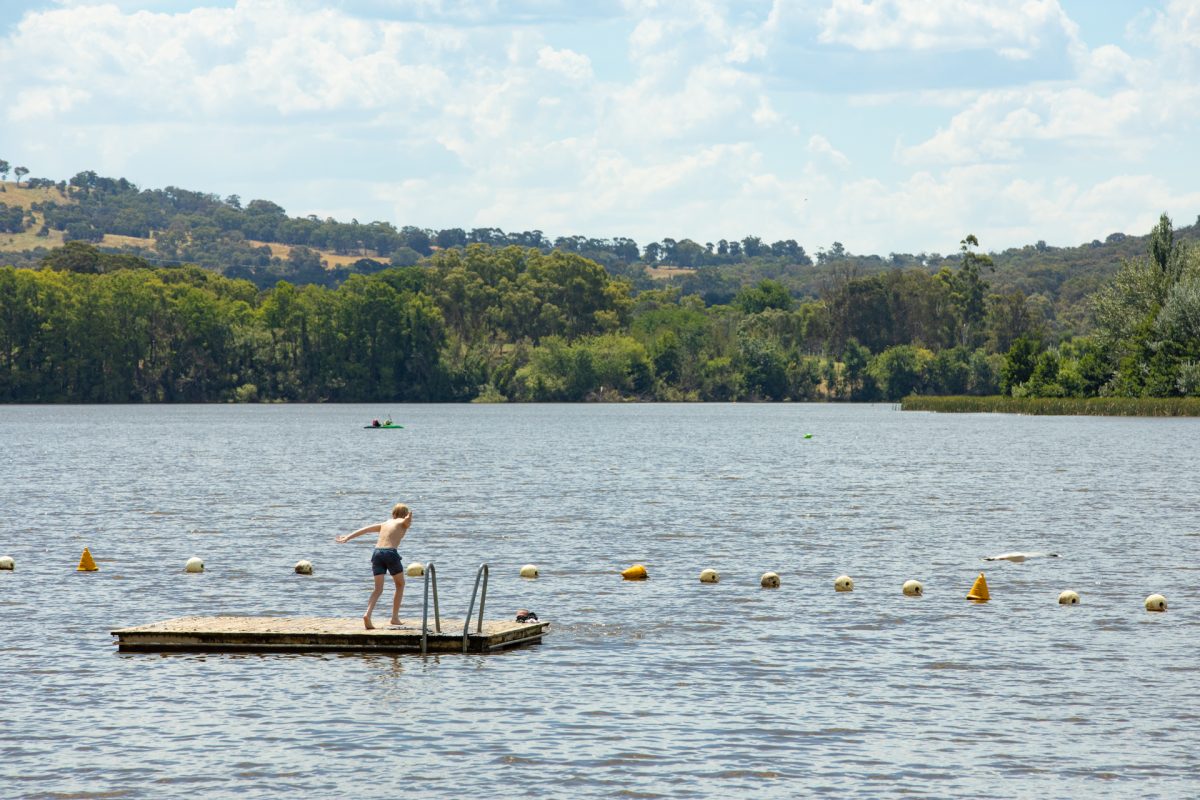
The rest of January will continue to be a scorcher for Canberra, but a drop in temperatures is in sight. Photo: Michelle Kroll.
The extreme heat that’s been breaking records across inland Australia will begin its slow shift east and north tonight (27 January), with the mercury peaking for much of Canberra and the Capital region tomorrow.
Bureau of Meteorology senior meteorologist Angus Hines said a dry wind change would be behind the shift from South Australia.
“Record-breaking heat will persist in other areas, particularly northern and eastern Victoria, as well as western and southern NSW, which includes the ACT,” he said.
“Many areas of western NSW will be between 47 and 49 degrees on Wednesday, with numerous records under serious threat.”
Canberra is forecast to reach a maximum of 42 degrees on Wednesday (28 January), two degrees shy of its hottest day on record.
This was reached on 4 January 2020, during the Black Summer.
An extreme heatwave warning has been issued until Thursday (29 January) for the Snowy Mountains and South West Slopes, while the ACT and Southern Tablelands are in the midst of a severe heatwave.
Heatwave warnings are issued based on the maximum and minimum temperatures over a three-day period and reflect how easily people’s bodies are expected to adjust to and find relief from the higher temperatures.
People have been urged to take the necessary precautions to protect themselves from the heat (which can have a cumulative effect on the body) and to make sure no children or pets are left in cars.
ACT Policing recently issued a warning about the dangers of leaving pets in vehicles after two dogs were rescued from a locked car in the Southpoint Tuggeranong carpark.
Police received reports of the two Cavoodles in a “very distressed state” at about 4 pm last Wednesday (21 January).
“Luckily, in this instance, bystanders contacted police who were able to intervene quickly, but this could have very easily had a tragic outcome,” ACT Policing Sergeant Mick Serbatoio said.
“Leaving a dog in a hot car can turn fatal within minutes”.
The dogs were assessed by their vet and found to have slightly elevated temperatures, which quickly resolved.
An ACT Government spokesperson said the amount of time the dogs were left in the vehicle couldn’t be determined.
“The owner returned to the vehicle as police were attending, and the owner removed the dogs from the vehicle,” they said.
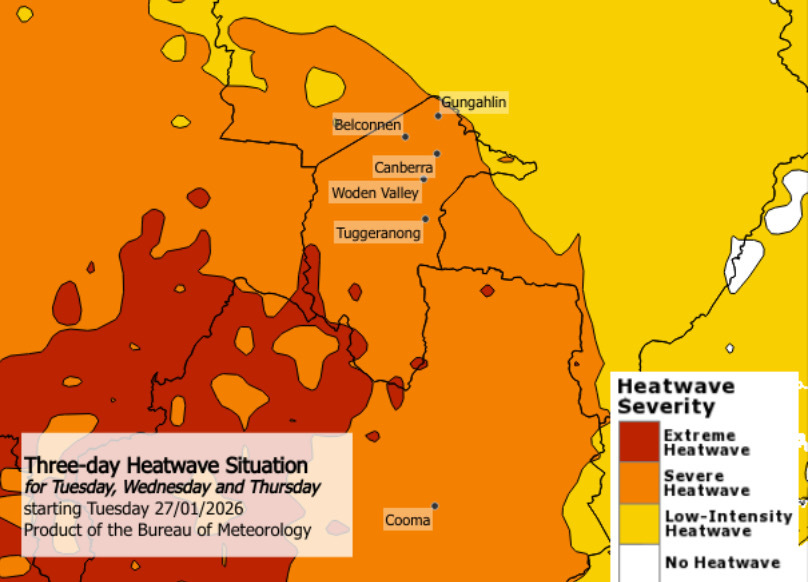
Severe to extreme heatwave conditions are expected to last until this weekend. Photo: BoM.
Relief will start trickling in for coastal areas as the week ends.
“No real relief from the heat, away from the coastline, is forecast until the weekend,” Mr Hines said.
This is when a stronger cold front is expected to cross the country, bringing relief to both inland and coastal areas.
Scattered rainfall is expected, but Mr Hines said many places would end up “missing out” entirely.
“Eastern Victoria and southern NSW could get some moderate falls, but little rain is expected elsewhere after this dry and blistering week,” he said.
The Australian Red Cross has this advice for staying safe during a heatwave:
- Stay inside and keep out of the heat as much as possible. Plan to do most of your activities early or late in the day to avoid being outside during the hottest hours
- Avoid sport and heavy exercise during peak hours of the day
- Drink plenty of fluids to stay hydrated, even if you don’t feel thirsty
- Keep your home cool by using external shade cloths or blinds to shield the inside of the house from direct sunlight
- Where possible, use a combination of air conditioning and fans to keep certain rooms in the house cool. Electric fans can be an effective method of cooling if air conditioning is not available
- If not using air conditioning, open windows during the cooler parts of the day and allow ventilation between rooms
- Take cool showers or baths, splash yourself with cold water, or use a cool, damp cloth to cool down
- If it’s too hot at home, go to an air-conditioned shopping centre, community centre, library or your local swimming pool
- Avoid direct exposure to the sun where possible and protect yourself with appropriate clothing (loose-fitting, lightweight and light-coloured)
- Do not leave children or animals in parked vehicles
- Keep in touch with friends, neighbours and relatives, particularly if they’re unwell or isolated.