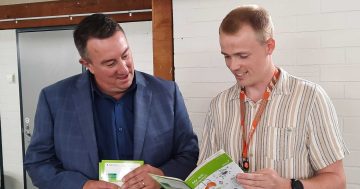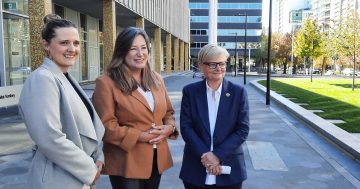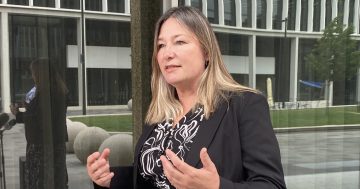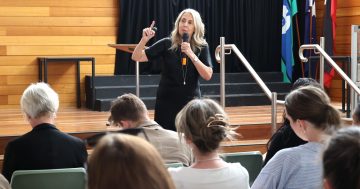

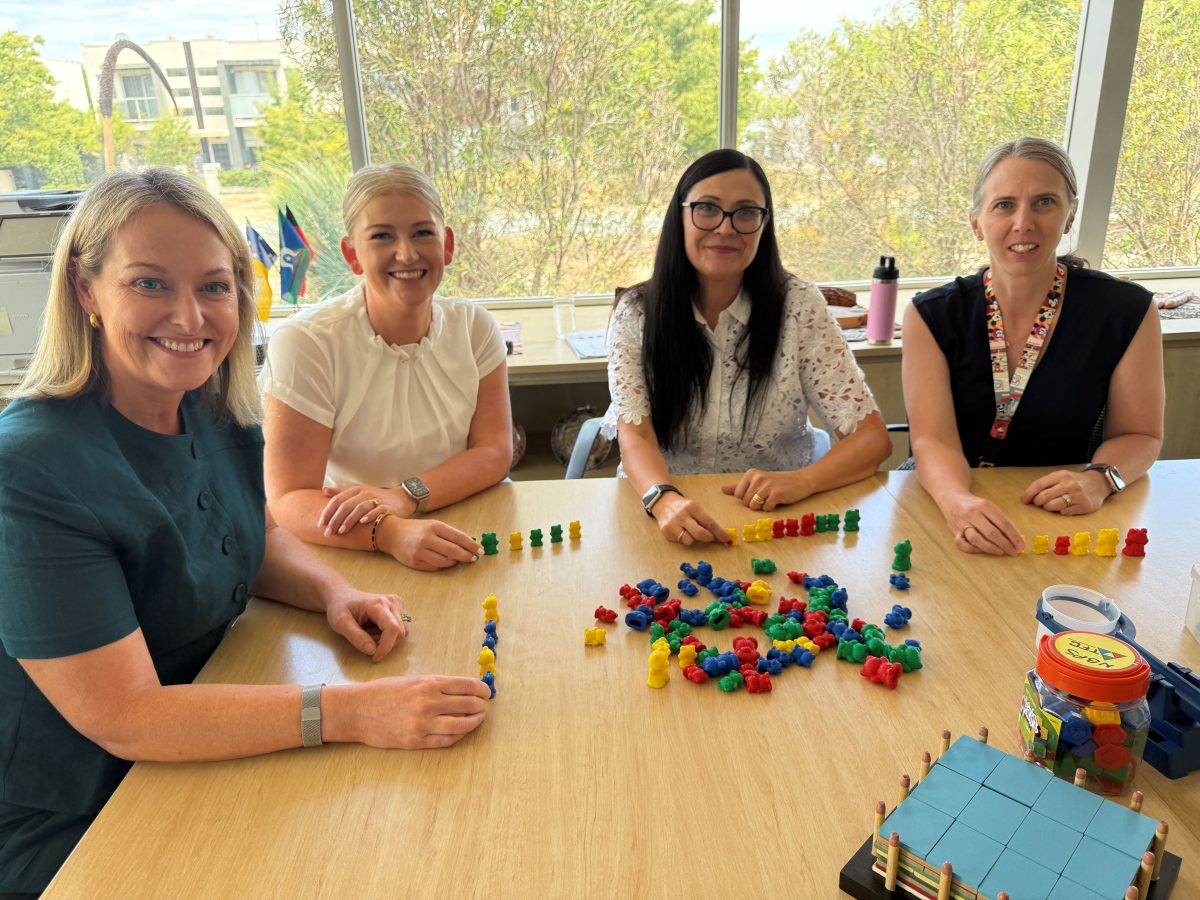
Executive Educational Leader with the Directorate, Merryn O’Dea, Neville Bonner Deputy Principal, Sylvia Headon, Neville Bonner Principal, Felicity Levett and Executive Teacher, Kelly Dunstan, with some of the new maths teaching resources. Photo: Education Directorate.
ACT public school teachers will be equipped with common practice guides and be required to devote prescribed amounts of time to teaching literacy and numeracy when they begin implementing a system-wide approach in 2026.
Students will also be subject to progressive testing and informal assessments so teachers can collect immediate data on how their students are faring, identifying those at risk of falling behind and those who need extensions.
ACT public schools are undergoing a three-year transition implementing the Strong Foundations recommendations of the expert panel on literacy and numeracy.
Education officials say this will embed explicit instruction across the system and introduce additional assessment windows, in addition to NAPLAN, to collect learning data to support teaching programs.
The biggest shift for schools will be the consistent application of teaching practice and student assessment across the system.
Education Directorate Deputy Director-General Angela Spence said progressive achievement testing would provide immediate results that could be used at a system, school and individual level to actually change teaching and learning programs.
Ms Spence said this information would help teachers talk to parents about their children’s progress.
Supporting this, in 2026, information packs aligned to Strong Foundations for parents on how to support their children in literacy and numeracy will be refreshed.
“But also information to help parents understand how every school does this, and I think this is a part of the change in the system that has been critical,” Ms Spence said.
Executive Educational Leader Merryn O’Dea said the assessment data would also be crucial in ensuring a seamless transition at landmark points in education, such as the shift from primary to secondary school.
She said that, in the past, information provided to new teachers was patchy, so they might not be aware of a student’s need for more support in certain subjects.
“What Strong Foundations has done is to really bring some consistency in how we do that,” she said.
“That information that we pass on to new schools at key transition points is really quite critical for educators to understand where the kids are at in their learning and make decisions around the learning programs for that year.”
Teachers will also operate within a common framework with specific obligations, including the time allocated to explicit instruction and its structure.
“So teachers will be required to align with a particular lesson structure, they’re required to explicitly teach content, they’re required to apply that in ways that are authentic so that it is more consistent across every school,” Ms O’Dea said.
She said 700 teachers representing about 20 schools recently participated in a three-day training program in explicit instruction.
Ms O’Dea said they would still have the freedom within that common framework to have their own teaching style.
“It’s about having that consistent language, and because this is the first time we’ve had a learning and teaching policy, it’s really important that we take the time to make sure we all understand, particularly words like ‘explicit teaching’ and ‘inquiry’,” she said.
“Are we talking about the same thing when we say that practice can be the same? It’s about getting everyone with a united understanding.”
Ms Odea said that long-term teacher workload would be reduced, especially in lesson plan development.
“What I’m teaching has been taught in the school before, we’ve got documents, we’ve got the resources to use with kids in the cupboard ready to go. Then the job becomes about tailoring it to the individual class, rather than reinventing the wheel every year,” she said.
Last year, the directorate purchased a range of resources to support teachers, including decodable readers for phonics instruction and concrete materials such as counters for numeracy. These will be rolled out across teaching programs.
At Neville Bonner Primary in Bonner, teachers are gearing up for a pivot to numeracy this year after focusing on reading in a school where 72 per cent of students are from non-English-speaking backgrounds.
Principal Felicity Levett said it seemed like the right place to start the explicit teaching journey, and the data showed the school had made good traction with it in 2025.
She said teachers were excited and passionate about the literacy work, and some had already transferred that approach to maths.
In 2026, that would be applied across the school.
“It’s around explicit instruction, about making sure that we have daily review happening every lesson, taking the work that we know around cognitive load theory about how the brain works, breaking things down into smaller chunks for their learning,” she said.
Teachers last week prepped for the start of term by participating in a workshop with instructional coach Dr Nathaniel Swain, an expert in the science of learning.
A leadership core will sit in on classes and mentor their colleagues, a culture already well established at Neville Bonner.
One of these leaders, Executive Teacher Kelly Dunstan, said a key lesson from Dr Swain was that teachers could use tangible objects, such as counters, alongside pictures and symbols, moving from the concrete to the abstract.
Ms O’Dea said that constant practice and review embed knowledge in memory, but the process also provides opportunities for teachers to gauge how well a student is learning.
In fact, teachers will be constantly assessing students, although they won’t realise it, so they can adjust their teaching if required.
Ms Dunstan upskilled colleagues with quick information-gathering techniques and strategies to assess student learning in the moment, during the lesson, not just when they get something correct, but also when they get it wrong.
This makes for a more interactive and dynamic classroom.