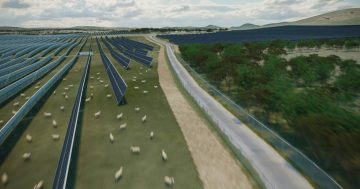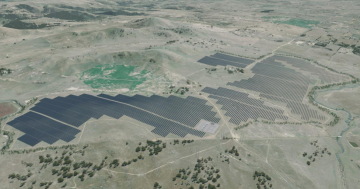

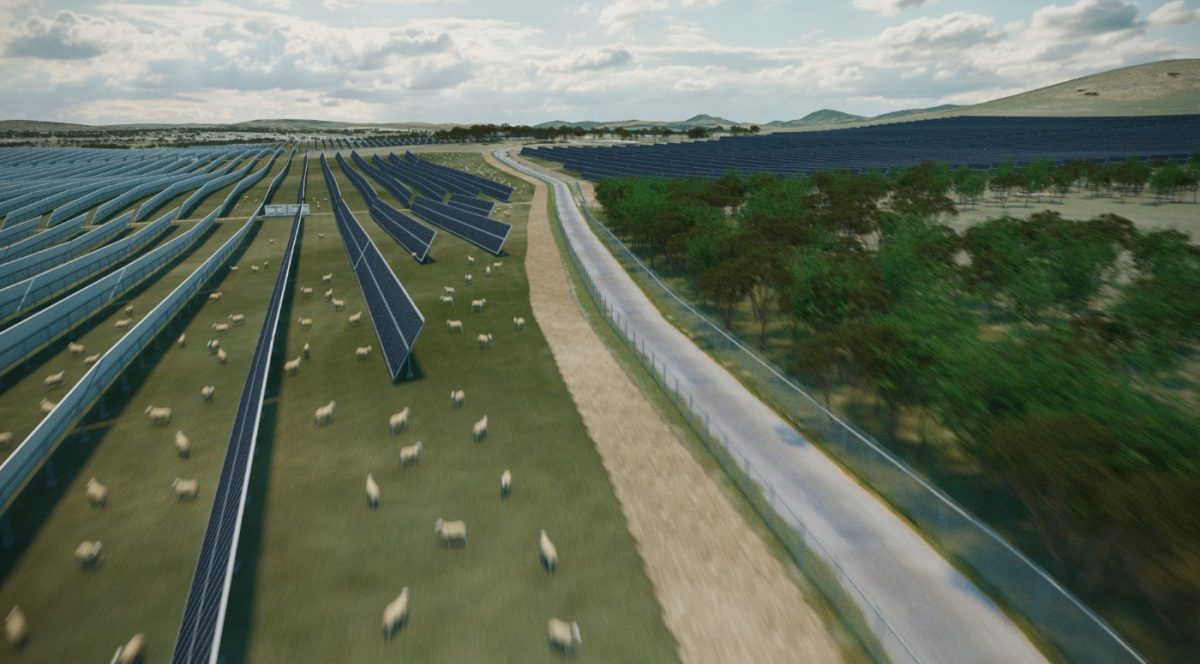
An artist’s impression of the Wallaroo Solar Farm. Image: Wallaroo Solar farm.
A court has dismissed an appeal against the approval of a 100 megawatt (MW) solar farm and battery storage facility on the ACT’s northern approaches, rejecting claims that it will damage the rural character of the land and citing the public benefits the project will bring.
Opponents have rejected the court’s decision and are weighing further legal avenues.
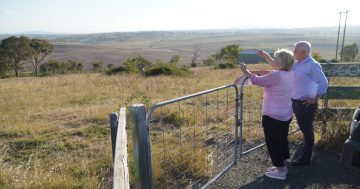
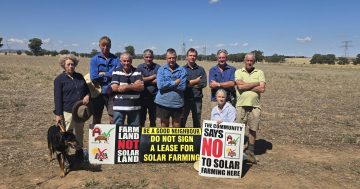
Nearby landholders Ben Faulks and Johnny Roso had gone to the NSW Land and Environment Court to challenge the NSW Independent Planning Commission’s 2024 approval of the Wallaroo Solar farm.
The applicants argued that the proposed development would affect the scenic quality and rural character of the surrounding land, as well as the views of local landowners and thousands of ACT residents.
They also contended that the use of the site for renewable energy development was inconsistent with the Yass Valley Settlement Strategy 2036, including its ban on large-scale development within 5 km of the ACT-NSW border.
There were also concerns about chemicals leaching into the ground and increased fire risks.
But Commissioner Susan O’Neill, who visited five properties near the site, including that of the two applicants, did not agree.
She accepted expert evidence that the 165.45-hectare site was located in a highly modified, low- to medium-value agricultural landscape, and that large-scale solar energy developments were not inconsistent with maintaining a rural character.
“We are accustomed to seeing renewable energy projects on farmland, and large-scale renewable energy projects within rural and natural landscape settings,” Commissioner O’Neill said.
They were also not incompatible with rural activity, such as grazing.
She ruled that being able to see a solar array, or parts of one, was not in and of itself a visual impact.
“The proposed development does not obstruct views, but introduces a new element into the view and onto the existing topography of the site,” Commissioner O’Neill said, also rejecting comparisons with industrial development.
“I am satisfied that the proposed perimeter planting, coupled with the existing vegetation in the landscape, will adequately soften the view of the solar array from the north and east of the site.”
ACT residents in the suburbs of Dunlop and McGregor would only see a “band of darkened area … obscured in places by existing vegetation and mitigation perimeter planting”.
Commissioner O’Neill said the Yass Valley Settlement Strategy was designed to limit urban sprawl within the 5 km buffer zone, not a renewable energy project, which will not be built on residential land.
She ruled that approving the solar farm was in the public interest as it would reduce greenhouse gas emissions and preserve traditional energy resources for future generations.
It would also create jobs, and provide community and economic benefits to the region.
The site was also suitable for the development due to its proximity to transmission lines.
Mr Faulks said residents were very disappointed in the decision and the lack of weight given to the impact on communities surrounding renewable projects.
“We have continuing legal avenues to pursue, which we are exploring at the moment,” he said.
The proposed development will take up half of the site and is expected to power about 48,000 NSW and ACT homes.
It is expected to take 12 to 18 months to construct and the proposed development will create up to 200 construction jobs and five operational jobs.
The $170 million proposal from New Energy Development and Univergy International attracted 100 submissions, mostly against, including from prominent winemaker Nick O’Leary.