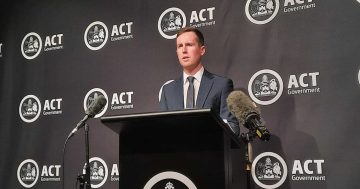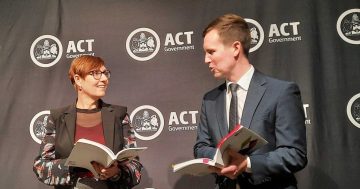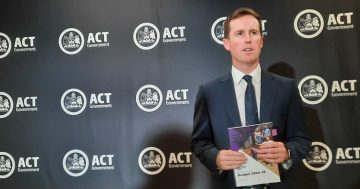

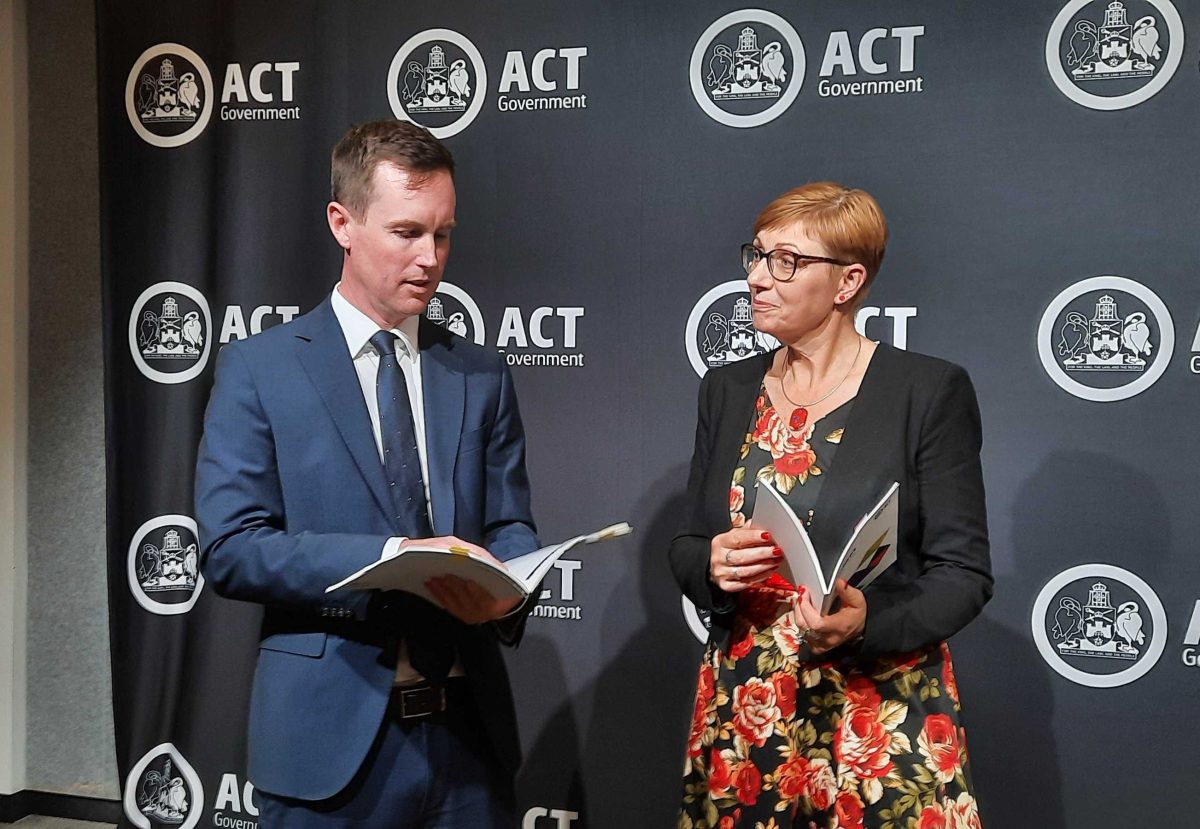
Staying on course: Treasurer Chris Steel and Finance Minister Rachel Stephen-Smith with the Budget Review. Photos: Ian Bushnell.
ACT Treasurer Chris Steel will not say if the controversial health levy could be scrapped now that the ACT has signed a new health funding deal from the Commonwealth.
The levy, along with other revenue measures and spending restraints across the ACT public service, has contributed to a $632 million turnaround in the ACT’s bottom line, and Mr Steel indicated he would stick with these in the multi-year plan announced last June to repair the budget.
The mid-year Budget Review delivered this afternoon (5 February) forecasts that the 2025-26 deficit will now come in at $499 million, down from last year’s record $1.1 billion, but still $74 million higher than the $425 million forecast in last year’s budget.
Mr Steel said this higher figure reflected a decline in GST revenue related to updated population figures from the ABS, a slight reduction in payroll tax receipts and new government spending, including a $43 million top-up for schools.
He said the budget was on course for the deficit to fall further to $79.7 million in 2026-27 before small surpluses of $63.3 million in 2027-28 and $280.3 million in 2028-29.
The greatest risk to this forecast appears to be the increasing demands of schools and hospitals in the Territory.
A school resourcing inquiry is still underway, and the health deal will help meet increasing costs, but not bridge the funding gap needed to put the ACT health system on a sustainable path.
The health deal – $557 million in public hospital funding over five years and an extra $150 million over the next two years – will be reflected in the June Budget, but extra money from NSW – $68.6 million in 2026 and more than $285 million over the four years – has assisted the bottom line in the Budget Review.
Mr Steel was non-committal about lifting the levy and other revenue measures taken to right the budget, or offering rates relief in light of the upward turn in interest rates.
He said the difficult decisions taken last budget were working and indicated that the government would stay the course with them.
“There’ll be a range of things that we’ll need to consider in the next budget, but in this Budget Review, what we’re showing is a stable return to surplus based on the decisions that we took,” he said.
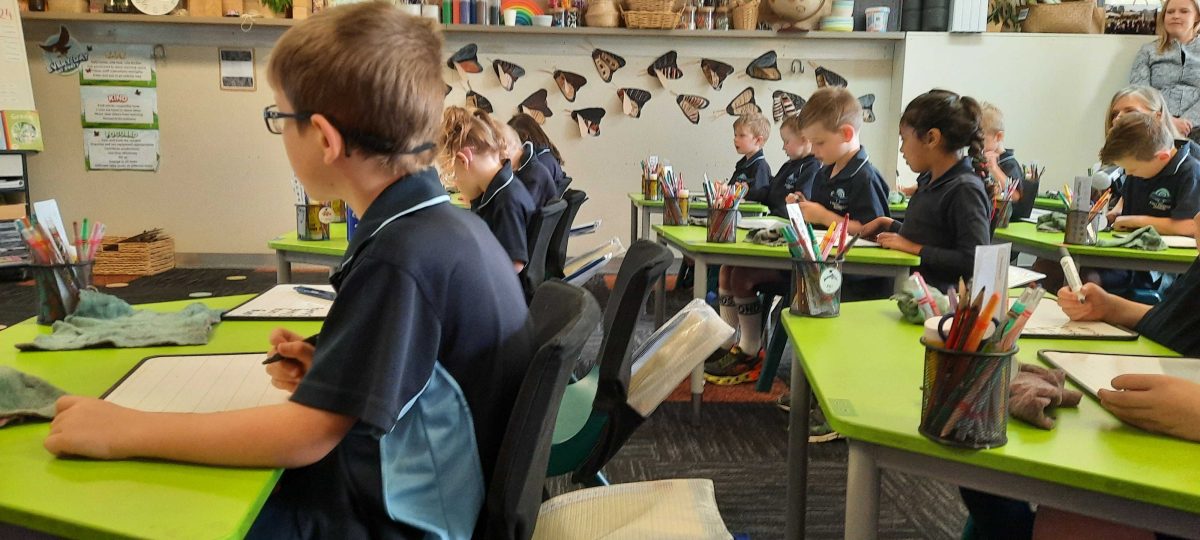
Public schools will get a $43 million injection.
The budget would have been in even better condition if the health levy had not been reduced. Over the four years to 2028-29, own-source revenue is expected to be $103.2 million lower than the 2025-26 Budget forecasts, mostly due to changes made to the health levy.
While the rate of public sector growth is being slowed at directorate level, the Budget Review shows spending increasing by $79.4 million in 2025-26 and $443.6 million over four years.
This includes $110.1 million over four years for new initiatives and $18.3 million in higher interest expenses in 2025-26 ($176.8 million over four years to 2028-29).
Mr Steel said the government still needed to make targeted investments in community infrastructure to support a growing population, particularly for more housing.
Net debt is expected to increase from $11 billion to nearly $14 billion in 2028-29, but Mr Steel said the government was in a good position to manage it.
“The independent ratings agency has said that the ACT Government can service its debts, and that we have a stable outlook in terms of our credit ratings,” he said.
“So the ACT is in a good position to meet any liabilities and making sure that we return the budget to surplus will assist us in meeting those liabilities in the future.”
But he would not say when net debt would decline.
The Budget Review said net operating cash was expected to move from a deficit of $430 million in 2024-25 to a surplus of $794.6 million in 2028-29, providing the capacity to reduce borrowings and fund a greater proportion of the Territory’s ongoing capital investment requirements.
Mr Steel also said that returning the budget to balance would enable the government to continue to pay for infrastructure.
He remained confident that the government’s prudent fiscal repair approach would bear fruit, despite many earlier promises of surpluses that had come to naught.
“Because we are continuing the whole of government savings measures that we outlined in the Budget last year, that is a multi-year task of looking at opportunities to reprioritise existing resources and for directorates and agencies to manage within their budgets,” he said.
Finance and Health Minister Rachel Stephen-Smith said the health deal would mean 37 per cent of ACT hospital costs being funded by the Commonwealth, short of the trajectory needed to reach the desired 42.5 per cent by 2030 and 45 per cent by 2035.
“So there is still a fairly significant gap there,” she said.
“But we will continue to seek to improve the efficiency of our delivery of health services, to deliver in a more cost-effective way, to deliver more care in the community and reduce the pressure on our more expensive acute hospital services.”
A sceptical Liberal shadow treasurer, Ed Cocks, said that year after year the government promised a surplus but never delivered.
Mr Cocks said the government had a tax-and-spending problem, with Canberrans struggling under their tax burden and Mr Steel wasting millions on projects.
He would not nominate where his party would make spending cuts, but said every government project needed to be reviewed.