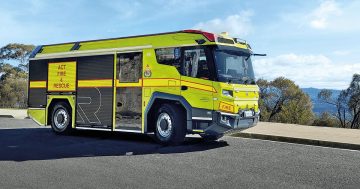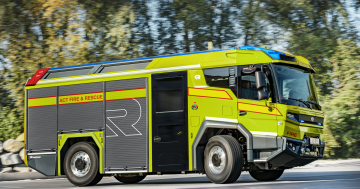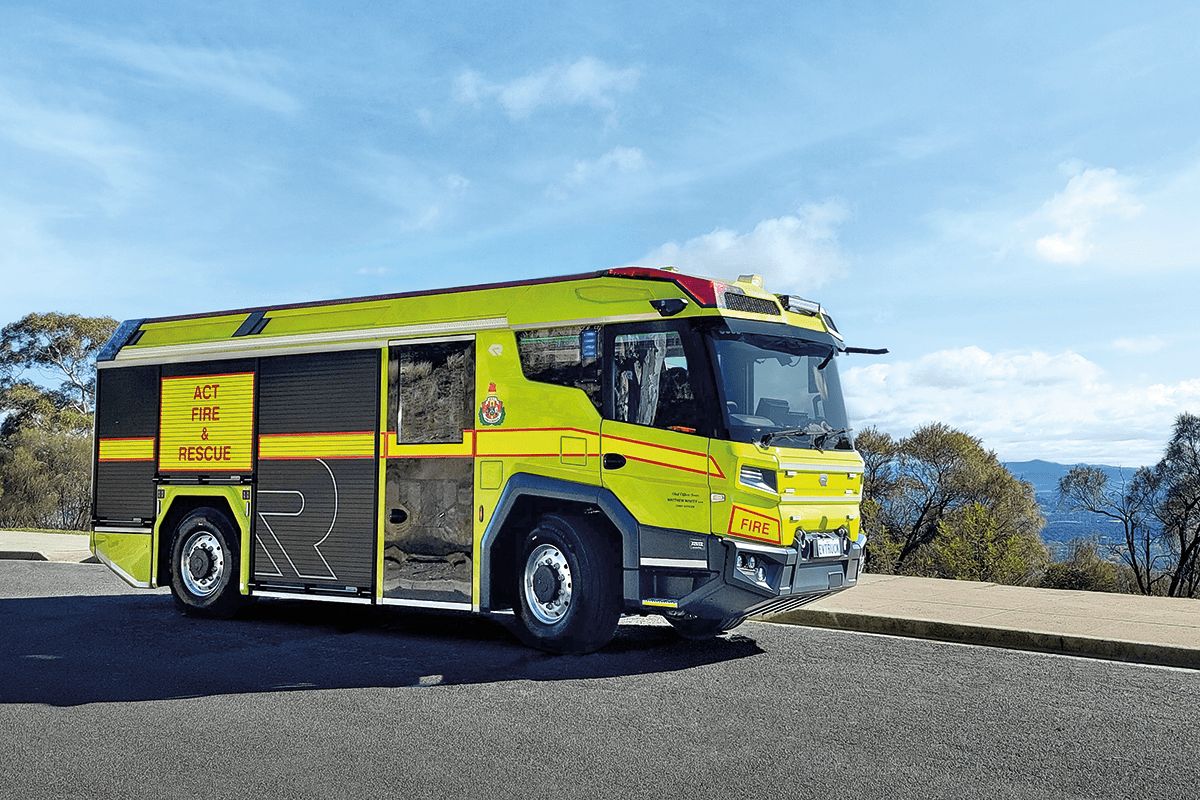
The Rosenbauer hybrid fire truck has been a constant source of grief for the ACT Emergency Services Agency (ESA). Photo: Rosenbauer.
In an unfortunate coincidence, Canberra’s plug-in hybrid fire truck is off the road again – just as newly released documents lay bare just how troubled its rollout has been.
The latest issue is relatively minor – a slow-retracting seatbelt – but it was enough to pull the truck from service this week.
But it comes as internal emails detail a long history of faults, from battery failures to repeated delays and missed deadlines.
The Rosenbauer-built hybrid electric pumper was introduced in early 2023 as the only fire truck of its type in Australia.
The “next-generation vehicle” was said to support the ACT Government and ACT Fire & Rescue’s “commitment to zero and low emissions vehicles as we work towards a sustainable and environmentally responsible future”.
The truck cost $1.6 million, or about $700,000 more than a conventional diesel-powered pumper truck. But the government promised it would make up the difference in diesel costs before long.
The vehicle can run purely on battery power for up to two hours, with a diesel generator extending that to six. It was also designed with firefighters in mind, featuring street-level entry to reduce strain and injury.
Emergency Services Agency (ESA) Assistant Commissioner Glenn Brewer said this was the key selling point.
“The true value proposition for this particular vehicle is to the health and wellbeing of our firefighters,” he said.
“Firefighters crawling out of a normal run-of-the-mill fire truck could have anything up to 20 kg of equipment and PPE [personal protective equipment] on their backs. It does take a toll.”
But the now-released documents, requested by the Canberra Liberals under freedom-of-information laws, show the truck has spent surprisingly little time in active service.
The Liberals claim it was roadworthy for only around 14 weeks in its first two years, with other reports suggesting it spent as little as 12 weeks on the road.
Internal emails reveal a steady stream of issues – at one point, the truck had 13 faults, including ongoing battery problems.
“I must express my extreme frustration and dissatisfaction with the service and support we have been receiving from Rosenbauer to date,” ESA’s head mechanic wrote.
“We spent more than $2 million on just this vehicle alone and we accepted the risks involved in having a ‘first of its kind’ electric fire truck in Australia with no Australian testing completed before purchase.”

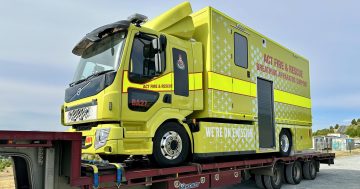
ACT Fire and Rescue’s other pumpers use standard Scania or Volvo commercial trucks as their base – unlike the purpose-built Rosenbauer. Photo: James Coleman.
Many of the early repairs were pushed back to 2024 due to “high-profile commitments”, including a week-long public exhibition.
By December, the Rosenbauer was labelled “completely unfit for service” and “a real disappointment for not only everybody involved but the Canberra community”.
“The ongoing let downs are at great cost both financially and to our reputation,” one of the emails read.
Even when fixes were identified, they weren’t always quick. A damaged 350 kg battery had to be shipped from Europe because it couldn’t be flown in.
“Issue is that NO airline will carry it so it will need to come by sea,” a manufacturer representative wrote.
Technicians also had to be flown in from across the world, including from Austria and Singapore, to help diagnose problems.
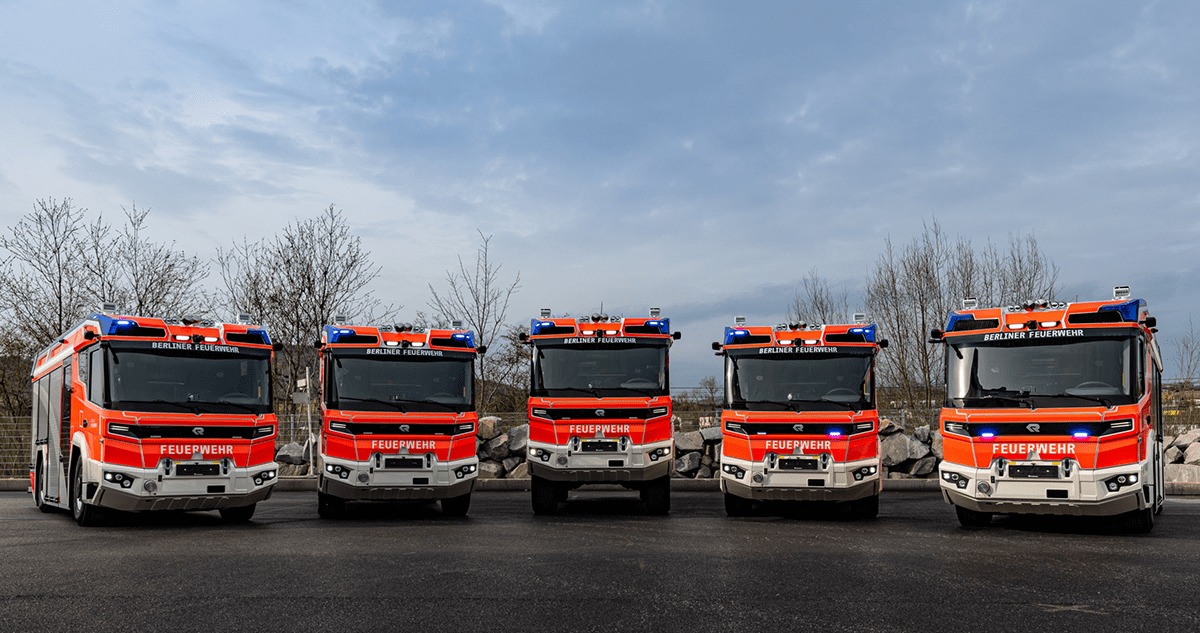
Berlin’s Rosenbauer hybrid fire truck fleet. Photo: Rosenbauer Group, Facebook.
At one point, the truck hadn’t attended a single job on its own before its original warranty was due to expire in June 2025.
It finally returned to service on 26 February this year, only to be sidelined again this week over the seatbelt issue.
Despite the revelations, both the government and ESA say they remain committed to the technology.
Mr Brewer said the latest issue was identified earlier this week.
“The seatbelt was still operating, but in an abundance of caution … we withdrew [the truck] to do an inspection,” he said.
“We’ve conducted the repairs … and now, we’re putting that back together and getting ready to return the truck to service.”
He said the ESA had always been frank about the problems, to the point that it has a page on its website devoted to the truck.
“We’re quite open about the fact that we have absolutely had some teething issues with this vehicle as we’ve brought it into service.”
He said the truck is a bespoke build and part of a complex, specialised industry, with ESA working closely with the manufacturer since 2019.
The warranty has also been extended due to the issues.
“The original warranty ran up until June of 2025 … [Rosenbauer] were quite happy to extend that out to December 2026.”

ESA assistant commissioner Glenn Brewer hasn’t ruled out more electric or hybrid trucks. Photo: Michelle Kroll.
Importantly, he said the experience hasn’t scared ESA off electric trucks.
“We’ll always be going to market … and if we’re able to … look after the health and wellbeing of firefighters, we will … continue to consider it.”
ACT Minister for Police, Fire and Emergency Services Marisa Paterson also acknowledged the latest issue.
“Everyone is well aware we’ve had some issues with this fire truck … And for awareness and transparency, the truck is not on the road at the moment. There is a seatbelt issue.”
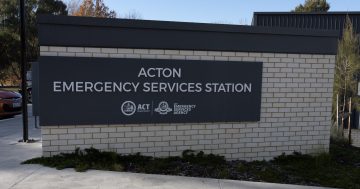
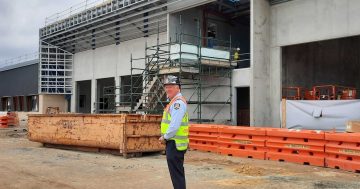
She said the government still plans to transition to an electric fleet, backed by new charging infrastructure at the new emergency-service stations at Acton and Molonglo.
“This is a really unfortunate situation,” she said.
“We’ll continue to work with Rosenbauer to see that this … pumper is fully operational and back on the road consistently and sustainably.”