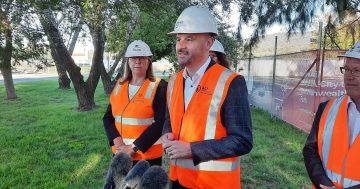

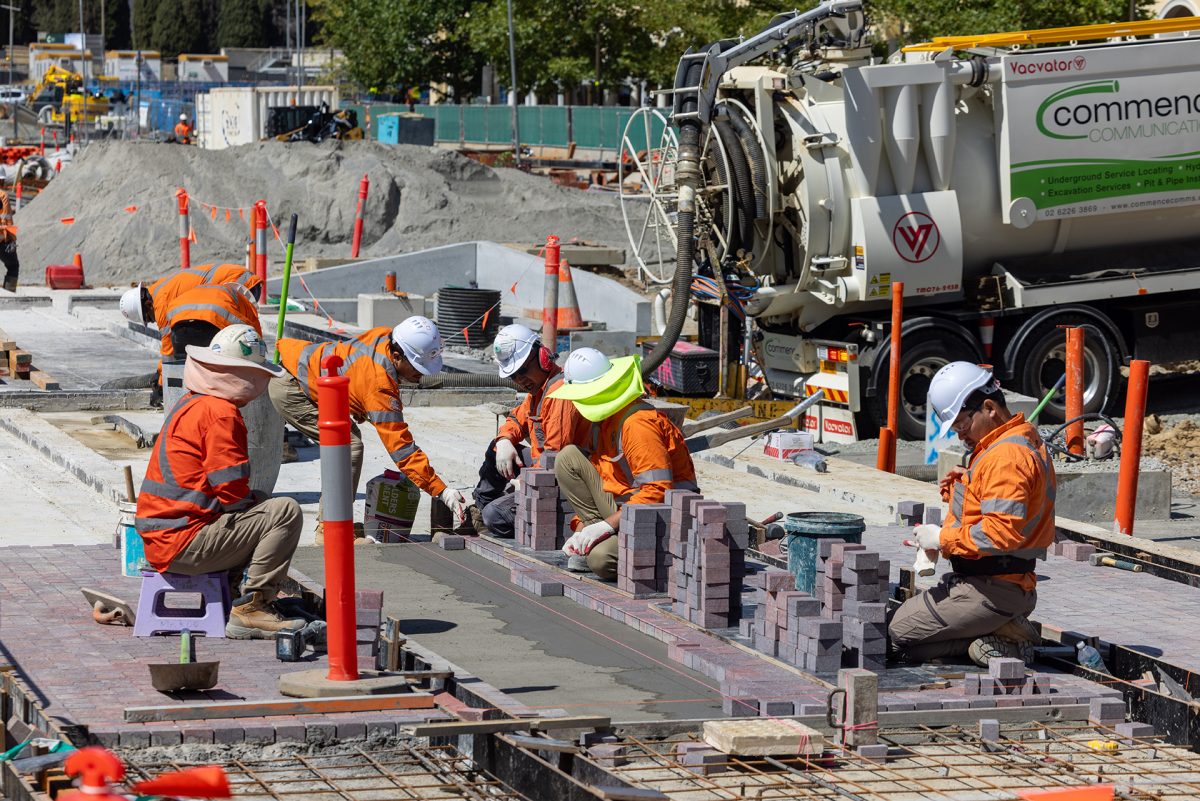
Infrastructure cost blow-outs are a major concern for the IMF. Photo: ACT Government.
The ACT Government has played down warnings from the International Monetary Fund on rising debt and spending levels, particularly on infrastructure.
The IMF’s latest assessment of the Australian economy warns that state and territory deficits and debt levels, driven in part by public project cost overruns, were an increasing risk.
It says higher state and territory debt levels could even impact Commonwealth borrowing costs.
The IMF warns that if states and territories do not get their houses in order, the Federal Government may need to take a firmer line with them.
“States with rising debt and deficits could be subject to enhanced scrutiny and oversight, under an integrated framework for evenhandedness, and supported by corrective mechanisms if no improvement is observed,” it says.
The IMF says there is scope for a review of spending and revenue policies across the federation, including fiscal equalisation, GST reform, and land tax, and overcoming infrastructure coordination issues to help address cost overruns.
The ACT Government did not fully address questions about the Territory’s $11 billion and rising net debt, or whether infrastructure spending needed to be curtailed or deferred, instead focusing on securing a better deal from the Commonwealth and on its budget repair strategy.
A spokesperson said the IMF report showed that the ACT was not alone in experiencing significant increases in demand for and the cost of delivering essential services and infrastructure, while also supporting its communities through cost-of-living crises.
The “persistent and systemic undercounting” of the ACT’s population by the Australian Bureau of Statistics skewed the IMF’s debt-to-population reporting, the spokesperson said.
This also impacted the Territory’s GST share, with the ACT receiving $550 million less in payments than it should have between 2016-17 and 2022-23.
The spokesperson said the ACT Government continued to press its case on the GST, but a fundamental issue was the 2018 reforms, which unfairly benefited Western Australia at the expense of all other jurisdictions.
“The ACT Government engages with the Commonwealth through the National Cabinet and the Council on Federal Financial Relations (CFFR) on opportunities to strengthen federal financial relations,” the spokesperson said.
“This has already delivered a significant new health funding agreement, worth $4.1 billion to the ACT over five years for the area of greatest expenditure in State and Territory budgets.
“The ACT will continue to work through CFFR on taxation reform, to address the challenges of Vertical Fiscal Imbalance and on fiscal coordination, in line with the recommendations of the IMF report.”
The National Health Reforms would see the ACT receive more than $557 million in additional funding over the next four years, taking the Commonwealth contribution rate to 37 per cent, but still short of the target of 45 per cent.
“This is just one area where states and territories could see more action from the Commonwealth to support the essential services the community relies on,” the spokesperson said.
The spokesperson highlighted the ACT Government’s significant turnaround in its bottom line, with a $632 million improvement in the Budget Review, and the strength of the Territory economy.
The ACT Government’s program to constrain its rate of spending growth was expected to generate $282.2 million in savings over the four years from 2025-26 to 2028-29.
The spokesperson said the ACT had a strong balance sheet, underpinned by a robust economy that was growing faster than any other jurisdiction in the country.
“S&P Global Ratings identify that the ACT has strong financial management by global standards, a very high-income economy and exceptional liquidity,” the spokesperson said.