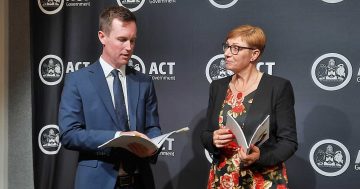
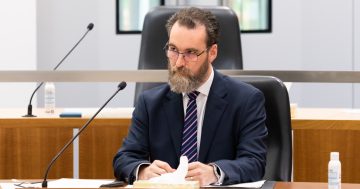
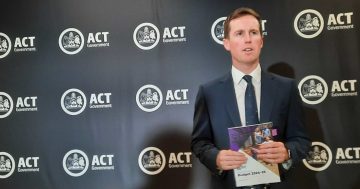
Treasurer Chris Steel and Finance Minister Rachel Stephen-Smith: Community before surplus. Photo: Ian Bushnell.
Treasurer Chris Steel has denied delaying the ACT’s budget repair after delivering a bottom line that will stay in the red a year longer than forecast in the Budget Review.
The ACT Budget shows a deficit for 2026-27 of $323.4 million, $243.7 million more than in the Budget Review in February, and a return to surplus, of $244.2 million, is now not due until 2028-29.
Net debt will continue to grow over the forward estimates, although slightly less than the Budget Review forecast. It is expected to balloon from $12.5 billion in 2026-27 to $14.1 billion in 2029-30, with an annual interest bill of $1.2 billion.
The government has made some progress, with the 2026-27 deficit $178 million less than forecast earlier in the year, but Mr Steel said the war in the Middle East and fuel price increases had not only impacted government finances but forced it to stay its hand on taxes and charges.
“We’ve deferred some revenue decisions, particularly the additional indexation that was going to apply on motor vehicle registration,” he told journalists ahead of handing down the budget in the Legislative Assembly.
“And we’ve also provided cost-of-living relief, but we had to be measured about that and make sure that it was targeted to those who are most in need.”
Mr Steel said the government had prioritised households, the community, and frontline services.
“We’ve made it very clear that we’re not going to prioritise a return to surplus over supporting our community,” he said.
But he said the government had still delivered against the fiscal strategy set out last year, highlighting the return to a cash operating surplus in 2026-27, as forecast.
This meant the government could fund more of its infrastructure program with cash instead of just borrowing, he said.
Mr Steel rejected any claim that he had dropped the ball on budget repair.
“We made the biggest turnaround in the Territory’s history in the past few years, and we’re continuing that improvement of $178 million between this year and next year, and we’ll continue to do the work that is required to improve and return the budget to balance in 2027-28 with surpluses over the forward estimates,” Mr Steel said.
He said the government would continue to consolidate debt, aided by strong cash operating balances, and ensure that the level of debt and investment in the infrastructure program were sustainable over time.
“We’ve also set a new fiscal target to make sure that debt as a percentage of gross state product remains at or below 19 per cent over time, and what we’ll see over the forward estimates is that level drop down closer to 17 per cent, which is further in line with other states and territories around the country,” he said.
The previously announced $700 million infrastructure pause would also help the bottom line.

The Budget numbers tell the story. The government is now aiming for a return to surplus in 2028-29 instead of 2027-28. Source: ACT Treasury.
The Health Levy has been scrapped in the wake of the new National Healthcare Agreement.
But residential rates will go up by an average of 5 per cent, although the pricey inner south shows double-digit increases.
The 14-year-old tax reform program continues to bear fruit for home buyers with significant stamp duty cuts, and first home buyers will pay none at all in an Australian first.
A 50 per cent cut to the Lease Variation Charge for missing middle housing proposals will remain in place until the 30,000 homes by 2030 target is met.
Commercial rates will go up by an average of 8 per cent.
There is $6.4 million available to directorates and agencies for restructuring, including redundancies, as part of the squeeze on public service growth.
Finance Minister Rachel Stephen-Smith said Directors-General could access this fund if they think that voluntary redundancies were part of their restructure strategy.
Ms Stephen-Smith said the number of redundancies was up to them.
“We know that many public servants actually jump at the opportunity to take a voluntary redundancy when it’s available, but the commitment that we have made to the unions and to our existing staff is that this isn’t about our public servants doing more with less,” she said.
“This is about delivering services as efficiently as possible, and many teams have put forward ideas about how things could be done more efficiently.”
Total revenue is expected to be $16.3 million higher in 2026-27 and $607.9 million higher over three years from 2026-27 to 2028-29, compared to the 2025-26 Budget Review, but spending is forecast to be $262.5 million higher in 2026-27 and $980.8 million higher over three years from 2026-27 to 2028-29.
This is due to the government deciding to spend $346.8 million ($920.7 million over three years to 2028-29) for new initiatives under Investing in the Wellbeing of Canberrans.
There are also higher interest expenses of $20.7 million in 2026-27 ($71.6 million over three years to 2028-29), primarily due to the impact of borrowings, and a one-off expense of $8.2 million in 2026-27 for payment to the Commonwealth for the ACT’s contribution to a reduction in the fuel excise in response to higher fuel prices.
Revenue from traffic fines and payroll tax was also down.
Mr Steel acknowledged that the outlook was uncertain, but the government had factored in those risks and the economy was still expected to grow and remain resilient, with inflation lower than the rest of the country and continued low unemployment.