
The 2024-25 Financial Audit Report found the ACT’s facing “significant fiscal challenges” that need strong budget and debt management. Photo: Claire Fenwicke.
The ACT Audit Office has flagged there are several IT weaknesses across government agencies and directorates that need to be addressed to reduce the risk of fraud, unauthorised access to sensitive data and cybersecurity attacks.
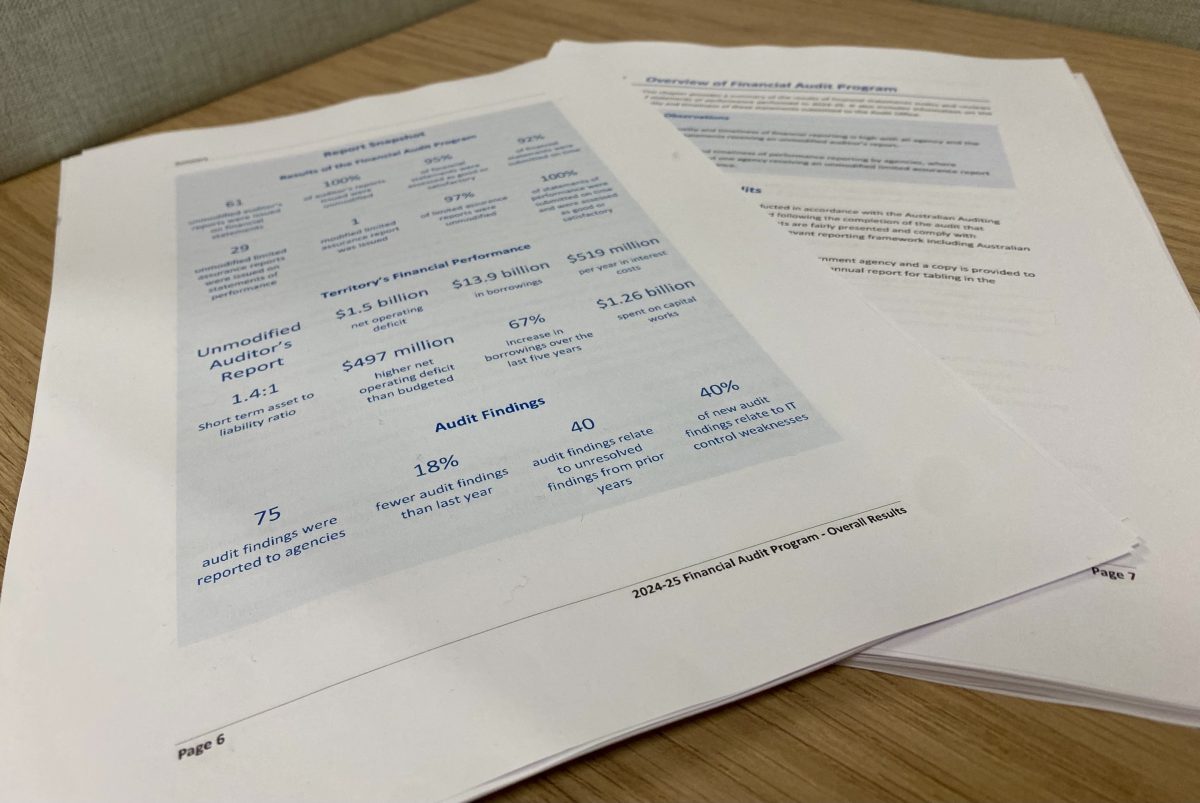
The 2024-25 Financial Audit results found IT control weaknesses remained “prevalent”, with 26 of the 40 audit findings raised in previous years.
“Twenty-seven of the 40 reported IT control weaknesses, or 68 per cent, relate to information security controls, which safeguard information systems by preventing, detecting or minimising the risk of inappropriate access to systems and data,” the report stated.
The Auditor General focused on IT controls over computer information systems, including key finance, payroll and accounts payable systems, major revenue systems for taxes, fees and fines and other agency systems supporting functions like transport fares, public housing, long service leave, school administration and healthcare billing.
“[There’s] reasonable assurance that the financial information produced by these systems is reliable, accurate and complete,” the report stated.
“However, there are IT control weaknesses that need to be addressed to further reduce the risk of errors and fraud in financial information, unauthorised access to sensitive data and cybersecurity attacks.”
Issued included a lack of security plans and processes and, when they were in place, some weren’t appropriately approved, properly followed or maintained.
The office also observed a lack of effective monitoring and logging mechanisms and inadequate user access management or timely termination of access for departing staff.
The report overall found while the Territory’s financial and performance reporting quality was high, the ACT faced “significant fiscal challenges” that needed strong budget and debt management.
“The Territory’s persistent deficits and growing debt highlight structural fiscal challenges,” the report noted.
“Careful management of expenditure and borrowing will be critical to maintaining financial sustainability over the long term.”
The Territory recorded a net operating deficit of $1.5 billion in 2024-25, exceeding the budget forecast by $497 million. This is a 133 per cent increase since 2020-21.
Borrowings have risen by 67 per cent over the past five years and are projected to increase by a further 51 per cent in the next four years. By 2028-29, nine per cent of the Territory’s total budget is expected to go to annual interest payments (a total of $1 billion).
“Expenses continue to outpace revenue growth, creating sustained pressure on the budget and reinforcing the need for tighter cost controls and efficiency measures,” the report stated.
“The Territory’s 2023-24 taxation revenue of $5551 per capita is close to the average across all states and territories. Therefore, any further increase in the Territory’s revenue through taxation would place additional financial burden on taxpayers.”
In the most recent budget the ACT Government did increase general rates for residential and commercial properties and increase existing levies such as the Safer Families Levy, the Police, Fire and Emergency Services Levy and the Road Safety Contribution Levy.
It also warned the ACT’s credit rating was in danger of slipping further unless there was “strong action” to return the budget to a “meaningful” surplus.
One area where the Auditor General wanted to be able to access more information related to capital works.
The largest allocations of the capital works funding went to Infrastructure Canberra at $647 million. Under the recent government changes, Infrastructure Canberra now looks after the delivery of all Tier 1 and Tier 2 infrastructure projects.
The Territory’s actual expenditure on capital works for the 2024-25 period was “largely in line” with expectations, with $1.26 billion or 92 per cent of allocated funding spent.
But information given to the Auditor General only referred to revised project values and expenditure to date for each project, rather than the initial project budget or expected completion date.
“While agencies report progress on their capital works in their annual reports, the centralised progress report provided to the Assembly by Treasury lacks detail on initial project budgets, own source revenue contributions used by agencies to fund their capital works and expected completion dates,” the report stated.
“Including this information would make it easier for the Assembly to more readily assess whether the Territory’s most significant capital works project are being delivered within budget and on time.”
Future reports are expected to include more detailed reporting on milestone progress along with expenditure for significant projects.