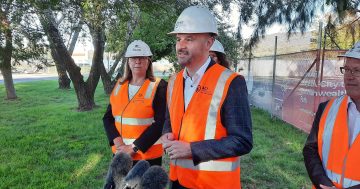
The Molonglo River Bridge was one project that split the costs 50:50 between the Territory and Commonwealth governments. Photo: ACT Government.
The ACT Government has failed in its attempt to reform federal infrastructure project policy, with the recommendations of a Senate Committee appearing to dismiss its concerns.
The inquiry into financial support for state and territory infrastructure projects focused on gaining feedback on the process, governance and effectiveness of federal financial support provided to state and territory governments.
The ACT has been investing heavily in infrastructure. With ongoing light rail construction, the more than $300 million Lyric Theatre, the Molonglo River Bridge and discussion of a new Canberra stadium, infrastructure has been the focus of the territory’s budget.
In the recent Senate inquiry, the ACT Government attempted to cut its costs by increasing the Commonwealth’s.
The ACT Chief Minister, Treasury, and Economic Development Directorate (CMTEDD) made a submission to the committee, where it claimed the current forms of funding held “systemic disadvantage” against the ACT.
It stated the current model “has historically made it challenging” for projects to be approved due to infrastructure projects being of lower value than other states and territories, and definitions-based criteria of “national significance” were hard to meet.
“While these areas are central to Australia’s governance and international reputation, the ACT bears the cost burden despite limited revenue-raising capacity and the Commonwealth being the primary beneficiary,” CMTEDD’s submission read.
The ACT Government argued infrastructure funding models assumed states/territories had both a state and local government – a model the ACT doesn’t have.
It claimed the region’s “national capital, urban, suburban, regional and even rural characteristics” reduced its ability to meet funding requirements and that the Territory faced unique challenges due to the Infrastructure Policy Statement (IPS) holding a 50:50 rule.
This rule outlines funding for land transport projects must be shared on a 50:50 basis between state/territory delivery partners and the Commonwealth.
CMTEDD suggested the IPS should contemplate the Commonwealth providing a larger share of the funding if the project took place on Commonwealth land.
Light rail was mentioned, as sections of the infrastructure would be constructed across Commonwealth land and were described as “serving nationally significant precincts”.
But the ACT’s submission appeared to fail to make an impact, with the final report handing down a list of recommendations which ignored the national capital’s infrastructure situation almost entirely.
Recommendations focused partially on accountability, including “more regular public reporting and communication” and “mandatory public reporting of post-completion reviews for all infrastructure projects above a certain threshold”.
The other half of the recommendations were focused on practical infrastructure assessments and processes.
This included the full implementation of the National Planning and Assessment Framework, and access to resources to councils in identified rural, regional and outer metropolitan growth areas.
There was a recommendation of a previous funding split away from the 50:50 model, towards an 80:20 model.
In bad news for the CMTEDD, this was only for “nationally significant road projects in regional and remote Australia”.
That criteria can only be attempted to be met if a road project in a regional and remote area was proposed in the ACT.