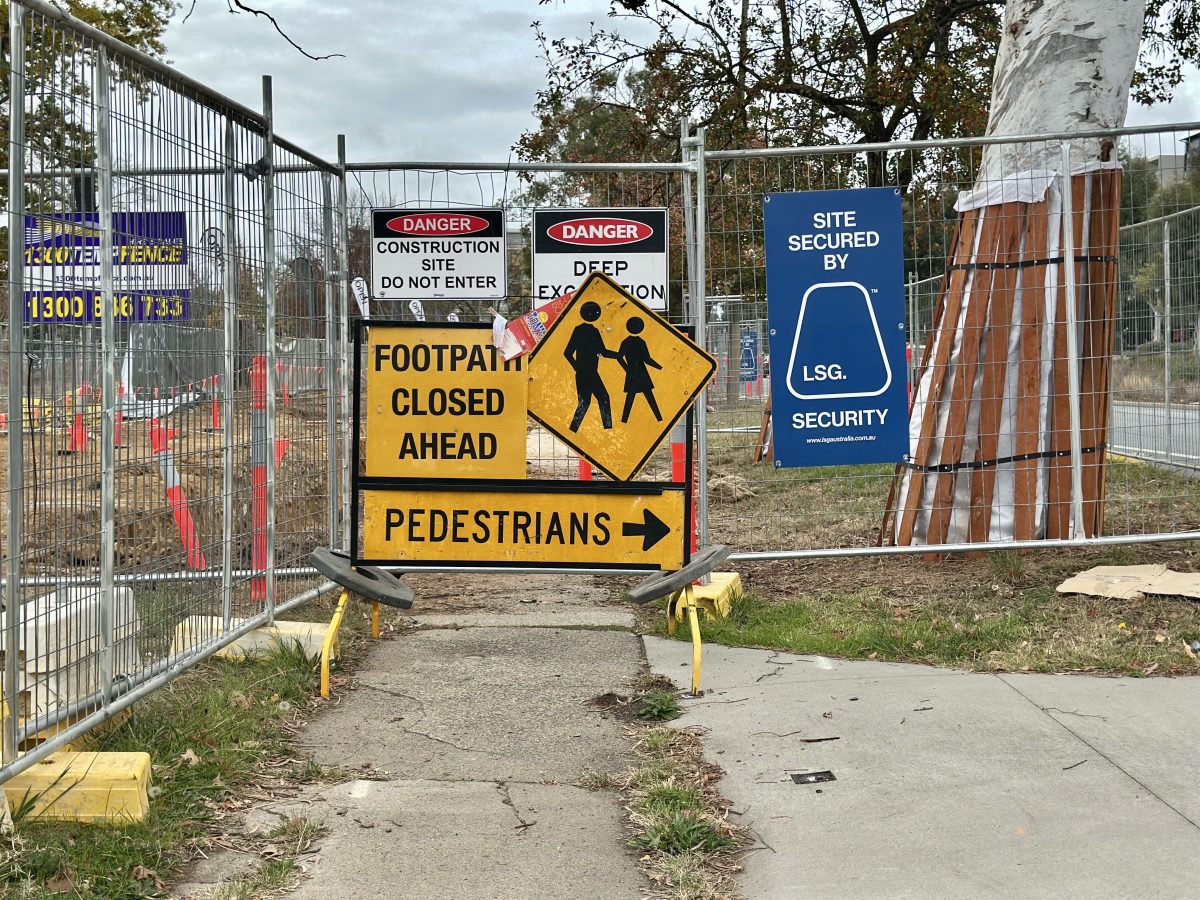
Accessibility advocates argue the fees for construction companies that shut footpaths aren’t high enough to make a difference. Photo: James Coleman.
The fees for developers to close Canberra’s footpaths during construction are under fire as advocates warn the cheap rates won’t make a difference to accessibility.
The fees – set under section 130 of the Public Unleased Land Act 2013 – were due to take effect in 2025 but were delayed following pressure from the development sector. An answer to an estimates question on notice showed only construction and property industry figures were consulted on the final rates.
Kurrajong independent MLA Thomas Emerson said it wasn’t good enough that pedestrian, cycling and disability advocacy groups weren’t included in the conversation.
“They’ve reduced daily fees for path closures from up to $200 per block to as little as 50 cents per metre,” he said.
“This is clearly nowhere near enough to actually disincentivise prolonged footpath closures and will just become another input cost for construction in our city.”
Mr Emerson said he was “constantly” hearing from Canberrans who were frustrated with the government’s approach to the issue.
“City councils across the country have prioritised pedestrian access by either prohibiting developers from closing footpaths around their construction sites or imposing significant fees for doing so.
“This is a problem we can solve, but it’ll take a bit of courage from the ACT Government to make it happen.”
An ACT Government spokesperson defended the targeted engagement, stating plenty of consultation had occurred in regards to active travel and accessibility of pathways over many years.
“This particular consultation was focused on the proposed fee and charging arrangements,” the spokesperson said.
“As the fees directly impact permit applicants, our engagement was targeted towards industries that regularly apply for road and pathway closure approvals and would be most impacted by the proposed changes.”
The spokesperson said safe and accessible paths were a priority wherever possible, pointing to the fee schedule as proof of that commitment.
“The objective of the fee schedule is to ensure the land is used only where necessary and for the shortest reasonable period,” the spokesperson said.
Other frameworks to discourage excessive use of public unleased land include tiered public land occupation rates and permit applications to close roads or paths for construction are assessed on a case-by-case basis.
But sometimes maintaining pedestrian access just isn’t safe or practical.
“Safety and accessibility are both key considerations of temporary traffic management plans, a required document for an application to close a road or pathway,” the spokesperson said.
The spokesperson stressed the construction industry’s critical role in delivering homes, infrastructure and public amenities for Canberrans and there were plenty of regulations around planning, safety, environmental and access requirements that they had to navigate.
“A strong partnership between government and industry is essential to support housing delivery while ensuring these important requirements are met effectively,” the spokesperson said.
“For this to occur it is important that compliance processes remain clear, efficient and practical, while maintaining strong protections for public safety, accessibility and community access.”
Community groups like Living Streets have long advocated for footpath closure fees.
Convenor Gillian King said this approach meant Canberrans would keep bearing the cost
“Path users in the ACT are inconvenienced and put in danger … developers or builders smash paths and leave them like that – often for years – and the taxpayer ends up having to pay to fix it,” she said.
“If we had been consulted, we would have pointed out deficiencies with the ACT Government’s approach to the problem.”
Ms King questioned why other requirements weren’t also placed on companies to make sure damage didn’t occur, pointing to Melbourne’s Bayside City Council as an example. It requires bonds for a single block, ranging from $2500 to $50,000, which is paid back once all construction work is complete (assuming there’s no outstanding damage).
Ultimately, Ms King said alternative and safe pathways (not necessarily the original paths) needed to be made available for public use in construction areas.
“Parking spaces or a road lane can be blocked off for vehicles in order to provide temporary, fully-accessible and safe pathways for the road surface,” she offered as a solution.
“Where overhead protection is required, the existing pathways can be protected with overhead gantries and scaffolding, or with reinforced container tunnels.
“Why are these remedies common elsewhere but not standard in the ACT?”
A committee report recommended the effectiveness of the closure fees be reviewed within 12 months.