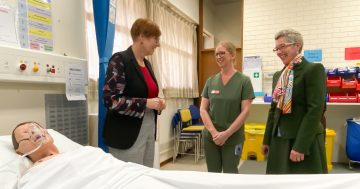
ACT Ambulance Service paramedics take part in a demonstration inside the new Blended Learning Interactive Simulation Suite (BLISS), where realistic scenarios help prepare crews to respond to occupational violence and aggression. Photo: ESA.
A patient suddenly turns aggressive.
The shouting starts. Abuse follows. Within moments, the paramedic must decide whether to continue treating the patient, attempt to calm the situation or step back and wait for police.
It’s not a real emergency but a scenario playing out inside the ACT Ambulance Service’s new immersive training room — a facility introduced as violence and aggression towards frontline healthcare workers continues to rise.
More than 190 incidents of workplace aggression were recorded by the ACT Ambulance Service last year, averaging more than one confrontation every second day. The figures have prompted the service to introduce a new training system that allows paramedics to practise responding to volatile situations before they encounter them on the road.
Known as the Blended Learning Interactive Simulation Suite (BLISS), the 270-degree projection system transforms a traditional classroom into an interactive environment where walls come alive with moving images, emergency scenes and realistic sound, recreating the pressure and unpredictability of frontline call-outs.
Rather than focusing solely on clinical skills, the simulations are designed to help paramedics recognise early warning signs, assess risks, communicate under pressure and make rapid decisions when situations become unsafe.
The launch reflects a growing concern across Australia’s health sector, where occupational violence — ranging from verbal abuse and intimidation to physical assault — has become an increasingly common part of the job for ambulance crews, nurses and doctors.
Police, Fire and Emergency Services Minister Marisa Paterson said while paramedics naturally focused on patient care, their own safety was equally important.
“This investment demonstrates the ACT Government’s commitment to providing paramedics with the training, tools and support they need to stay safe while serving the Canberra community,” Dr Paterson said.
“It also reinforces our commitment to providing our paramedics with the latest technology and training opportunities, helping them continually enhance their skills and maintain their reputation as one of the highest-performing ambulance services in the country.”
Inside the simulation suite, instructors can recreate the kinds of situations paramedics increasingly encounter — domestic disputes, mental health crises, drug and alcohol-related incidents and emotionally charged emergencies where aggression can escalate without warning.
The scenarios unfold in real time, forcing crews to make the same decisions they would face on an actual call-out while remaining in a controlled learning environment.

Police, Fire and Emergency Services Minister Marisa Paterson and ACT Ambulance Service chief officer David Dutton at the launch of the new immersive training facility designed to help paramedics prepare for occupational violence and aggression. Photo: Supplied.
ACT Ambulance Service chief officer David Dutton said the technology represented a significant step forward in preparing paramedics for the realities of frontline work.
“BLISS represents a significant advancement in how ACT Ambulance Service delivers education, training and professional development,” he said.
“This capability provides paramedics with realistic learning opportunities that enhance situational preparedness before they encounter similar challenges in the field.
“The goal is simple — reduce harm by preparing our people for challenging situations in a safe and controlled environment.”
The facility will also support paramedics returning to work after injury, allowing them to rebuild confidence and refresh operational skills before heading back into the field.
The investment comes as healthcare leaders warn violence against medical staff is becoming more frequent and more complex.
Australian Salaried Medical Officers Federation ACT Branch president Professor Dipti Talaulikar told Region both reported incidents and anecdotal accounts of occupational violence had roughly doubled over the past few years.
She said patients were arriving at hospitals older, sicker and with increasingly complex health needs, while emergency departments were also seeing more people experiencing mental illness, dementia and drug or alcohol-related conditions.
“Patients presenting with acute problems, those with mental health issues, drug and alcohol dependence, dementia or behavioural issues can get frustrated, especially when facing longer wait times, leading to occupational violence,” Professor Talaulikar said.
She said workforce shortages often compounded those pressures, while poor reporting and inconsistent follow-up meant many incidents were never fully addressed.
In a multicultural city like Canberra, communication barriers and differing cultural expectations could also contribute to misunderstandings that sometimes escalated into violence.
When violence erupted inside a hospital or emergency department, treatment could be interrupted, procedures delayed and clinicians diverted away from other patients, placing further pressure on an already stretched health system.
The new simulation suite is one attempt to break that cycle by preparing paramedics before those situations occur.
Asked whether the ACT Government was considering tougher penalties for assaults on paramedics and other emergency workers, Minister Paterson said all options remained under discussion, but the government’s immediate focus was on prevention.