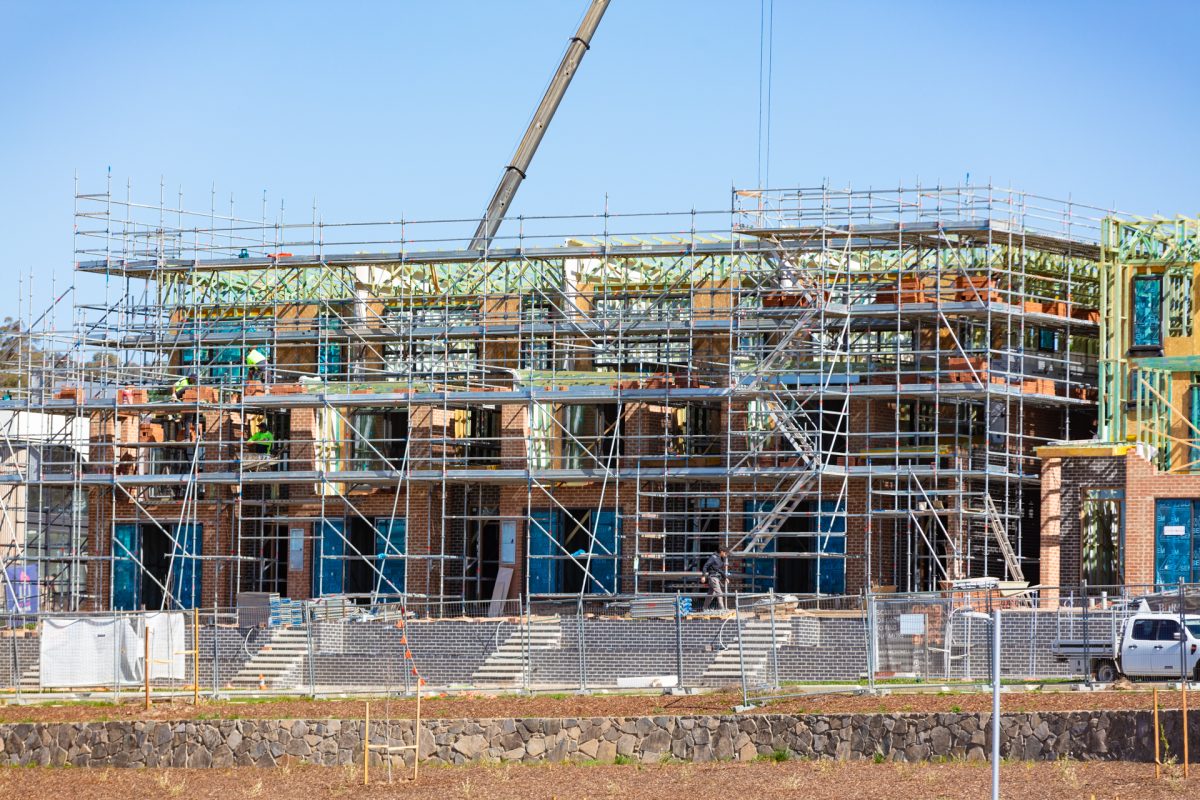
The property industry will have a year from 1 May to adopt NCC25. Photo: Michelle Kroll.
The ACT will give the building industry a year to prepare for the introduction of the 2025 National Construction Code and its new requirements for building homes.
The government has announced the Territory will adopt the new National Construction Code 2025 (NCC 2025) on 1 May 2027.
It said this transition period would provide greater support and flexibility to the building industry in the current period of global uncertainty.
The 12 month transition period will run from 1 May 2026 until 1 May 2027 for new building approvals.
Builders can choose to comply with either the existing NCC 2022 or the updated NCC 2025 for new projects, in line with NSW.
Projects that are already well advanced, where key planning or works applications are lodged before 1 November 2026, will also have the flexibility to choose which code applies for their project.
Planning and Sustainable Development Minister Chris Steel said the updated code reflected national best practice and would lift building quality while supporting a capable, strong construction sector.
“The updated National Construction Code ensures new homes and buildings in the ACT meet the modern standards our community expects,” Mr Steel said.
“These changes include stronger water management requirements for apartment buildings, such as improved waterproofing of balconies, which will address a major cause of building defects.
“There are also important changes to building ventilation requirements, which will reduce the risks of mould and condensation in new homes which is important in the ACT’s cooler climate and fire safety and accessibility requirements for commercial developments.”
But proposed changes to improve residential energy efficiency and preparedness for electric vehicle charging will not go ahead in NCC25.

Planning and Sustainable Development Minister Chris Steel says phase-in time will support industry. Photo: Ian Bushnell.
Mr Steel said some of the accepted changes would particularly impact commercial development.
“Which is why we are providing industry a reasonable transition time to prepare whilst also providing a pathway for early adopters to benefit from the updated provisions,” he said.
The government would monitor implementation across other jurisdictions in deciding whether to adopt any variations to NCC 2025.
“This will include ongoing engagement with the construction sector to ensure they have the tools they need in order to apply them as we work towards enabling 30,000 new homes by 2030,” he said.
Property Council ACT & Capital Region executive director Ashlee Berry said the announcement responded to industry concerns about feasibility, timing and cross-border consistency.
Ms Berry said it would give industry the time it needed to plan, price and deliver projects with confidence.
She said the Property Council had called for the ACT to pause implementation until 1 May 2027, while allowing voluntary early adoption from 1 May 2026.
“A clear adoption timeline and a 12 month transition period will help avoid unnecessary redesign, reduce compliance risk and support the continued delivery of housing and commercial development in the ACT,” she said.
“This is especially important at a time of heightened construction costs and feasibility pressures and a positive signal that the ACT Government is willing to listen and respond to such pressures with sensible measures.”
Allowing projects that lodge a development application or works approval by November 2026 to proceed under the current NCC requirements was an important practical safeguard, particularly for complex and multi-stage projects that were well advanced.
“Locking in existing requirements where approvals are lodged by November 2026 will help avoid disruption mid-project and provide much needed certainty for proponents making long-term investment decisions,” she said.
But Master Builders ACT CEO Anna Neelagama said now was not the right time to introduce substantial changes that could further escalate costs for households.
Ms Neelagama said increased costs for new builds could range from $14,000 to $55,000, creating additional burdens for prospective homeowners.
“It is crucial to take into account the current economic climate and the financial strains placed on families looking to build or renovate,” she said.
“Increased materials costs, interest rate rises and fuel costs are already putting significant strain on builders and homebuyers alike.”
Master Builders ACT urged the government to consider the broader impact on the construction industry and join other small jurisdictions in making this delay permanent.
“South Australia and Tasmania have both recognised that their building industries cannot cope with the increased costs and complexity imposed by NCC 2025 and will not be implementing this update,” Ms Neelagama.
Master Builders ACT had made several recommendations to the ACT Government regarding the NCC 2025 update.
These included NCC 2022 undergo a detailed review prior to NCC 2025 being adopted and the ACT align the NCC2025 implementation process with other jurisdictions such as Tasmania.
Master Builders ACT urged the funding of a technical training package tailored to all parties responsible for upholding NCC, a formal industry readiness assessment prior to enforcement of NCC 2025, full cost-benefit analysis for ACT housing and public projects, and that ACT-specific variations be avoided.
The Australian Building Codes Board released a preview version of the code in February, with the full code due to be published on 1 May 2026.
Last year the Federal Government paused residential changes to the the NCC for four years until 2029 after pressure from industry that it was struggling to keep pace with the requirements and associated costs.