Prevention of Family and Domestic Violence Dr Marisa Paterson (front, with CPO Scott Lee, DVCS CEO Sue Webeck and YWCA CEO Francis Crimmins) introduced legislation to criminalise coercive control on 28 May. Photo: Claire Fenwicke.
“Coercive control is a thousand learnings: learning to retreat, to second-guess yourself, to apologise for things that were never your fault or never a fault at all.
“A thousand moments of learning to shrink, a thousand feelings of despair and anxiety, a thousand moments where you could not see a way out, where you could not breathe.
“Coercive control is a thousand acts of survival … staying small to stay safe.”
These are the words Prevention and Family Domestic Violence Minister Dr Marisa Paterson used as she introduced proposed legislation to criminalise coercive control as a standalone offence in the ACT.
The Crimes (Coercive Control) Amendment Bill 2026 would see a new offence inserted into the Territory’s criminal code to capture coercive control as a “course of conduct”, rather than a single incident, used to coerce or control a partner or family member.
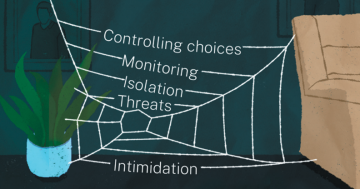
Coercive control can include financial abuse, tracking and stalking behaviours, gaslighting, abusive and threatening language, and systems of abuse which can continue long after separation.
Dr Paterson said defining coercive control as a pattern of behaviour, rather than a single incident, was especially important language to use.
“This is a key difference between this offence and traditional approaches [to] family violence offending,” she said.
“[This law] does not seek to criminalise ordinary disagreements, family tensions or imperfect relationships.
“[Coercive control] is not incidental or accidental. It is a deliberate and targeted pattern of abuse.”
While there is no set number of incidents or specific timeframe required, a pattern and intent must be established.
If passed, the crime would carry a maximum punishment of seven years’ imprisonment, 700 penalty units, or both.
It would cover offending by current or former intimate or domestic partners, relatives or people with whom someone has a family-like relationship or a person treated or regarded as a family member.
This step has been several years in the making.
The ACT Government started considering coercive control and its impact as other states started moving to criminalise the behaviour in 2022, and the inaugural domestic and family violence review of 2023 found coercive control was present in the majority of homicide deaths in the Territory.
The Canberra Liberals attempted to move to criminalise coercive control in 2024, but were told that more education was needed first.
In the same year, the Domestic Violence Crisis Service said it could get an education campaign up and running in six months if it received funding to do so. The ACT Government then budgeted for such a public education campaign (but not necessarily from DVCS), fulfilling a promise it had made in 2020.
In 2025, the public awareness campaign was launched, but in September, it was argued that “substantial cultural change” was still needed before coercive control was criminalised.
The Women’s Health Matters Too Urgent to Rush report warned that coercive control had become so normalised that some found it difficult to recognise it as abuse.
Given all this, if the coercive control amendment bill is passed, it will have a two-year implementation period.
ACT Chief Police Officer Scott Lee said a standalone offence would allow officers to take action at an earlier stage, and hopefully before behaviour worsens.
“Coercive control has long been understood as a feature of family violence. These amendments give police a clearer basis to take action in response to that behaviour, intervene earlier where appropriate, and prosecute offending that may previously have been addressed only as part of a broader pattern of abuse,” he said.
Support services have long been calling for the criminalisation of coercive control.
YWCA CEO Francis Crimmins said making sure it didn’t just apply to intimate current or ex-partners was an important aspect of the proposed legislation.
She shared a case study of a working woman whose life was entirely micromanaged: she had no control over her own finances, her shopping lists were heavily inspected, and she was forced to hand over any remaining change.
“We also see it for older women … we know that [coercive control] can extend to adult children and sometimes spouses of adult children, who are using coercive control on elderly women.”
DVCS CEO Sue Webeck said it was important to remember that legislaiton follows decades of advocates repeatedly telling their stories to create change.
“This is decades of victim-survivor voices culminating in government being able to take action towards creating safer responses,” she said.
“Our thoughts should be with all of those victim-survivors that have sacrificed so much of their lived experience to contribute to this reform in order to support our community, hopefully being safer and better equipped to respond moving forward.”
If this story has raised any concerns for you, 1800RESPECT, the national 24-hour sexual assault, family and domestic violence counselling line, can be contacted on 1800 737 732. Help and support are also available through the Canberra Rape Crisis Centre on (02) 6247 2525, the Domestic Violence Crisis Service ACT on (02) 6280 0900, the Sexual Violence Legal Services on 6257 4377 and Lifeline on 13 11 14. In an emergency, call triple zero.