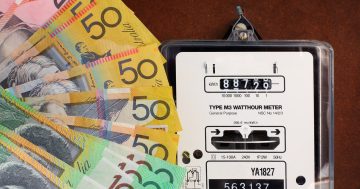
Canberrans on standing offers with ActewAGL will see their bills increase by $64 for the 2026-27 financial year. Photo: Michelle Kroll.
Canberrans on an ActewAGL standing offer will see their rates rise by 2.73 per cent this coming financial year, an increase that’s below inflation.
The pricing regulator released its price direction report, stating that the standing offer tariff represented a real decrease of 0.51 per cent.
“Wholesale electricity purchase costs decreased for 2026-27, but this was offset by an increase in network costs and costs associated with government policies,” Independent Competition and Regulatory Commission (ICRC) senior commissioner Richard Owens said.
The maximum increase of 2.73 per cent means an annual bill increase of $64 for an average residential customer on a standing offer (which is the default if you don’t choose a market offer or negotiate a plan).
For an average non-residential customer consuming about 25,000 kWh, their annual bill will increase by $245.
The ACT’s typical standing offer bill is estimated to be lower than South Australia and NSW, but higher than Victoria and Tasmania.
Wholesale energy purchase costs decreased from $163 per megawatt-hour (MWh) in 2025-26 to $143/MWh in 2026-27.
The report stated that lower wholesale costs reflected improved electricity supply conditions in 2025, “supported by expanded renewable generation and battery storage, reduced reliance on high-cost gas generation during peak demand periods, and fewer periods of unusually high prices in the wholesale market”.
However, “network costs are increasing by 15 per cent in 2026-27, contributing 4.1 percentage points to the price rise. This reflects higher transmission and distribution charges approved by the Australian Energy Regulator and the impact of inflation within the regulatory framework”.

Electricity cost components for 2026-27 (compared to 2025-26). Photo: ICRC.
One of the other major contributors to the increase, as in previous years, is ACT Government scheme costs, set to increase by $10.06/MWh.
“The ACT Government’s large-scale feed-in tariff scheme [LFiT] costs are increasing by 90 per cent in 2026-27, reflecting the ACT Government’s Reasonable Cost Determination of $95 million for 2026-27,” the report stated.
“These costs represent payments to large-scale renewable electricity generators contracted by the ACT Government to meet its 100 per cent renewable electricity target.
“Overall, ACT Government scheme costs remain a significant and growing component of the total cost stack.”
The LFiT scheme is where the government sources renewable energy from generators in the ACT, NSW, Victoria and South Australia, paying a fixed contract price for the electricity they feed into the grid.
When wholesale market prices are below the agreed fixed price, a top-up payment is made to the generator to match the agreed contract price. This cost is then passed on to consumers.
“Electricity prices in the ACT are expected to move from the lower end of the national range in previous years to the mid-range in 2026-27,” Mr Owens said.
The rise is set to take effect from 1 July.
The ICRC encourages consumers to regularly compare tariffs between providers.
“Our research shows that most market offers are priced below … the regulated standing offer,” the report noted.
Comparisons can be made through the Australian Government’s Energy Made Easy tool.
Low-income Canberrans can apply to receive an annual rebate of up to $800 to help meet their electricity costs through the ACT Government’s electricity, gas and water rebate.