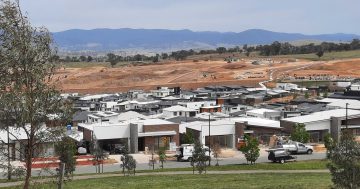
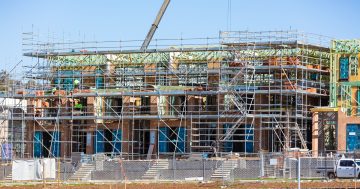
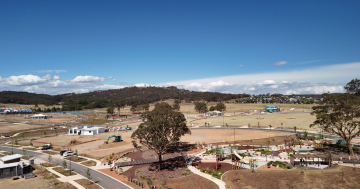
The Suburban Land Agency coordinates land release to deliver residential, commercial and industrial developments. Photo: SLA.
Recent analysis about Canberra’s land release program has raised a question we should be asking much more seriously: Are we making housing scarce and then wondering why it is unaffordable?
The question matters because Canberra is not simply experiencing a housing affordability problem. We are experiencing a housing supply problem.
And when supply does not keep pace with demand, the consequences are predictable.
Prices rise, rents rise, young people delay buying, families move further away, older people struggle to downsize.
And people who work in Canberra increasingly find themselves unable to afford to live in the city they keep functioning.
The ACT Government has an unusual position in Australia’s housing market because it controls the release of Territory-owned land for new housing.
That gives it enormous power and enormous responsibility.
The latest ACT Government figures show that about 3700 approved applications were on the public housing waiting list at 30 June 2026. Of these, about 200 were priority applications, and about 2000 were classified as high-needs. The average waiting time for standard applicants was more than five years.
But the pressure is not confined to people seeking public housing.
A young Canberra couple earning decent incomes can also find themselves locked out of home ownership because the combination of land prices, construction costs and interest rates has pushed the price of a house beyond their reach.
This is where the land release debate becomes so important.
Analysis by former ACT chief minister Jon Stanhope and former Treasury official Dr Khalid Ahmed – Exploding Rents, Skyrocketing House Prices—Housing (Un)Affordability in the ACT – found that the ACT fell about 24 per cent short of its residential dwelling supply target in 2024-25. Only about 300 standalone dwelling sites were supplied, representing less than 9 per cent of total supply.
The problem is not simply how many homes we eventually build. It is whether enough land is being released, soon enough, in forms that people actually need.
And the price of housing tells its own story.
The median Canberra house price was about $1 million in the September quarter of 2025. In June 2026, Domain data echoed that finding.
That should concern all of us.
I am not suggesting that every Canberran needs a large detached house. Canberra needs apartments, townhouses, smaller homes and different forms of medium-density housing.
But we should not confuse housing diversity with housing scarcity.
If families want a detached home and there are very few blocks available, the answer cannot simply be to tell them that their expectations are outdated.
Nor can we solve Canberra’s housing problem by pushing more families across the border to Queanbeyan, Googong, Yass or Murrumbateman.
That may reduce pressure on Canberra’s housing statistics, but it does not solve the problem; it simply exports it.
There is another part of this debate that deserves much greater scrutiny: the financial return the ACT receives from land sales.
Stanhope and Ahmed’s analysis argues that the ACT Government’s land sale profit margin has increased from about 35 per cent to 80 per cent, with the margin averaging about 60 per cent over the past five years.
These figures deserve serious public scrutiny.
The ACT Government’s own 2024-25 Suburban Land Agency annual reporting records a gross profit margin of about 55 per cent on land sales. That measure is not directly comparable to a conventional private-sector profit margin because of the way the ACT Government accounts for infrastructure and other development costs.
But it nevertheless highlights the scale of the financial returns associated with releasing public land.
The basic public policy question remains: How much profit should a government make from land when that land is the foundation of someone’s home?
Government should certainly recover legitimate costs. It should manage public assets responsibly.
But if the objective of housing policy is affordability, revenue maximisation cannot quietly become the overriding objective.
This is where my experience in public policy makes me uneasy.
Governments are very good at measuring things they can count: land releases, approvals, revenue and dwelling targets.
But we do not always measure what ultimately matters.
Can a nurse afford to live in Canberra? Can a teacher buy her first home? Can a young family stay close to grandparents? Can an older person downsize without leaving the community they have lived in for decades? Can someone who came to Canberra as a migrant, contributed to the city and raised a family here afford to remain?
We should not create a Canberra where the next generation can live here only by inheriting a house, receiving substantial family assistance or moving further and further away.
The ACT needs a housing reset.
We should independently examine the cumulative gap between promised and actual land releases, the cost of ACT land compared with other jurisdictions, the relationship between land supply and house prices, the financial returns generated from land sales and whether the mix of housing being released reflects what Canberra’s population actually needs.
We should also examine the cumulative shortfall in planned versus actual housing supply identified in recent analysis and make that gap transparent to the public.
And we should publish the results every year in a simple Housing Supply and Affordability Scorecard.
Canberrans deserve to know how many blocks were promised, how many were released, how many homes were actually built, what type of homes they were and what happened to affordability.
Most importantly, we need to put the public interest back at the centre of land policy.
A government should not deliberately create scarcity in a market where people need the product simply to live.
Growth should mean more than more people and more buildings.
It should mean more opportunity.
Because ultimately, housing policy is not about land.
It’s about people. It’s about families, and it’s about communities.
Mainul Haque OAM is an economist, former senior Australian public servant, community leader, and former ACT Multicultural Ambassador. He was awarded the Medal of the Order of Australia for service to the Canberra community.