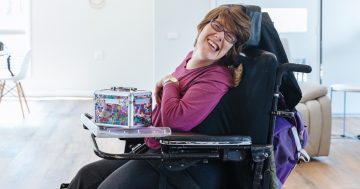
‘My dream internship’ … Jamie Larsen, 21, pictured with Hartley Lifecare CEO Eric Thauvette, says he loves the care and community of the organisation. Photo: John Lomnicki.
Jamie Larsen knows what he wants. It’s just that sometimes people ask his support worker instead.
The 21-year-old Canberra university student, powerchair soccer player and communications intern has plenty to contribute to a conversation, including the ones about him.
“A lot of the time people look to my support worker for what I want,” he says.
“It makes me feel like less of a person.”
For anyone who has ever hesitated to say hello to someone with a disability, worried about where to look or whether to offer help, Jamie has some straightforward advice.
“If you’re going to assume, assume the highest of someone before you choose how to interact with them,” he says.
There’s plenty to discover about them if you do.
Take Jamie.
Born and bred in Canberra, he’s been playing powerchair soccer for six years, using a chair that’s lower to the ground and fitted with a guard around the bottom to manoeuvre the ball. He loves board games and Dungeons and Dragons, and his three-year-old Cavoodle, Robbie.
Getting out into the community makes him feel “free and happy”.
He’s also keen to make a difference in it.
That ambition initially drew Jamie towards medical science before he realised a career in communications could offer its own opportunities to bring about positive change in the world.
Now studying a Bachelor of Communication and Media at the University of Canberra, specialising in public and corporate communication, he’s now enjoying putting the theory into practice.
His latest placement is with Hartley Lifecare, where he’s spent the past six weeks helping with communications, social media, events and marketing.
Tuesdays and Wednesdays are workdays, with the others reserved for study.
Jamie describes it as “my dream internship”.
“There is so much care and community here,” he says.
“The clients are really involved and central to the organisation. You can really feel the sense of community and support here.”
Being included and having a say are things Jamie would like everyone to experience, wherever – or whoever – they happen to be.
“The main thing is to be treated like anyone else rather than assuming that because I’m in a wheelchair I have lower capacity,” he says.
Diagnosed with Duchenne muscular dystrophy at four, Jamie attended Garran Primary School, Alfred Deakin High School and Canberra College, graduating in 2022.
He speaks positively about his public education, saying he experienced none of the barriers he might have faced because of his disability.
His family has helped and continues to help him, while a support worker assists with personal care most days and accompanies him in the workplace.
But having support doesn’t mean someone else should automatically answer for him. Nor does meeting one person with disability tell you what the next person might need.
“A lot of it is assuming,” Jamie says of the faux pas people can make. “It doesn’t mean all people with disability have the same needs.”
The starting point? Ask.
If you think someone needs a hand, check first, then listen and follow their direction, he advises. They know what works for them.
And yes, say hello. Smile. There’s no need to look away or avoid an ordinary conversation because you’re worried about getting it wrong.
“Treat them like a person first,” Jamie says.
For someone who is non-verbal or communicates differently, that still means addressing them directly and allowing them to respond. If a support person or carer is helping with communication, include both.
It’s about asking and engaging, according to Jamie.
And it’s a message he hopes to share through his work at Hartley, bringing lived experience to the communication skills he’s developing in a workplace.
“I’m keen to use my communication skills in a way that helps raise awareness and help people with disabilities to live a good life,” he says.
“And that’s what Hartley does.”
For the rest of us, his advice begins with our next encounter.
“The important thing to remember is whether you can see the disability or you can’t, always treat the person you meet with the human dignity you would afford anyone.”