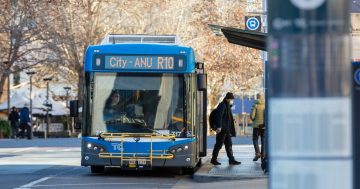
Transport Canberra currently uses about 13 million litres of fuel each year. Photo: Michelle Kroll.
Treasurer Chris Steel has warned that the uncertainty around the ongoing war in Iran could affect what Canberrans can expect in the 2026-27 ACT Budget.
But we’ve been given assurances in the short term that one major service has the fuel it needs to continue operating: public transport.
Canberra Liberals leader Mark Parton asked Mr Steel (who is also Transport Minister) how vulnerable the ACT’s buses were to the pressures at the bowser, with some stations running dry as people panic-buy.
Mr Steel said fallback storage options were being considered to shore up supply.
“Transport Canberra has the capacity to hold approximately 10 days’ worth of diesel fuel, based on current network usage,” he said.
He explained that the government had increased its monitoring of fuel and AdBlue supplies, was taking daily readings, and was passing that information on to the ACT’s industrial diesel supplier, Parks Fuel.
“[Parks Fuel] provides five deliveries per fortnight to Belconnen, four to Tuggeranong, and we’re actually looking at extending – given the current concerns around fuel – diesel storage to Woden Depot, even though [it] is for battery-electric buses … to make sure we have that fallback option as well,” Mr Steel said.
“We’re receiving the supplies that we need.”
Mr Steel also confirmed that conversations were underway with the Transport Workers’ Union (TWU) to increase bus services across the network.
He said these were not just in the context of the war, but in response to the “current traffic environment”.
“We will be putting in some timetable tweaks in the next few weeks to address early running issues on the network,” Mr Steel confirmed.
He added that further discussions were ongoing to revise and update the bus timetable for Term 3, including extending West Belconnen bus services through the rapid R2 and R3 routes, and to address capacity issues on the R4 and R5 services.
TWU ACT sub-branch secretary Klaus Pinkus confirmed these conversations, given the impacts of the Commonwealth Avenue Bridge project on bus services.
Originally, rapid buses were given an average of 12 minutes to cross the bridge, but this has now been revised to an average of 7 minutes, meaning some services were finishing their routes early.
Mr Pinkus said this meant there was the ability to extend or expand some services that reached the outer suburbs or were experiencing time pressures.
“You can’t run early … and have a bus sitting in the City for five minutes before heading off [to the next stop],” he explained.
“[Transport Canberra] want to use some of that gained time elsewhere.”
At a national level, there have been calls for public transport to be prioritised when it comes to fuel supply.
The Bus Industry Confederation (BIC) executive director, Varenya Mohan-Ram, has called on the Federal Government to make sure buses are explicitly considered in national fuel planning and emergency response frameworks.
“Buses carry more than half of Australia’s public transport passengers … Fuel security is not just an operational matter. It is a matter of social equity and community resilience,” he said.
The BIC has also called for temporary fuel excise relief for operators.
An emergency national cabinet meeting has been called for Thursday (19 March) to discuss the country’s fuel supply.
Treasurer Steel did sound a warning about how the Iran war could impact Canberrans in the coming months.
“We’re in very uncertain times. We don’t know how long these particular impacts will last in terms of the impact on oil prices [and] other commodities,” he said.
“We’ll have to look at that very closely as we pull together the 2026-27 budget.”
The ACT Budget is expected in late June.