
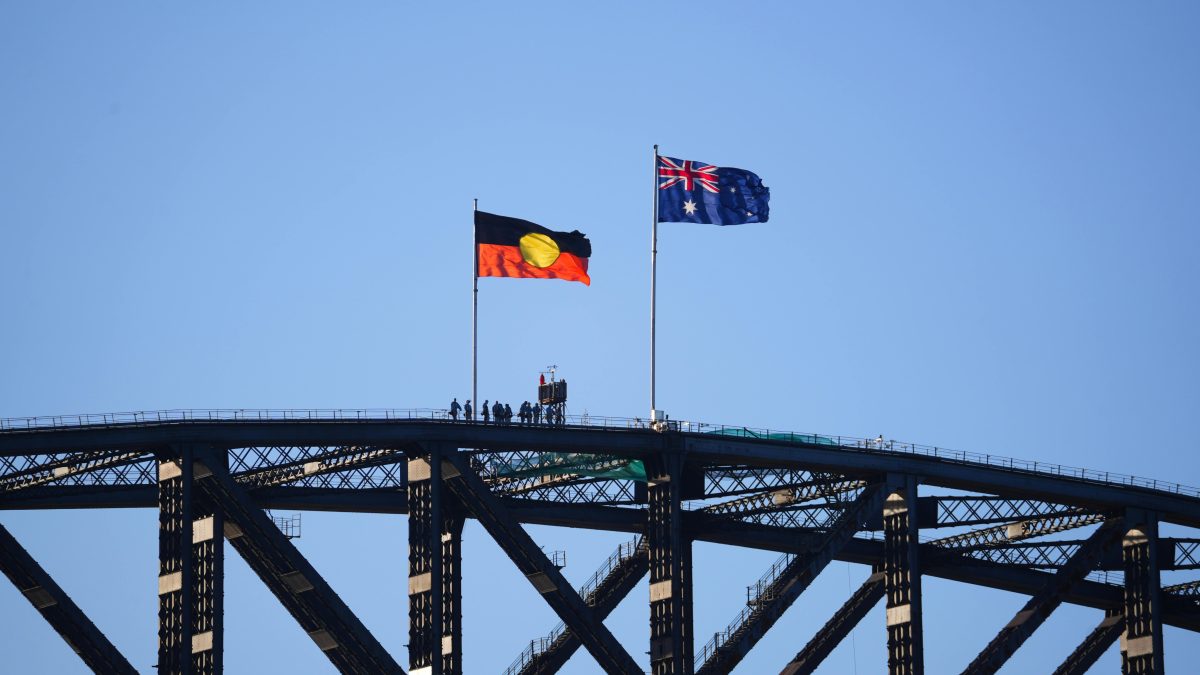
There are calls to take down Aboriginal flags but Oliver Jacques says more scrutiny needs to be placed on the one next to it. Photo: Pexels.
The Aboriginal flag was under sustained attack throughout 2025.
Critics argue it is divisive, that it represents only a small minority and that one nation should be united under one flag.
But if that’s the test, the question writes itself: is a Chinese-made piece of cloth dominated by Britain’s Union Jack really the best symbol of modern Australia? If unity is the goal, the current national flag fails it — and has for decades.
Former opposition leader Peter Dutton reignited the debate when he said he would remove the Aboriginal flag from official government press conferences if elected Prime Minister.
“I’m very strongly of the belief that we are a country united under one flag,” Mr Dutton said at the time.
“If we’re asking people to identify with different flags, no other country does that, and we are dividing our country unnecessarily.”
Mr Dutton lost the election, but his sentiment lived on when NSW’s Federation Council voted to take down the Aboriginal flag from its local government chambers.
“Exclusively flying the Australian national flag in the chamber ensures a clear expression of civic neutrality,” Mayor Cheryl Cook said during the debate.
She added that because more than 97 per cent of the council’s population does not identify as Indigenous, it was “timely” to seek a more unified culture.
But a more unified culture is not delivered by the current Australian flag, which places Britain’s Union Jack in its most prominent and honoured position, the upper-left canton.
That contradiction was identified more than 30 years ago.
In 1992, then Prime Minister Paul Keating argued that our flag, which is often mistaken for New Zealand’s, was out of date.
He said it symbolised Australia’s colonial past rather than its future and suggested it reflected an ongoing psychological attachment to Britain long after legal, political and economic independence had been achieved.
“Of the 50 members of the Commonwealth, only four countries still have the Union Jack as part of their flag,” Mr Keating told Parliament.
“While we share many of our institutions, traditions and even attitudes with Britain, we are not Britain. Our history is our own.
“To make our way in the world — particularly in this part of the world — we have to be entirely certain of who we are and what we wish to do.”
The flag debate quickly fizzled out and has remained largely frozen ever since.
It’s unlikely to be revived any time soon, with the Left preoccupied with gun laws and the Right focusing on Muslim immigration in the wake of the Bondi terrorist attacks.
Nevertheless, Mr Keating’s argument in favour of change has only grown more relevant.
According to the latest ABS census, fewer than half of Australians now claim British ancestry in what’s now one of the most multicultural nations on earth.
When Australia adopted the first iteration of its flag in 1901, about 60 per cent of its trade was with the United Kingdom. Today, that figure is less than three per cent.
Britain’s grip on our flag is curiously out of step with reality. The country Australia once depended on economically is now grappling with long-term decline, shrinking influence and diminishing relevance in our region.
Even on the cricket field — once the great symbolic bond of empire — the relationship has flipped, with our team teaching theirs how to play the game properly. Australia no longer looks to Britain for leadership, direction or validation.
If conservative politicians are serious about unity, they’re targeting the wrong piece of fabric. The problem isn’t that Australia flies too many flags — it’s that the main one still flies a foreign past.
Mr Keating was right when he said “no great country has the flag of another country in the corner”. You don’t unite a modern nation by pretending it’s still 1901.