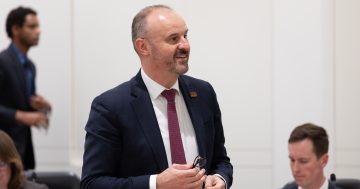
Chief Minister Andrew Barr: “There is no downside for the ACT in this agreement. It is one of the most important things we can do,”. Photos: Jasmine Thompson.
The adoption of artificial intelligence and continued development of technology-based industries will drive productivity and private sector growth in the ACT as migration and public infrastructure projects scale down, according to Chief Minister Andrew Barr.
In his State of the Territory speech at a Canberra Business Chamber event on Wednesday (4 November), Mr Barr also launched a staunch defence of the Australia-European Union Free Trade Agreement, which he said was vital for ACT tech firms to access that market.
Mr Barr said that after a decade of the country’s highest economic growth, the ACT would now need to pursue productivity gains through AI and play to its strengths in technology, cyber security, defence, education, health and renewable energy.
“It is clear how closely Canberra’s strengths in AI, cyber security, research and advanced technology align with the areas international investors are backing,” he said.
The Australia-European Union Free Trade Agreement would give Australian businesses access to a market of around 450 million people and a $30 trillion economy.
Mr Barr, who recently visited Germany and the UK, said researchers, engineers and technicians would benefit from an Innovation Mobility Pathway to travel, stay and work across the EU.
“Our universities and education providers will also have better access to the European market. For a city whose future depends on talent, research, services exports and international connections, the agreement presents a significant opportunity for Canberra businesses and workers,” he said.
Mr Barr said the agreement was an important opportunity to strengthen our trade relationships, attract investment and create new opportunities for Canberra’s knowledge-based industries.
“There is no downside for the ACT in this agreement. It is one of the most important things we can do,” he said.
“Imagine Australia turning its back on a trade agreement with the European Union. I’ve been Trade Minister for 15 years.
“I was there at the start of these negotiations. I’d like to be there at the finish and to see the real benefits that it will bring for our economy and for the Australian economy.”

Mr Barr says the ACT is a services exporter and technology services are the future.
Mr Barr said the government wanted more Canberra start-ups to succeed in global markets, attract more international investment, create more high-value jobs and increase the ACT’s exports.
“We want to turn more research into commercial success, attract talented people from around Australia and the world, and strengthen the industries where Canberra has genuine advantages.”
Mr Barr said no sector was better placed than the technology sector in terms of concentration of skills, talent and capital.
He told Region that much of the trade and commerce discussion focused on goods, but the ACT is not a goods exporter.
“We are a services exporter and technology services are the future, so undoubtedly that is a big opportunity,” Mr Barr said.
He said the success of Canberra companies such as Seeing Machines, Liquid Instruments and Quantum Brilliance showed the value of supporting a sector that was now maturing.
The energy transition was also giving Canberra an opportunity to develop expertise, technology and services that could be exported nationally and internationally.
The government’s Integrated Energy Plan was guiding the shift to an all-electric jurisdiction, while the Energy Innovation Fund was backing new ideas and positioning Canberra as an export-oriented hub for energy transition innovation.
Mr Barr said AI tools could make the ACT public service more productive without eliminating jobs.
He said they could help the workforce reduce processing times, improve customer interactions and free people to focus on more complex work.
“The objective is not a smaller public service. It is an increase in the output of the public sector,” he said.
“We want to use technology to deliver better services, make better use of public resources and improve productivity.”
Mr Barr said before his speech that it was important for humans to remain in the decision-making loop.
“But AI-assisted decision-making, particularly on things that are pretty black and white, it’s either eligible or it’s not against a set criteria, just being able to process all of those things more quickly will increase the output of the public sector,” he said.
Mr Barr said attracting talented people to the ACT and retaining them was also crucial to greater productivity.

He said the era of cheap money was over and that apart from Brisbane, where the Olympics would be held in 2032, all jurisdictions were winding back infrastructure spending.
In the ACT, the lyric theatre and the Convention and Entertainment Centre projects would deliver economic benefits, but the focus would turn to renewing ageing assets.
Whether some projects would need to be deferred was still on the table.
“We haven’t made any decisions to that effect yet, but we will need to see obviously the Commonwealth’s mid-year update, and their budget next year,” Mr Barr said.
He also said the ACT’s fiscal position had improved by about $100 million, according to the latest financial statements.
Net debt was $13 billion, but the Territory’s assets were now approaching $53 billion.
“So our balance sheet is in reasonable shape, but clearly an increased cost of capital in the near and medium term means you need to be prudent about projects that you’re borrowing for,” Mr Barr said.
He said the ACT was expected to pass half a million residents next year, and the economy would be worth $60 billion.