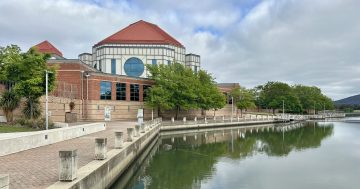
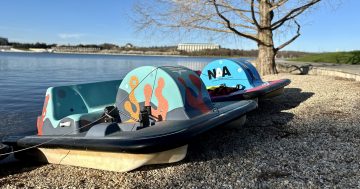
The algal bloom has been triggered by nutrients like nitrogen and phosphorus being washed into the lake through stormwater. Photo: Diane Falla, Facebook.
Just in case you were feeling tempted, Canberrans are being warned to steer clear of Lake Burley Griffin after vast swathes of it turned an eye-catching shade of green over the weekend.
Photos shared online showed the water taking on a near-lime hue, with one aerial image capturing a green cloud spreading from beneath Kings Avenue Bridge.
“Our national capital – home of the green machine,” one post to the ACT Weather Chasers & Photographers Facebook group read.
But the colour is no joke.

The National Capital Authority has increased its water-quality testing to year-round. Photo: Diane Falla, Facebook.
The National Capital Authority (NCA), which manages the lake on behalf of the Federal Government, confirmed a blue-green algal bloom is behind the change – and says people and pets should stay out of the water.
“Following the recent rainfall, algal blooms have appeared in certain locations on Lake Burley Griffin,” a spokesperson said.
“Green-blue algae may be harmful to humans and pets. The NCA encourages lake users to exercise caution if considering activities in the lake that may cause them coming into contact with water.”
The bloom has been triggered by nutrients like nitrogen and phosphorus being washed into the lake through stormwater.
“Rain events cause excess nutrients to enter the lake. This can often be attributed to pollutants entering via the urban stormwater catchment, highlighting the importance for Canberrans to help protect our waterways and stop pollution.”
Blue-green algae (also known as cyanobacteria) thrive in still or slow-moving water when there is plenty of sunlight and nutrients.
They can multiply quickly, forming blooms that discolour the water and, in some cases, produce toxins.
Those toxins can affect humans and animals in different ways. Some cause skin rashes, while others, including hepatotoxins and neurotoxins, can damage the liver and nervous system.
One of the most dangerous, cylindrospermopsin, can affect the liver, kidneys, gastrointestinal tract and blood vessels.
A 2020 review commissioned by the NCA and led by the University of Canberra found that two of the three species that bloom in Lake Burley Griffin during warmer months can produce both liver and nerve toxins.

Blue-green algae on Lake Burley Griffin. Photo: Jye Crotty, Facebook.
The risks are not just theoretical either.
In October last year, one dog was hospitalised, and another died after ingesting blue-green algae at Belconnen’s Lake Ginninderra. Investigations found clumps of a species known as Tychonema were present – a naturally occurring algae that can become toxic if consumed.
The NCA says it has also stepped up its monitoring in response to the growing year-round use of the lake.
Previously, water quality sampling was only carried out weekly during the “recreation season” from October to April, with visual monitoring outside those months.
“The NCA has commenced year-round water quality testing in response to the growing popularity of year-round aquatic activities in the lake,” the spokesperson said.
“The test results are published on the NCA’s website and allow users to make informed decisions about undertaking aquatic activities.”
While the bright green water may look unusual, it’s not the first time our waterways have drawn attention for their colour.
In 2019, a stormwater creek in Lyneham turned a vivid green, but that incident was caused by a non-toxic dye called Fluorescein used by the ACT Government to trace pollution.
Authorities at the time stressed the dye posed no environmental harm and would clear “within a week”.
The same can’t be said for this week’s bloom, which could last several weeks.