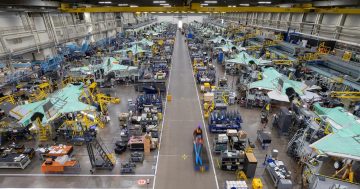
F/A-XX concept art. Image: Boeing.
The US Navy has announced that Boeing will build its next generation of combat aircraft.
Currently dubbed F/A-XX, the new aircraft will replace the current Boeing F/A-18E/F fighters and EA-18G electronic attack aircraft onboard US Navy aircraft carriers from mid next decade.
The selection of Boeing effectively gives it a sixth-generation fighter monopoly for the Pentagon, after it was also selected last year to provide the US Air Force’s next combat aircraft, dubbed F-47.
The generational labelling has been used for about 35 years since the Lockheed YF-22 and Northrop YF-23 battled it out in 1991 to be the US Air Force’s first fifth-generation fighter.
Compared to the previous generation of fighters which included the F/A-18, F-15, and F-16, fifth generation included stealthy shaping and coatings, integrated avionics and sensors, the ability to cruise supersonically without using fuel-hungry afterburners, and the internal carriage of weapons.
The F-35 which evolved out of the Joint Strike Fighter (JSF) program is also labelled as a fifth-generation combat aircraft, as are China’s J-20 and J-35, and Russia’s Su-57 fighters. China has also revealed a couple of newer aircraft designs in the past year dubbed J-36 and J-50, but little is known about these yet.
To be labelled as sixth generation, it is generally accepted that the F-47 and F/A-XX will add AI-assisted processing, additional stealth features such as a lack of vertical tails, new more efficient engines, and the capability to control multiple collaborative combat aircraft (CCA) in flight. It is also expected the new aircraft will be somewhat larger and have far greater range than those they will replace.
The selection of Boeing for F/A-XX means it is likely it and the F-47 will share many design features, components, and capabilities, as observers have previously said it would be beyond a single company’s capability to concurrently develop two sixth-generation combat aircraft.
Boeing also continues to manufacture advanced variants of the F/A-18E/F Super Hornet and F-15EX Eagle for the US Navy, US Air Force, and other countries, as well as the new MQ-25 Stingray uncrewed carrier-borne refuelling aircraft.


Boeing beat out Northrop Grumman for F/A-XX, while Lockheed Martin failed to be shortlisted last year. But Northrop Grumman is busy developing and producing the B-21 bomber for the US Air Force as well as fuselage components for the F-35, while Lockheed Martin continues to struggle to roll out upgrades for its F-35 program.
Both Northrop Grumman and Lockheed Martin have been reported to also have a number of smaller highly classified intelligence, surveillance and reconnaissance (ISR) aircraft programs also in development.
The F/A-XX contract is valued at US$20bn (A$29bn), and covers the full-scale development phase including multiple test aircraft for ground, airworthiness, systems and, weapons integration testing. Production contracts will follow. The aircraft will be manufactured in St Louis, and will be powered by General Electric engines.
Its primary role will be long-range strike missions against targets in heavily defended airspace, and will also be tasked with defending aircraft carriers and other high-value assets from air and missile attacks.
Michael Duffey, the Pentagon’s Under Secretary of Defense for Acquisition and Sustainment said the F/A-XX was a critical pillar for the US Navy.
“F/A-XX will dominate contested airspace, extend operational reach, and deliver a decisive combat advantage for the warfighter,” he said.
“The F/A-XX platform represents a crucial, non-negotiable investment in America’s national security and long-term air combat capabilities.”
Australian-born president and CEO of Boeing Defense, Space & Security, Steve Parker said it was an honour to be selected to produce the Navy’s first sixth-generation platform.
“Backed by decades of work, bolstered by game-changing innovations and solidified by the investments we’ve made in new facilities uniquely suited to build multiple products with next-generation capabilities, our dedicated and talented team is ready to execute this critical program,” he said.
“Delivering two advanced fighters in parallel was always our plan, and we invested accordingly.
“We are ready and able to build multiple concurrent future combat aircraft franchise programs.”
Both the F/A-XX and F-47 programs likely point to what the Royal Australian Air Force will be operating in the future, with a decision on the replacement of the RAAF’s F/A-18F Super Hornets and EA-18G Growlers scheduled to be made in the early-to-mid-2030s, for service entry around 2040.
Original Article published by Andrew McLaughlin on PS News.