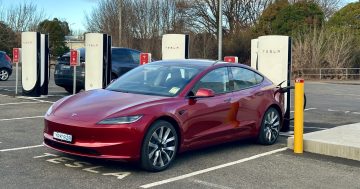
We can do the job: Industry wants to see charging consistency across power networks. Photo: James Coleman.
Governments need to clear regulatory roadblocks to unleash the development of electric vehicle charging infrastructure across the nation, a coalition of EV businesses says.
In a joint statement, the EV businesses say the private sector is being held back from investing in charging stations at a time when demand for EVs is surging as a result of the fuel crisis caused by war in the Middle East.
They say the private sector is ready and willing to spend billions of dollars providing the infrastructure necessary to give drivers confidence when they travel which, in turn, would increase EV take-up, reduce dependence on imported fuel and save consumers money.
This would mean a major expansion of both fast and destination charging to support EV uptake this decade.
But government should enable the market, not replace it.
Removing regulatory barriers would ensure a stable and competitive market, and unlock private capital, accelerating deployment while avoiding additional costs being passed on to households and businesses already facing high fuel and energy prices.
They are calling on the Commonwealth, state, and territory governments, and energy regulators to provide policy certainty, protect competition and enable a coordinated, partnership-led rollout of EV charging infrastructure.
To preserve investor confidence and avoid crowding out private capital, there should be a clear separation between regulated monopoly network businesses and the competitive public charging market.
This includes a moratorium on rule waivers known as ring-fencing and rule changes that allow monopoly power infrastructure companies (DNSPs), such as EvoEnergy in the ACT, to own or operate public charging assets.
DNSPs seeking changes argue they are better positioned to deliver cheaper charging services to EVs, but private operators say this will add an extra layer to the system and give DNSPs too much market power.
Kerbside charging company EVX chair Sean McGinty said the spectre of monopoly DNSPs, which control 90 per cent of the input costs of EV charging, entering the competitive EV charging market was slowing investment in EV infrastructure, perversely creating the problem they’re spruiking to be the saviour of.
“The French competition regulator has published warnings about allowing DNSPs entering the EV charging market, and the allowance of creating a middleman,” he said.
“We need to learn from the failures of other markets.”
Tesla said DNSPs had a vital role to play as enablers of market-led solutions, but they should not be permitted to act as default providers in the absence of proven market failure.
Industry wants connection processes streamlined and standardised across DNSPs, with transparent service standards and timelines, and improved data transparency.
EV-ready services would also address slow, costly and unpredictable connections, which are one of the biggest barriers to rollout today, it says.
What people pay at the charger should also recognise the value of smart, flexible charging infrastructure, including pricing models that support lesser-used sites, the use of EV owners’ own home solar generation, and efficient network use.
“Under the right policy settings, the private sector is ready to deploy billions of dollars of cumulative investment by 2030 to expand Australia’s charging network at speed and scale, and create the skilled jobs needed for building and maintaining this critical infrastructure and services,” the EV stakeholders say.

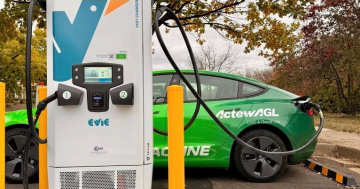
The government has been told that private companies such as Evie should be empowered to expand the EV charging network. Photo: Supplied.
They say the industry wants to work with government on site identification and deployment, including support for reserved bays and place-based rollout planning.
This would mean building a network with open access and interoperability, roaming models and easy-to-use chargers.
“The fuel crisis should be a catalyst for action,” the statement says.
“Industry is ready to invest. Government now needs to provide the policy settings that allow Australia’s EV charging network to be built bigger, faster and better.”
Smart Energy Council Chief Advocacy Officer David McElrea said the biggest barrier to rolling out EV charging at scale wasn’t demand or technology, but the system’s basic ‘plumbing’.
“We’re seeing wildly inconsistent connection costs and delays of up to two years, which is holding back investment that’s ready to go,” he said.
“If we fix connections, tariffs and pricing signals, private capital will do the heavy lifting – delivering charging faster and at lower cost to taxpayers and energy consumers.”
Evie Networks CEO Chris Mills said Australia needed significantly more charging infrastructure of all types.
“Evie is ready to continue investing at scale, provided policy and regulatory settings address the current barriers to deployment and support fair competition,” he said
The statement praised the Victorian Government for becoming the first jurisdiction to explicitly commit to removing barriers so the competitive market could deliver and welcomed the NSW Government’s recently announced EV Strategy as an initial step.