8 April 2026

Calls to power up charging infrastructure as EV sales surge

| By Ian Bushnell
Join the conversation
28

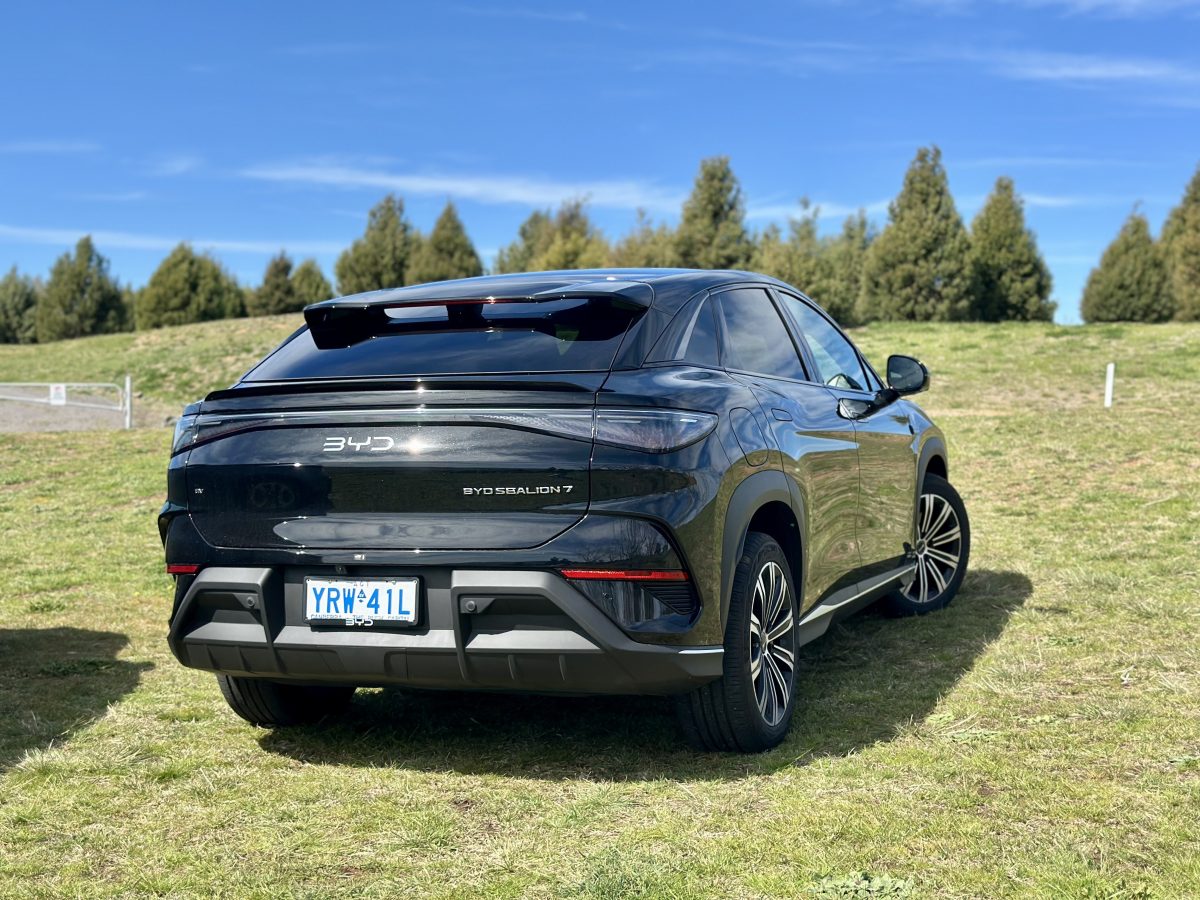
Popular: The Chinese BYD Sealion 7 ranked fourth in VFACTS vehicle sales in the ACT for March. Photo: James Coleman.

Industry figures have called for more investment in electric vehicle charging infrastructure, especially in the regions, after long queues at highway chargers marked Easter travel, and new figures showed a surge in sales in both new and used EVs.

The VFACTS sales data for March shows the number of Battery Electric Vehicles sold in the ACT was double that of the same month in 2025, reflecting a nationwide surge driven by the Iran war-induced fuel crisis.

One in five vehicles sold were BEVs, double the share of March 2025, with the BYD Sealion the fourth most popular choice among Canberra buyers.

Overall, actual vehicle sales were fewer than a year ago, down 78 units or 4.7 per cent from 1657 to 1579.

But BEV sales totalled 326 last month, up 155 or 90.6 per cent on the 171 sold in March 2025.

There were also 175 plug-in hybrids sold in the ACT in March, 11 per cent of sales, and 360 conventional hybrids (22.8%).

VFACTS does not report Polestar and Tesla sales, but Electric Vehicle Council figures show the combined number for these brands in the ACT was 95.

When these numbers are incorporated, a total of 1674 vehicles were sold in the ACT: 25.1 per cent were battery electric, 10.5 per cent were plug-in hybrid, and 21.5 per cent were hybrid. Around 43 per cent were internal combustion engines.

As of 6 April 2026, the ACT had 15,030 registered EVs, accounting for almost 4.4 per cent of all vehicles.

READ ALSO 'Significant structural shift': Price-sensitive car-buyers flick the switch to electric in August

The Federal Chamber of Automotive Industries said the latest release of VFACTS sales data showed EV sales increased significantly in March, reaching their highest share of the Australian market to date.

A total of 15,839 battery electric vehicles from all sources were sold in March, accounting for 14.6 per cent of total sales, compared with 7.5 per cent of sales in March 2025.

Chief executive Tony Weber cautioned the increase could be temporary due to fuel spikes, but if it was the start of a long-term shift, Australian governments would need to sharpen their focus on public charging infrastructure, particularly in regional areas and locations where home charging was not practical.

“Ensuring infrastructure keeps pace with consumer demand will be critical to enabling sustainable growth in EV adoption beyond short-term influences,” he said.

Mr Weber said the automotive industry would welcome a sustained shift to EVs, given its substantial investment in bringing more than 100 EV models to the Australian market and industry efforts to meet ambitious New Vehicle Emission Standards.

The Electric Vehicle Council said there needed to be a single national infrastructure plan that identified priority areas, planned the allocation of new chargers, and then staged accordingly.

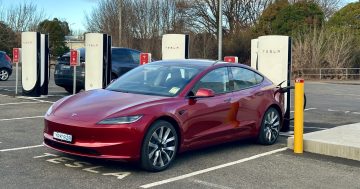
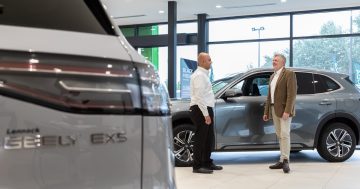
With sales and interest growing, the question is whether the multi-player charging network can keep pace. Photo: James Coleman.

The NRMA’s Peter Khoury agreed more needed to be done, particularly in regional areas where you do get high peak periods at Easter and Christmas.

Mr Khoury said there were challenges in building the network regionally in Australia that other countries had not had to face, such as access to the grid. EV take-up had been slower than elsewhere, and the infrastructure was catching up.

He said it wasn’t just a case for government and the network needed diversity.

“There are more players coming on to the market, there’s partnerships currently underway with federal, state governments,” Mr Khoury said.

“Across the country, there are private operators building charging stations.

“You want a lot of different people building fast charging that’s readily accessible and affordable.”

But Mr Khoury said building the network would be ongoing, just as fuel stations were still being rolled out.

According to the Electric Vehicle Council, EV sales were up 40 per cent in the first quarter of 2026, compared with the same period last year, for two leading brands.

Tesla and Polestar sold a combined 7725 vehicles in the first quarter of 2026, up from 5549 in the same period in 2025.

In March 2026 alone, Polestar and Tesla sold a combined 3645 new vehicles, with March sales growing 21.1 per cent year-on-year and up 6.6 per cent from the previous month, February 2026.

READ ALSO New EV sales continued to climb to record heights in 2024

The EVC said the March data also indicated the second-hand EV market was firming.

Second-hand EV sales in March for Pickles were up 60 per cent on February, and EV searches on the Pickles website jumped 163 per cent month‑on‑month.

New data from Pickles shows 82 per cent of used EVs were sold for under $50,000, with 43 per cent under $30,000.

The Commonwealth Bank reported that its lending data saw a 161 per cent lift in demand for EV finance since the start of March.

EVC CEO Julie Delvecchio said interest in EVs was growing rapidly, as people looked to save up to $3000 per year on running costs.

She said the market was at a tipping point and the numbers reflected a fundamental shift in how Australians thought about EVs.

“Volatile global oil markets are changing the conversation,” she said.

“Australians aren’t asking whether EVs are the future anymore. They’re asking which one they can get their hands on, and when.”

Ms Delvecchio said it was the wrong time to make changes to the Electric Car Discount, currently under review.

The EVC website saw almost 100,000 page views in the past month, up 71 per cent, with 97 per cent of visitors new to the site.

The Australian Automotive Dealer Association (AADA) said the new vehicle sales data highlighted a clear shift in consumer preferences.

BEV sales were up 42 per cent month-on-month and 92 per cent year-on-year, accounting for 12 per cent of total new vehicle sales so far this year.

Plug-in Hybrid Electric Vehicle sales reached 8215 units in March, up 40 per cent month-on-month and 40 per cent year-on-year, accounting for 7 per cent of total new vehicle sales for 2026.


Free Daily Digest

Want the best Canberra news delivered daily? We package the most-read Canberra stories and send them to your inbox. Sign-up now for trusted local news that will never be behind a paywall.
Loading
By submitting your email address you are agreeing to Region Group's terms and conditions and privacy policy.

Join the conversation

28
All Comments
  • All Comments
  • Website Comments
LatestOldest

Yes Mr Khoury, our recent trip to Melbourne a week ago(during the week) encountered one NRMA dual EV charger at Jugiong (good stop for lunch) and a dual charger at Holbrook (which we and two other drivers had to queue for an hour until after 5pm….nice Holbrook pub btw). Good thing we were retired and decided to stay over but the people heading to Melbourne and Sydney weren’t and had to be at work the next day. Maybe the NRMA could get onto the shortage of EV chargers on the Hume Highway. As for the Tesla only chargers at Holbrook….and other locations…really?

Well, while the Chargefox fast charger at Gundagai looks like it’s been shut down (why?), there’s always the 12 Tesla superchargers at Coolac which are open to non-Teslas. Plugshare is your friend.

Capital Retro9:20 am 14 Apr 26

Diesel is my friend.

One of the important issues around EV charging is around those who live in apartments having access to chargers. There are too many executive committees around #CBR denying access to owners on the basis of the false narrative of increased fire risk or increased insurance premiums. We want to buy an EV but, unless and until we have access to a charger which doesn’t involve queueing up, we won’t be doing it.

A Nonny Mouse7:24 pm 08 Apr 26

Charging at home is highly desirable. Buildings that don’t have it will be valued lower by buyers and tenants than buildings that do. You might be able to bypass an obstructive EC and put your own proposal to an AGM. An AGM decision trumps the EC. This site might help to reassure your fellow owners of your building that others are finding ways to add charging without the sky falling in. https://aeva.asn.au/act-ev-friendly-strata-complexes/

@A Nonny Mouse I’m a unit owner and find that most proposals for additional features in our complex will only benefit a few, not the majority of tenants/owners. However, all owners need to pay for the additional features. This is generally why such ideas fall over. EV chargers in unit complexes are but one example.

Mouse offers good advice.

Otherwise, this sort of resistance by an EC – which is supposed to represent All tenants – just shows how out-of-touch they may be. Many of those social media-driven myths have been debunked, and the claim that such an addition needs to benefit all tenants is short-sighted.

Besides, why can’t you plug a portable charger in to a power point in the garage? They’ll only draw a max 2.4 kW which is the same as powering a kettle (although you’ll need to charge the car overnight to get a decent top-up).

A Nonny Mouse12:02 pm 09 Apr 26

There are many different ways to do charging in a building as illustrated by the listing of EV-Friendly strata. What works best for one might not be the preferred option for another building. I agree that options that allow for incremental additions may have more success with some owners corporations. On the other hand, in some places, there may be support from owners to do it all at once. Each site really needs to look at what is possible both from an engineering point of view and for gaining support from owners.

Michael Pless3:42 pm 08 Apr 26

Better public charging infrastructure is always going to be welcomed, and I was in Holbrook on Good Friday where the NRMA chargers at the submarine had a queue into the road. A queue that was far shorter than the queue at a petrol stationi n Sydney recently. And as frustrating it must have been for those waiting in Holbrook, I checked chargers along the way and found there were vacant stalls on the road through Yarrawonga, Rutherglen, and Albury. I didn’t check Gundagai or other locations though. So although places like news.com.au and Sky (both the preferred sources for the brain-dead) may have sensationalised the situation, I’m unsure if it’s as bad as was made-out. That said, I can see no reason for charging bays not to be installed at highway/motorway rest stops – and even with long bays for those who tow. Yes, BEVs *can* tow and do a fine job of it, despite what the bigots might assert.

what time of the day did you see the empty chargers? asking for context

BEV buyers beware, between cheapest & dearest there are so, so many configurations be sure to read/study thoughtfully before making a could be costly mistake.

Gee, that sounds like buying a car.

It was ever thus.

As with many statistics, you can twist them to almost any message you like. It is clear that most families are rational and will buy whatever car suits their needs and is affordable, and that they will do so when they need to, not on a whim. Those that want to buy for environmental or other reasons have probably already done so, and there is nothing wrong in that. Either way, war or no war, as EV prices decline consumption will rise, so investment in highway EV charging is sensible and should be better coordinated than it is. Reliance on the private sector is fine where the commercials make sense, elsewhere, government has a role and public servants should already be on top of it. Woke distractions and vanity projects are not core government business, the issue here is their failures, not arguments about one or two percentage points in a clear trend toward more EVs.

A recent article on this site claimed that only 1.8% of all cars in Australia are electric.
Even if this was “out” by a point or two, it doesn’t show electric vehicles as being very popular.
I was selling cars in the late 70’s when the world went through a worse fuel shortage. You couldn’t give away a 6 or 8 cylinder car. Toyota sales boomed. Twelve months later, there was no fuel crisis. Everything was back to normal and so were the sales of large family cars. Falcon and Commodore sales exploded.
The current fuel crisis will certainly see an increase in EV sales. Maybe we will get to 5% ownership in Australia?

I have no doubt ownership will get to 5%, followed by 6%, 10% 40% etc.

If you do not want to believe the shift in people’s decisions, have a look at what is being built, product plans and government regulation around the world.

By the way Grosby, the oil crisis in the 1970s cut supply by 5%-7%. The American/Israeli war on Iran has cut supply by 20%. That is worse.

Axon. Based on your figures for the previous oil shortage, only one third of the current shortage, imagine how many more petrol cars will be sold when things get back to normal. Triple?
I don’t much care about what is being built around the world. If you do, then go and live there.
Nowhere in the world has the sparse population and huge distances that we have in Australia. We are unique. So are our vehicle needs.

Actually Penfold, you appear to be cherry picking with the headline. It’s a reasonable headline noting that sales have indeed increased, regardless of the reason.

But as to the probable reason, the current Middle East crisis has just reminded many people how reliant we are on non-renewable sources, like oil. It was just a matter of time that many would reach that threshold of thinking, now that many myths regarding EVs have been broken. So with the numbers of EVs increasing, it’s only reasonable that there’d be a call for more charging infrastructure, as well as access to dual infrastructure at existing petrol stations – charging stations alongside pumps for petrol. This is a very common in Europe already.

It’s a bit hard to cherry pick a headline Stuart. The point being the suggestion that sales have risen belies to longer trend. Which, notably, flies in the face of all the forecasts and predictions by EV proponents.

Regardless, while you’re right that there mightn’t be sufficient charging infrastructure (especially given the time charging takes), that reliance on oil extends to 90% of energy use in Australia and isn’t going away anytime soon.

If anything the fuel crisis confirms how ridiculous our anti-fossil fuel policies have been over two decades and how vulnerable we are to oil shocks. Energy security is national security and it doesn’t come from a reliance on Chinese solar panel imports.

The long term trend for EVs is up. Greater fuel security for people is found thereby.

China is not the sole source of solar panels, though it may be a good idea to build more of them ourselves.

Unlike fuel which must be resupplied continuously, solar panels keep working for decades even without new supply so about half our grid and more than half our households already have that advantage. Time enough to source from elsewhere or build manufacturing ourselves. We have all necessary materials.

So just to be clear here, EV sales have fallen almost 5% in the past 12 months. But because the March on March comparison showed a rise of 155 vehicles, we’ve got a headline reading “EV sales surge”.

Wow, that’s some impressive cherry picking.

An alternate headline could be “EV sales decline in past 12 months”.

Or, “Fuel crisis sees rise in March 2026 EV sales”.

Fudging Penfold fudges figures again.

The headline is true. EV sales comprised 7.5% of the market in March 2025 and 14.6% of the market in March 2026. That is a surge in both proportion and in numbers despite a 3.3% fall in total vehicles sold (all types).

EV sales were higher in 2025 than in 2024. That is growth.

On present trend EV sales will be higher in 2026 than in 2025. That is growth.

It is certainly the case that the fuel crisis has promoted EV sales, more than doubling enquiries as people recognise the value and security in electrifying their transport. Good point.

Fudging figures, lol. Axonomics strikes again ! Perhaps this part of the article was worth a read 🙂

“Overall, actual vehicle sales were fewer than a year ago, down 78 units or 4.7 per cent from 1657 to 1579.”

Lol Penfool whining about others funding figures, when foolish one can’t even manage to calculate simple percentages.

The inability to understand the difference between absolute numbers and percentages is clearly on show here too.

Penfold denied none of what I said.

He pretended by dodging, cherry-picking his period while ignoring proportions even in the figures he did quote.

All of my prior statements are correct.

The growth of EVs will continue along with other process changes. Economically, strategically, and environmentally, nothing else makes any sense.

Feel free to point out any “fudged figures” Axon. All numbers were quotes from the article or extrapolations thereof.

Maybe as always it’s worth reading the article first. 🙂

It continues that Penfold can deny nothing of what I said.

Penfold is fudging. I did not say he lied on this particular occasion; his implication I said so is another false distraction. Penfold is misrepresenting an increasing trend. He picks figures as if to show an EV trend decline while ignoring whole-of-market decline. He ignores proportions, which he has never handled successfully on any thread here anyway.

The headline is true. EV sales comprised 7.5% of the market in March 2025 and 14.6% of the market in March 2026. That is a surge in both proportion and in numbers despite a 3.3% fall in total vehicles sold (all types).

EV sales were higher in 2025 than in 2024. That is growth.

On present trend EV sales will be higher in 2026 than in 2025. That is growth.

Penfold works hard for the fossil fuel / climate denial lobby, just like some worked for smoking lobbies in the past.

What a jumbled word salad there Axon. Who would bother “denying” some of the silliness you post.

It is a simple fact that – as the VFACTS data shows – between March 2025 and March 2026 sales of EVs went down. So “on present trends”, your statement is false. The numbers might change in the future, who knows.

That these numbers conflict with your ideological beliefs is meaningless. Some people think if they make a statement enough times it must be true. Blackout Bowen does it daily.

“Some people think if they make a statement enough times it must be true.”

The irony.

Although on your account, there’s one thing you are better than Bowen at, as you do it every time you write a comment here.

Daily Digest

Want the best Canberra news delivered daily? Every day we package the most popular Region Canberra stories and send them straight to your inbox. Sign-up now for trusted local news that will never be behind a paywall.

By submitting your email address you are agreeing to Region Group's terms and conditions and privacy policy.