23 February 2026

Can Saul clean up this mess? It's worth a try

| By Ian Bushnell
Join the conversation
34
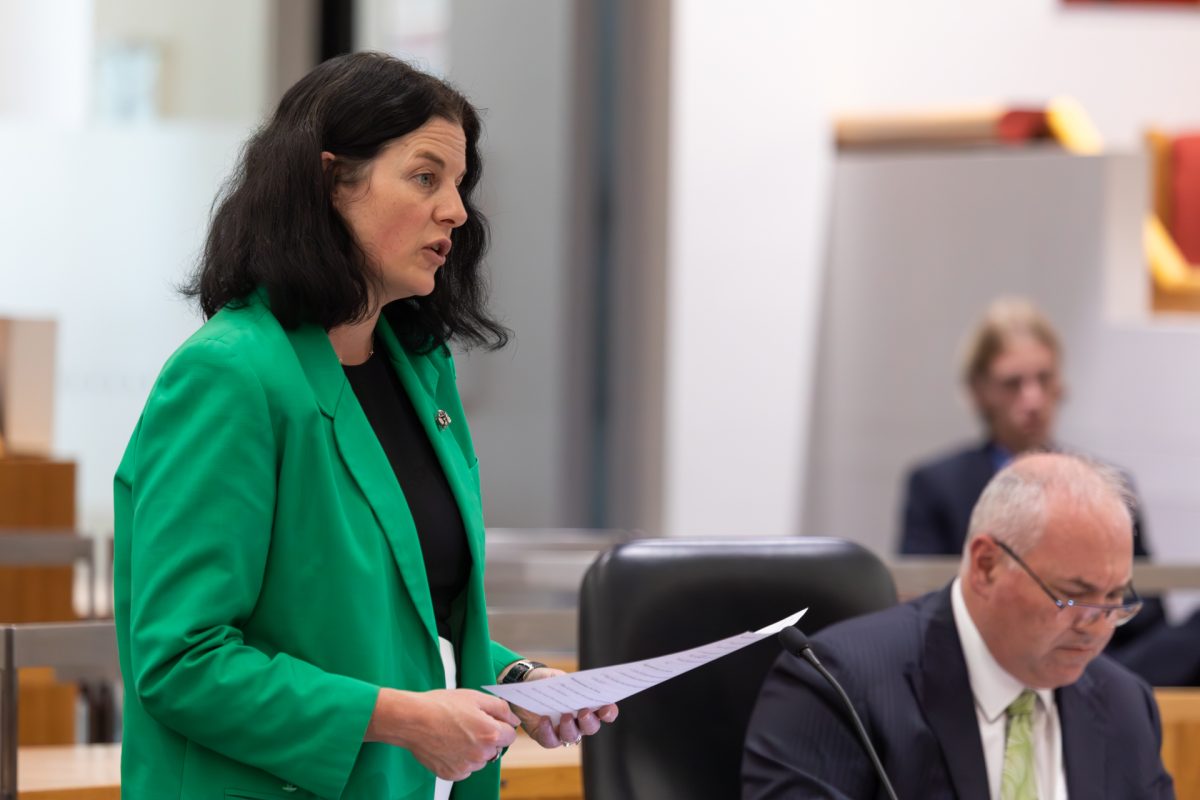
Woman speaking into microphone at a government hearing

Committee chair Jo Clay says an independent view of the situation will be valuable. Photo: Michelle Kroll.

At first blush, paying economist Saul Eslake $121,000 to review the ACT’s finances seems a waste of his time and our money.

His report runs the risk of sitting on a shelf gathering dust with all the rest if Treasurer Chris Steel finds his recommendations unpalatable.

These are likely to include increasing taxes or cutting spending (read services), or both, all of which have their opponents.

The chair of the Select Committee inquiring into the ACT’s fiscal position, Jo Clay, acknowledges this risk, but says just obtaining a view independent of government will be worthwhile, especially from an economist of Mr Eslake’s experience and reputation.

The inquiry itself is a political response to last year’s billion-dollar Budget deficit, with the strange bedfellows of the ACT Greens and Canberra Liberals both alarmed at the Territory’s deteriorating fiscal position and not accepting Mr Steel’s version of events.

The two may come at the finances from different perspectives, but it is in their interests to try to get to the bottom of the situation outside of the bureaucracy that has such a long association with Labor governments.

READ ALSO Racism at Aussie unis systemic, says Human Rights Commission

Ms Clay, tiptoeing around her role as committee chair and Greens MLA, believes commissioning an “accurate picture” of the financial position and what can be done to improve it will have enormous benefits.

Certainly, the inquiry will have much more clout if its findings are underpinned by such a report.

For the public, limited to government reporting framed by Treasury and the response from an underresourced opposition and crossbench, Mr Eslake’s report will be eagerly awaited.

External reports do emerge, such as those from the ratings agencies and last week the International Monetary Fund, which covered the states and territories but still resonated for the ACT.

But the Labor Government generally plays down warnings, cherry-picks data and reassures everyone the balance sheet and economy are strong, and the growing debt is manageable.

Yet structural problems remain as health and education consume bigger chunks of the budget and the government continues to implement its ambitious infrastructure program.

According to the Budget Review, the government’s repair job is working and the ACT is on the way back to surplus, not that this is a crucial goal in itself.

But it holds out the promise of a crisis averted without really dealing with the underlying problems.

And of course, the Labor surplus has been a mirage for many years.

It will be interesting to see what Mr Eslake makes of the ACT’s special situation as a small jurisdiction with a narrow revenue base and its reliance on Commonwealth funding.

For example, can it deliver the services and facilities its citizens demand under its current structure?

Does it need more Commonwealth help to negotiate a temporary period of updating infrastructure, given the ACT is now well into its second century?

Or does there need to be a reappraisal of Commonwealth funding? Mr Steel would certainly argue that the ACT is consistently dudded when it comes to GST payments.

But Ms Clay notes that the GST is no longer the growth tax it was touted to be, and would be looking, as a Green, for some vindication of her party’s stance on revenue options.

READ ALSO Immigration policy gearing up to be hottest issue of next election

No doubt all parties will take what they want from Mr Eslake’s report, and it will come down to the increasingly fluid dynamics in the Assembly.

Ms Clay says Labor’s minority position and the potential for non-traditional alliances mean the government won’t easily dismiss Mr Eslake’s recommendations.

After the recent revelations of coalition talks between the Liberals and the Greens, one should not make any assumptions about the year ahead.

Mr Eslake’s findings and the committee’s final report are due in July, after the Budget is handed down in June.

It would be best if the government took both seriously and the Assembly worked together to put the Territory on a long-term path to financial sustainability.


Free Daily Digest

Want the best Canberra news delivered daily? We package the most-read Canberra stories and send them to your inbox. Sign-up now for trusted local news that will never be behind a paywall.
Loading
By submitting your email address you are agreeing to Region Group's terms and conditions and privacy policy.

Join the conversation

34
All Comments
  • All Comments
  • Website Comments
LatestOldest
HiddenDragon10:55 pm 24 Feb 26

The Tasmania report had some forthright things to say about much more rigorous assessment of infrastructure spending proposals – a theme which could usefully be developed in the report for the ACT.

On a related point, and noting that Eslake’s revenue raising ideas for Tasmania are already largely in place in the ACT, special attention should be given to the interesting subject of an explicit value capture tax for the current and planned light rail lines – given that a seriously under pressure federal budget is unlikely to come to the rescue, and that ACT Labor has had to resort to what amounts to double-charging levies for more pressing matters such as emergency services and health.

Beyond that, the report really will need to take a closer look at spending than its Tasmanian precursor, which essentially relied on broad brush comparisons of spending to conclude that Tasmania was, if anything, under-spending and therefore taxes needed to go up – an approach which neatly sidesteps inconvenient questions about whether any jurisdiction is spending at efficient and sustainable levels.

I see the local Labor Hacks are out to make sure we know how bad independent review and oversight into the current government’s fiscal management is.

Of course, that’s only because they know that their persistent defence of the indefensible might come out looking quite silly when the recommendations point out the obvious failings.

I predict Saul Eslake’s $121,000 report will be along the lines of the recommendations contained in the ACT auditor’s report into the ACT’s financial statements which was tabled in the Assembly last December. The auditor undertakes financial audits of ACT finances annually and in accordance with strict commonwealth laws including the Financial Management Act and the Corporation’s Act. The report highlights the Territory’s financial performance, results of key accountability indicators and significant audit findings.

The audit team consisted of 31 auditors plus seven of Australia’s leading financial and accounting firms supporting the review including Ernst & Young and RSM. The audit report is available on the agency’s website.

The Greens should be hauled over the coals for this latest expensive stunt. I wonder what services or programs were cut to fund it.

” will be along the lines of the recommendations contained in the ACT auditor’s report into the ACT’s financial statements which was tabled in the Assembly last December”

Ah, there he is, already making excuses and muddying the waters with deliberate mistruths.

The ACT Auditor General’s report made no recommendations in this space because it wasn’t part of their role in the auditing of the financial statements.

Their key “findings” and “observations” simply highlight the woeful state of the Territory’s finances but do not go to the core reasons for that objectively poor and deteriorating position, nor what specifically should be done to fix it.

Although I would thank you for referencing the report, it seems to be the first time you’ve acknowledged how bad the finances are as the auditor’s findings outline.

I would, however, agree with you it would be a pointless excercise if Saul Eslake’s work does not go further than this.

But I think we both know it will, which is why you are so against it.

You “doth protest too much” Jack.

Who’s muddying the waters now? I suggest people read the report and its conclusion and make up their own minds.

Chewy, as usual flip flopping around now joining with the Greens in their endeavours to undermine the ACT’s independent oversight mechanisms and the Auditor-General in particular in his role scrutinising government finance and spending.

How is factual and consistent positions “flip flopping Hack?

You made deliberately false statements and were called out on it.

As usual, happy for you to provide a shred of evidence to back up your claims if you think you can.

But we both know that never happens, because you aren’t interested in facts or evidence.

One has to love chewy at his smug and arrogant best.

I used the term “recommendations” in my original comment rather than the word “conclusion” and chewy has latched on to it in his usual approach in putting down those he disagrees with and undermining their opinions. Now he is on a roll, accusing me of deliberately making false statements.

Roll on chewy!

Maybe chewy can explain to readers why the ACT’s powerful and independent oversight mechanisms, a part of our Westminister system, are not up to the task of keeping our government accountable. These oversight mechanisms include, but are not limited to, the ACT’s Ombudsman, the Integrity Commission and the Auditor General. There is also our parliamentary committee system streamlined live on the internet giving our elected members, from all sides of the parliament, the opportunity to question and scrutinise ministers and public servants on legislation, policy and public expenditure.

Hack with another long partisan diatribe instead of simply admitting he was wrong. It was ever thus.

As for why external expert advice is necessary or desirable, surely even Jack is not that dense to miss the benefits.

The ACT Government themselves have used similar reviews, its the lack of control of the outcomes that clearly has Jack worried.

Leon Arundell5:10 pm 23 Feb 26

Eslake will earn his $121,000 a thousand times over, if he can make Steel understand that it makes no sense to sign a $577 million contract for a project that offers only $150 million worth or benefits.

Maybe Jon Stanhope & Khalid Ahmed should have walked the talk and made a submission to the inquiry like the 18 other interested parties. Jo Clay keeps telling us that this is a “really really” important inquiry but submissions from the government only included one from the Treasurer who was the only representative of our parliament to do so.

Would be smart of Saul Eslake to also read the reports by Jon Stanhope & Khalid Ahmed on the state of the ACT Budget published in CBR CityNews.

Capital Retro3:42 pm 23 Feb 26

Wasn’t Jon Stanhope the prime mover of the National Arboretum?

And he also supported Actew’s investment in Transact Communications.

His commercial judgment is no better than that of the people he is criticizing.

To his credit, he wasn’t a supporter of of the Light Rail but then he didn’t go on the “fact finding tour” either.

Maybe Jon Stanhope & Khalid Ahmed should have walked the talk and made a submission to the inquiry like the 18 other interested parties. We are told that this is a “really really” important inquiry but submissions from the government only included one from the Treasurer who was the only representative of our parliament to do so.

Capital Retro5:30 pm 23 Feb 26

And how could I forget Stanhope’s Rhodium Asset Solutions debacle. They still don’t know how much ratepayers money was lost.

https://region.com.au/the-rhodium-scandal/3229/

jonathan gaul2:31 pm 23 Feb 26

Will the ACT take the lead in reversing the national spendathon? Dream on. The entitlement syndrome is too entrenched in the ACT’s dna. As is the penchant for public works that can never meet the benefit cost ratio – just like Melbourne’s Big Build Train to Nowhere. As for a Green-Liberal coalition – an Alice in Wonderland fantasy.

What an absolute waste of money and another stunt from the Greens and Jo Clay. A top-heavy review hatched with the Liberals and chaired by the Greens. A Greens party that was in a power sharing alliance with Labor for over 16 years and did absolutely nothing whilst in government. A party that was constantly in the news for its controversies including accusations of poor performance, inappropriate sexual behaviour and bullying, forcing a reshuffle and a Greens MLA to step down after being referred to police. A party whose leader stood up in the assembly every year during their 16 years in power sharing agreements with Labor, supporting the government’s budgets. A Greens party who lost two of its highest profile MLA’s at the last election for poor performance.

We have seen this all before, opposition parties using the same stunts, wasting their assemblies time for futile exercises by engaging high profile economist Saul Eslake to audit and review government finances. Reviews which are largely ignored and have been heavily criticised. Interesting though that Eslake made recommendations in his Tasmanian review recommending that the state’s Liberal government discontinue its crude savings measures, so beloved of conservative governments, including efficiency dividends and vacancy controls which were driving down state revenues and services. Eslake made recommendations in his review in line with the ACT’s reformed taxation system of increasing taxes to raise revenue and improve services by abolishing stamp duty over time and replacing it with broadly based land taxes, reforms which have been in progress in our city for the past 15 years.

Jack D – Anyone with at least half their brain functioning well would know that Barr’s government needs independent oversight by people who actually want to ensure wise spending in the ACT, instead of the massive waste on dodgy CIT contracts with sham consultants, IT systems that don’t work, public transport with exorbitant costs that leaves residents paying the highest rates in Australia, poor quality services in health & education.

Independent oversight psycho? Isn’t that what we should be getting from our parliament and the nine Liberals and the six crossbench members elected to our assembly?

Not to mention the ACT’s Integrity Commission, Ombudsman, Audit Office, Public Sector Standards Commissioner as well as ACT Legislative Assembly parliamentary processes and its Standing Committees. There are also many other independent oversight authorities, statutory offices, and committees designed to ensure accountability, integrity, and human rights compliance within the public service and government agencies.

I thought even those with half a functionining brain would know that!

Then there is our local media. Jon Stanhope and Khalid Ahmed have been having a pretty good go at ripping into the government and Andrew Barr in that disgraceful and grubby local magazine they write in but I note they were too lazy to make a submission to this current inquiry.

CBR CityNews covers many things that this one misses, providing valuable information in an extremely timely manner without the bias so commonly seen in other places. I suppose that is why you dislike it so much, aside from the fact that your favourite government can’t control the content.

and in 15 years Jack the Government has increased the burden of stamp duty massively for any Canberran buying an average house in dollar terms while the average rate payer is being slaughtered with crippling quarterly rates bills. Barr and co have sneakily and dishonesty used the power of bracket creep in house prices to increase the stamp duty take and the story is exactly the same with average land value thresholds …. bracket creep is working beautifully there as well, with more and more ratepayers pushed into higher brackets and facing higher rate bills even without the overlay of tax reform.

Crime n Punishment11:18 am 23 Feb 26

Long overdue reality report required.
@Ian it’s not a given that ‘cutting spending’ equates to ‘(read services)’ since we’ve seen $90m lost on cancelled ICT contracts (and no one held to account) and we’ve seen $200m overspend in health (not all directly related to increase patient activity – and no one held to account). There’s a very real opportunity to improve spending outcomes. Less spend + less waste = same services.

It’s a ten year turn around plan that needs new governance and independent oversight.

Revised Fiscal Sensitivity Framework:
Before designing the strategy, it’s worth anchoring it in the ACT’s own sensitivity analysis, which shows that a 1% shift in revenues or expenses swings the headline net operating balance by approximately $185–200 million per year. That number should inform every decision.

Phase 1: Stabilise (Years 1–2) — Stop the Bleeding
Infrastructure Investment: Tiered BCR Gating.

Projects below $20 million proceed under normal directorate approval, subject to existing budget envelopes. Projects between $20 million and $100 million require a BCR assessment of at least 1.2, conducted by Infrastructure Australia or an equivalent independent body, before any new commitment.

Projects above $100 million require a BCR of at least 1.5, independent review, and a tabling in the Legislative Assembly before commitment. Projects that cannot demonstrate a BCR of 1.0 or above are deferred until the operating surplus reaches $500 million annually — a threshold that signals the territory can genuinely afford to borrow for capital without compounding its structural deficit.

Light Rail Stage 2B sits squarely in this last category. Current ridership data and cost estimates make a BCR above 1.0 very difficult to demonstrate. It should be formally deferred, with the decision documented transparently rather than quietly shelved.
This gating framework would likely defer or cancel approximately $1.8–2.2 billion of the current IIP over five years.

And for all our current cautious conservative public servants, who know full well there inefficiencies in the system, but fear a liberal slaughter bath approach to savings…

The ACTPS headcount and wage bill is the single largest lever. The public service has grown faster than population, service demand, or any productivity metric. A combination of natural attrition management (not replacing a proportion of departures in non-frontline roles) and a genuine shared services consolidation — not the rhetorical kind that has been announced multiple times without execution — could realistically yield $200–250 million annually within two years without forced redundancies.

Capital Retro11:36 am 23 Feb 26

“forced redundancies”

This has to be the tautology of the century.

Why, Capital Retro? Have you not heard of voluntary redundancies, where a limited number of packages are offered to a group in expectation only some will take them up? Depending on the scale of reduction intended, these can be sufficient.

Capital Retro3:31 pm 23 Feb 26

Redundancy is when an employer no longer needs an employee’s job to be done by anyone.

In simple terms (for you) it means your job does not exist anymore and in some cases there are concessions made (tax) to employees.

Public service “voluntary redundancies” are a sham.

Capital Retro,
Its almost like there can be groups of employees doing functionally similar roles.

When a business or government determines that priorities have changed in an area and want to reduce a headcount, what methods could they use for these types of roles…..

Hmmmm.

Capital Retro, in still simpler terms you erred when you wrote “an employee”. As chewy14 points out, there can be a group of similar employees where headcount is to be reduced, not all eliminated, so individuals in the group may volunteer to accept an offered package.

This happens in both private and public sectors. Your inexperience shows.

@Capital Retro – The jobs are redundant and no longer need to be done so some staff have to go but the nature of the public service (and some large private companies) is such that they don’t care which people go as long as the right number leave. People can volunteer to leave whilst others stay. That’s a voluntary redundancy.

Daily Digest

Want the best Canberra news delivered daily? Every day we package the most popular Region Canberra stories and send them straight to your inbox. Sign-up now for trusted local news that will never be behind a paywall.

By submitting your email address you are agreeing to Region Group's terms and conditions and privacy policy.