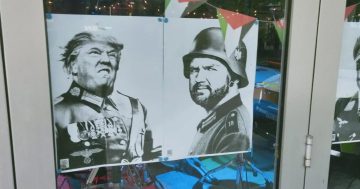

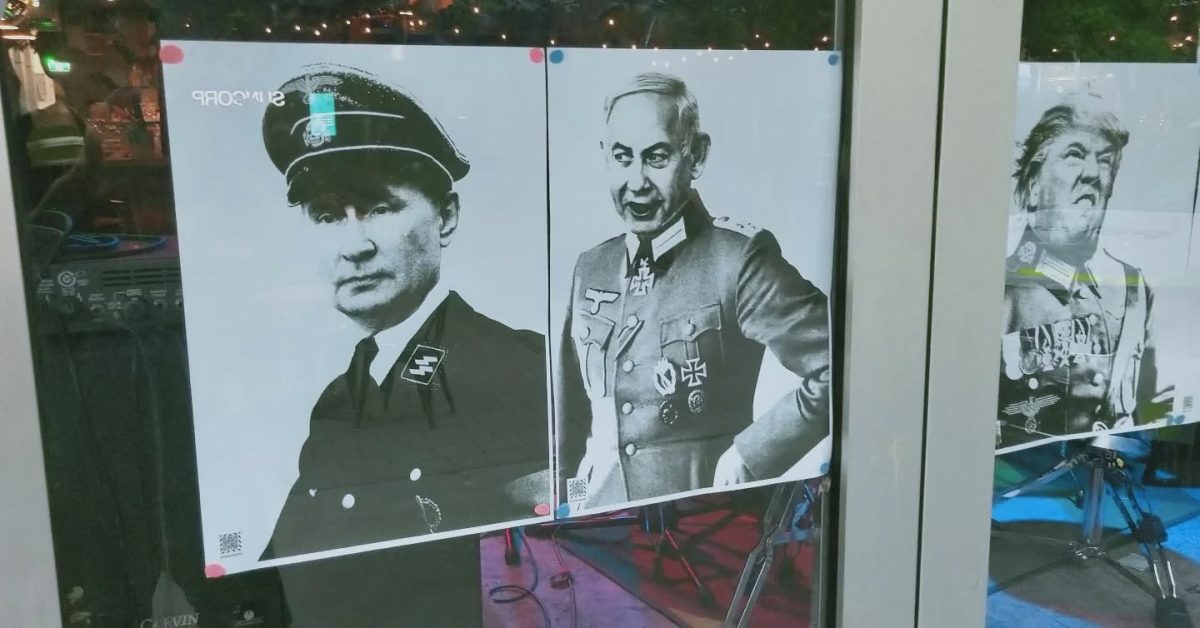
Dissent Café and Bar’s front window displaying the offending posters. Photo: Dissent Café and Bar.
We should thank the anonymous complainant who was offended by posters featuring a group of world leaders and a tech baron, depicted in German World War II uniforms, that adorned the front of a city bar.
It shows how absurd and dangerous the new anti-hate laws are, and how they could be used to stifle artistic expression and dissent, appropriately, the name of the City Walk bar, which became a crime scene on Wednesday night (18 February).
The artworks are nothing new, nor is the idea, but they make a point – whether you agree with it or not isn’t the issue.
The targets were a rogues gallery – Donald Trump, JD Vance, Benjamin Netanyahu, Vladimir Putin and Elon Musk. They all have plenty of form to attract this kind of attention, and you could add a few more to the list.
But just who was offended?
Was it a MAGA American? A Russian embassy official sticking up for the boss? A SpaceX admirer, angered that the great man was being made fun of?
My bet is it was the irony of an Israeli Prime Minister in a Nazi uniform that did it. It wouldn’t be the first time that Israel’s actions had been suggested to be similar to those of the regime that tried to exterminate the Jewish people.
And Mr Netanyahu is the subject of an arrest warrant issued by the International Criminal Court for alleged war crimes in Gaza.
He also has plenty of critics within the Jewish community and in Israel itself, where a corruption cloud still hangs over him. Being anti-Netanyahu should not be conflated with being antisemitic.
But it could have been just the sight of the Nazi insignia that sent the complainant off to the police.
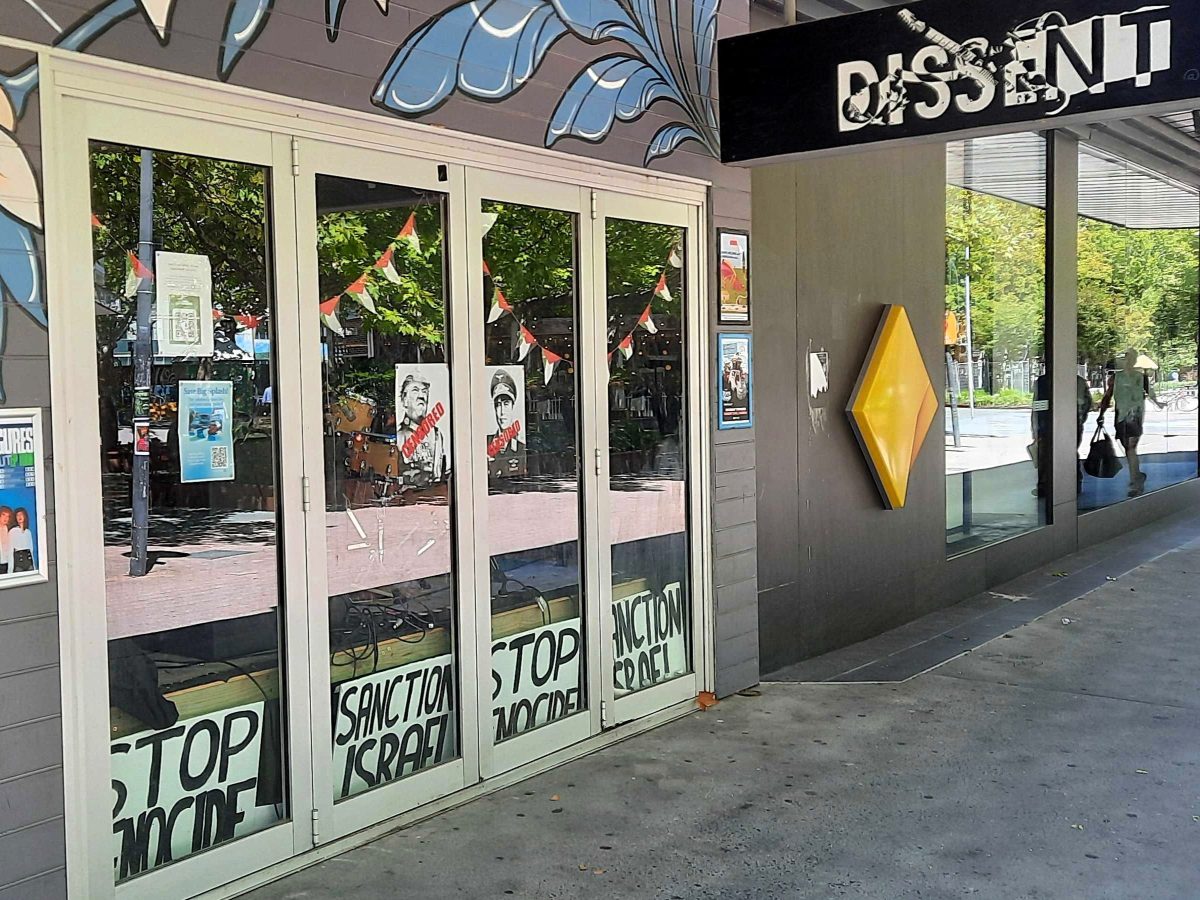
Dissent on Thursday with posters adorned with “censored”. Photo: Ian Bushnell.
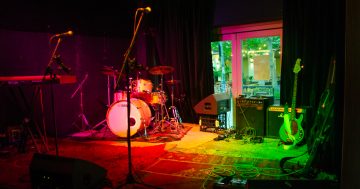
This heavy-handed police action – three uniformed officers and two detectives – not only confiscated the artworks but declared a crime scene and closed down the venue where a band was preparing to play.
Punters had paid for tickets, and the bar owner lost a night’s takings.
This was based on one anonymous complaint and police suspicions that the posters were illegal. They admit their legality was unknown, revealing that the law is too complicated or unclear for them to understand.
Yet there they were, doing exactly the kind of thing that the posters in their own unsubtle way were making a point about.
The police action was carried out under the Commonwealth’s Combating Antisemitism, Hate and Extremism (Criminal and Migration Laws) Act 2026, passed in a hurry last month after the Bondi Beach attack.
The laws expand offences relating to prohibited hate symbols, allow police to seize items displayed in public and increase penalties for hate crimes.
Under the legislation, it is an offence to publicly display a prohibited symbol. A police officer may seize an item “if the thing is, depicts or contains a prohibited symbol that is displayed in a public place”.
There are exemptions for “religious, academic, educational, artistic, literary, scientific or journalistic” purposes.
ACT law also makes it an offence to publicly display a Nazi symbol, but there is an exception if the symbol is displayed in opposition to fascism or Nazism.
That means that the police had plenty of discretion, but so sensitive has the issue become that they obviously took the more zealous approach.
Unfortunately, it shows how such legislation can be a slippery slope, giving the state the power to intimidate its citizens and deny their artistic and political freedoms.
This week, the winner of the satirical art prize, the Bald Archy, now an institution, was announced. It is a competition in which our political leaders and the rich and powerful are often the targets.
Winner Mark Davis said Australia’s democracy gave us “the privilege of both electing and critiquing our leaders, including through humour.”
This episode is a warning that satire may not be as safe in this country as once thought.
But were the laws intended to capture this kind of behaviour and waste police resources on a peaceful evening in the city?
I doubt it.
The bar owner wants his day in court. If common sense prevails, the police will retreat.
But the Albanese Government will need to take another look at the legislation to ensure it does what it is intended to do and does not trample on people’s rights, or waste police time and resources.