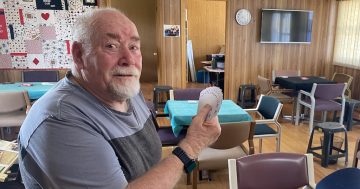


Canberra Bridge Club’s Catherine (Kate) Latimer and Steve Geddes. Photo: James Coleman.
If you’re already expecting to break your New Year’s resolution by mid-January, Canberra Bridge Club has a better idea.
“We suggest people skip the New Year’s resolutions that have them trying to lose weight or save money – they won’t stick,” committee member Catherine (Kate) Latimer says.
Instead, she suggests a hobby that can genuinely change your life: learn to play bridge.
And this summer, the club is going all-in. Beginning Wednesday, 7 January, it will run a six-week program of daytime and evening beginner classes, followed by several weeks of ‘fundamentals’ and ‘supervised play’.

Canberra Bridge Club boasts more than 700 members. Photo: James Coleman.
The goal: to grow its membership, draw in younger Canberrans and reclaim its place as Australia’s third-largest bridge club.
But the club’s pitch isn’t just about numbers. It’s about health.
Bridge is often described as one of the most cognitively demanding card games in the world. Research supports that playing complex, mentally taxing games can stave off cognitive decline – and bridge, according to those who play it, is about as “thinky” as it gets.
“I reckon my memory has improved because you do have to remember what the other players have as well, and they’re giving clues,” Kate says.
“I think it’s really improved that bit, and that bit can go really quickly. Your short-term memory is vital.”
Teacher and long-time player Steve Geddes says the social side might be just as beneficial.
“Keeping your mind busy is always an advantage in terms of cognitive decline,” he says.
“But also I think it’s the social side … you are forced to interact with a dozen pairs. You get such a broad mix of people you wouldn’t normally meet. And even if you don’t like them, it’s actually fine – it only takes 20 minutes and then they go on.”
Steve says for many older players, bridge becomes the anchor of their weekly routine.
“There’s a lot of people who play bridge four times a week and golf twice a week, and that’s their life.”

The wall of honour boards at Canberra Bridge Club. Photo: James Coleman.
Bridge can seem mysterious to anyone who hasn’t encountered it outside of a grandparent’s dining table, but Steve boils it down simply.
“You play in a partnership … two partnerships sit down at the table for four and play against each other,” he says.
“You have a single deck of cards … and every hand you play, you then pass to the next table and a different pair have to play exactly the cards you’ve played.
“So there’s no luck because everybody gets exactly the same cards … it’s very, very skill-based. It’s not like poker where you can have a lucky run.”

The club hosts its own competitions. Photo: James Coleman.
From a simple premise – the highest card wins – emerges a “wealth of tactics and strategies”, he says.
Despite its size, Canberra’s bridge scene is unusually large. With more than 700 members, Canberra Bridge Club is the fourth largest of Australia’s 342 registered clubs.
While bigger cities seem like obvious hubs, Steve says the capital’s geography gives it an edge.
“If you could whiz around Sydney in 15 minutes the way you can in Canberra, there’d probably be an 8000-member bridge club,” he says.
“Most capital cities have got a similar pool of players, but they’re much more localised because it’s so hard to get around.”
Kate offers another explanation: “I think there’s also a sense in Canberra of people being into `thinky’ fun. There are public servants, the institutions, the universities. That’s probably why it’s big in Adelaide as well.”
While the club’s demographic skews older, things are changing. Twenty-seven-year-old member Zara Chowdhury joined soon after moving to Canberra in 2023. Last year, she represented Australia in the under-26 women’s team at the World Youth Transnational Bridge Championships in Poland.
“Most people have heard of bridge from their grandparents … and don’t expect a young person to be playing,” she says. “A lot of the time it’s a reaction of ‘Oh my gosh, really?'”
For Zara, bridge has been a social lifeline.
“Moving to a new city, you’re looking for opportunities to create community… My partner Liam and I went along to a beginner’s course and were pretty much obsessed from the minute we started.”

Canberra Bridge Club player Zara Chowdhury. Photo: Zara Chowdhury.
And yes – Zara knows she’s also investing in her future brain health.
“I’m doing it for fun, but I am fully aware this is like a preventative measure when it comes to memory loss.”
Nationally, about a third of beginners are still playing a year after their first lesson – a retention rate the club says is strong compared with other hobbies.
For Kate, the message heading into 2026 is simple.
“Don’t save money, don’t lose weight. Come and play bridge,” she laughs. “Improve your brain, improve your memory, meet new people.”
Visit Canberra Bridge Club for more information on the 2026 beginner classes. A membership fee applies.