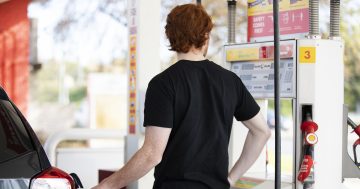
Canberra fuel prices are surging again. Photo: Michelle Kroll.
Pressure’s rising for another cut to the fuel excise as Canberra records the highest diesel and petrol prices in the country due to renewed conflict in the Middle East exacerbating supply issues.
The Australian Competition and Consumer Commission’s weekly fuel reports have reflected the jump in prices.
ACT Senate candidate Nick Tyrrell has written to the consumer watchdog (copying in Treasurer Jim Chalmers), asking for a please-explain on why Canberra’s prices are so much higher than the rest of the country’s.
“Canberra now pays more for fuel than Darwin. We’re not the most remote capital in the country,” he said.
“We’re three hours from Sydney on a major highway, sitting on the same supply chains as every other mainland city, and somehow this is the most expensive place in Australia to fill up a car,” he said.
The latest report outlined average petrol and diesel prices across major cities as of 9 September.
Canberrans were paying an average of 217.0 cents per litre of petrol and 271.0 cents per litre for diesel.
Darwin wasn’t far behind for petrol, averaging 215.0 cents per litre, but diesel cost only 258.6 cents per litre.
By comparison, Sydney outlets were charging an average of 208.2 cents per litre for petrol and 252.8 cents per litre for diesel.
Mr Tyrrell has also called on the ACCC to outline what steps it was taking to improve competition in the ACT’s retail fuel market.
“This isn’t a statistic for tradies, delivery drivers and small business owners [in Canberra] who put fuel in their vehicle every single day, or for families already stretched by some of the highest costs of living in the country,” he said.
“Every extra cent per litre comes straight out of the weekly budget.”
An ACCC spokesperson confirmed it had received Mr Tyrrell’s letter and that he would receive a response “in due course”.
“The ACCC continues to take a range of actions on fuel-related issues, including delivering weekly reports that provide transparency around price movements and their influences,” they said.
“We do not comment on potential investigations.”
Historically, fuel has often been more expensive in Canberra than in other major cities.
The ACCC has previously pointed to several reasons why this might be the case, including fewer independent fuel retailers, less competition, Canberra’s distance from fuel refineries and the city’s relatively high average incomes.
Petrol prices typically move up and down in Australia’s largest capital cities (known as petrol price cycles), but this doesn’t occur in Canberra, Hobart or Darwin.
Earlier this year the ACT introduced legislation to force fuel retailers to report their supply information. It also introduced harsher penalties for price gouging.
The fuel excise discount ended on 3 August and the Commonwealth has since remained firm that it won’t introduce such a measure again anytime soon.
Energy Minister Chris Bowen told the ABC on Monday evening (14 September) that there were no immediate plans to bring in a second cut.
“We were very clear that [the original excise] was a temporary measure. It’s not the only cost-of-living measure that we put in place. Obviously, tax cuts, cheaper medicines, free TAFE, etc, right across the board and so we’ll obviously continue to focus on those other measures,” he said.
“We’re not going to respond to every daily movement on the world oil price.”
Deputy Prime Minister Richard Marles told News 24 there weren’t any plans for more fuel relief.
“There is literally news [about the changing situation in the Middle East] every day and I think it’s important to take a step back and to just get a sense of how this is playing out over a slightly longer term,” he said.
The ACCC encourages people to shop around to find the best fuel price deals. Consumers can report issues to the ACCC.