6 March 2026

Canberra Liberals could find a rails run to 2028 election by accepting the 'tram'

| By Ian Bushnell
Join the conversation
93
Alinga Street light rail stop

The Canberra Liberals could learn to love light rail. Photo: Michelle Kroll.

Have the Canberra Liberals finally decided on a nuanced position on light rail?

It’s looking like that after leader Mark Parton teased this week that the party had not arrived at a position on light rail, or the tram, as the Liberals have labelled it pejoratively over the years.

After yet another election loss in which they declared their opposition to light rail, in the 2024 iteration Stage 2B to Woden, Mr Parton has left the door open to not going into the next campaign weighed down by a commitment to axe the multi-billion dollar transit project.

That may not mean the Liberals have fully embraced light rail, but it is an acceptance of two realities.

The first is that Canberrans, on the whole, like light rail, want a network to be built across the city, and four election losses in a row show it’s time to stop flogging a dead (iron) horse.

The second is that by October 2028, Stage 2A will be up and running (it will be popular), approvals for Stage 2B will be in place, and the Labor Government may have signed contracts for the project.

READ ALSO Parton reveals new light rail stance; Barr rejects infrastructure spending caps

The Liberals would be loath to abandon the project with so much of the lead-up work already done, and tearing up contracts would expose the Territory to significant compensation costs and undermine industry trust in government.

But this does mean that in the two and a half years until the election, while Mr Parton will be able to hammer the government on the (unknown) cost of light rail Stage 2B, and therefore transparency, it’ll be harder to use the tram as an example of spending profligacy.

It was significant that Mr Parton made the light rail comments in the context of the budget crisis and the inquiry into fiscal sustainability, in particular, economist Saul Eslake’s initial assessment of the ACT’s finances.

He highlighted Mr Eslake’s finding that, over the past decade, ACT Budgets had included ‘capital initiatives’ totalling at least $5.7 billion, which have been entirely funded by debt.

Referencing light rail, Mr Parton said the Liberals would be examining the business case extremely robustly when it came out, “because there are a lot of things that we can have as a Territory that we’d like to have, but given the state of the finances, we really have to examine how it fits into that envelope.”

But he also said his party would be examining infrastructure spending in the future.

“I’m sure Labor will be examining them as well, but unfortunately, when it comes to projects like the tram, they’re so far down that rabbit hole that it would appear that they’re unable to get out of it,” he said.
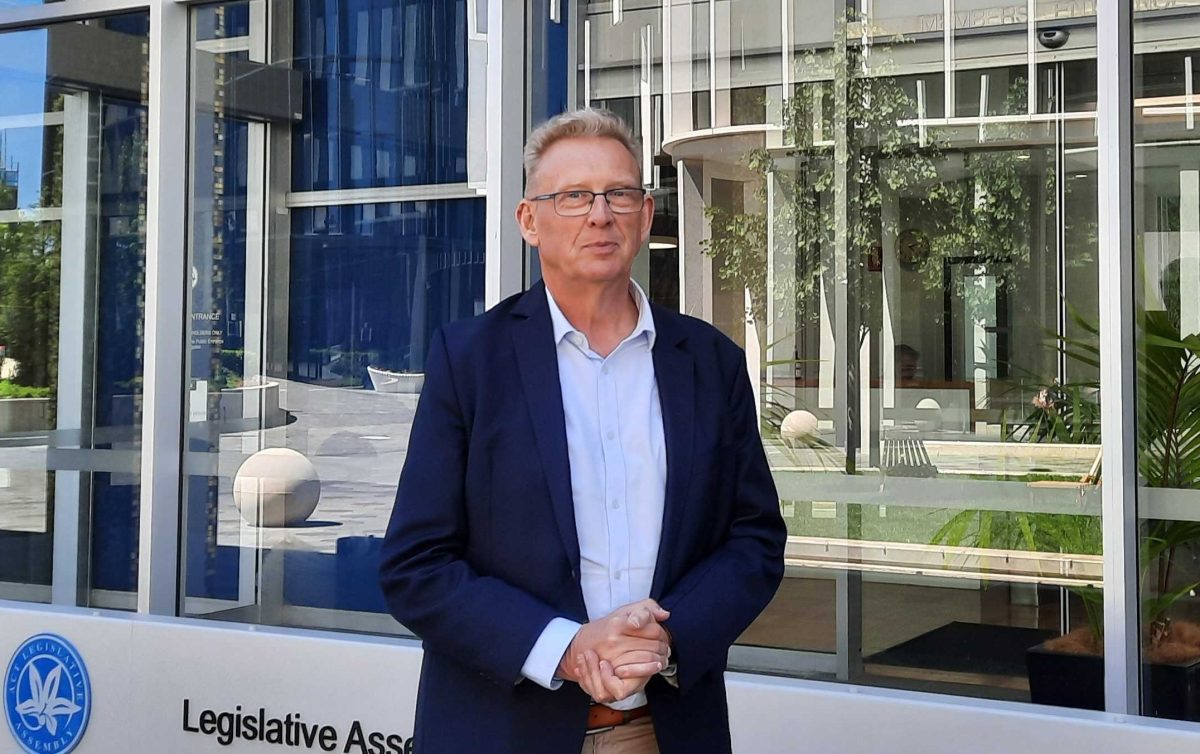
ACT Opposition Leader Mark Parton said the Liberals would be closely examining the business case for light rail. Photo: Ian Bushnell.

Mr Parton probably recognises that a Liberal government is also going to be stuck with light rail, and a much smarter way to approach the issue is to focus on the government’s budgetary practices, its spending, and to promise to restore order to the ACT’s finances, including the management of the light rail project.

It’s anti-light rail base may not like it, but the Liberals are not going to win government just by pleasing rusted-on voters.

READ ALSO Health-first approach may see light rail Stage 2B pushed into the 2030s

The other factor that has emerged this year is how the state of the budget and lingering bitterness have pushed the ACT Greens closer to the Liberals.

Despite both parties, at least on the surface, pulling back from any notion of a coalition or governing agreement after widespread horror at the prospect among members on both sides (mainly the Greens), this issue has not yet played out fully.

If there was one key policy difference that has stood out for more than 12 years, it has been light rail, the Greens’ baby and the Liberals’ bête noir.

Remove that, and there’s one less issue to separate them.

Letting go of its opposition to light rail would broaden the Liberals’ appeal, signal that they were forward-thinking, and give them clearer air to prosecute the case against an increasingly vulnerable Labor over its economic and financial management.

Free Daily Digest

Want the best Canberra news delivered daily? We package the most-read Canberra stories and send them to your inbox. Sign-up now for trusted local news that will never be behind a paywall.
Loading
By submitting your email address you are agreeing to Region Group's terms and conditions and privacy policy.

Join the conversation

93
All Comments
  • All Comments
  • Website Comments
LatestOldest

What has been the return on investment for the North link ? All the budgets eggs in the one basket for light rail whilst other critical services decline …….i love seeing my rates go up for the benefit of inner city residents whilst everyone else is forced to navigate the rest of Canberras healthcare , schools and unkept facilities

Another 7 more terms of Barr ..yes please ….

Bill Gemmell8:23 am 10 Mar 26

At $3 per litre for fossil fuels, the household economic case for light rail will only strenthen. No point arguing EVs will do the job, because they just aren’t “there” yet.

The case for public transport alternatives to light rail would also strengthen.

If only the Government would conduct a proper options analysis.

Leon Arundell8:36 pm 09 Mar 26

Why should anyone “accept” a multi-billion dollar public transport project that the government expects will add 10 to 15 minutes to Woden-Civic public transport travel times, and will reduce the Territory’s public transport travel by 5%?

Capital Retro8:10 am 11 Mar 26

Because light rail isn’t public transport, it’s a tool in the government’s urban renewal concept.

Personally, I think the Light Rail doesn’t stack up economically. I like travelling on it when I need to and would likely not take a bus if it wasn’t available. From a whole of Canberra perspective, I think Light Rail is supported because it is seen as Canberra going ahead where as the Libs stance has always seen as anti progress. Like it or not we have Self Government and they’re not a local council so big ticket items built for the future should be on the agenda. Acknowledging Light Rail expansion will win Libs votes. Those who don’t like it are unlikely to vote Labor because of it in any case.

HiddenDragon9:35 pm 07 Mar 26

The crucial phrase in the remarks quoted above from Parton is “so far down that rabbit hole” – that is not particularly nuanced (nor should it be) and it certainly does not suggest a stance which would preclude the Liberals from using the tram/light rail as an example of spending profligacy – which it is, when it comes without any honest acknowledgment from Labor about the trade-offs involved in their blatantly political pursuit of this project.

The interim report from Eslake coincides with clear views from the ACT Auditor-General about the state of the ACT’s public finances, the limited scope for even higher taxation and the consequent need to get spending under control.

That means choices about spending priorities, and if some have effectively been ruled out by the commitment to this project, Labor needs to answer for that – particularly to the many voters who they have blithely led to believe that it would somehow magically pay for itself or that the costs were so small in the scheme of things that no trade-offs were required.

Pejoratively?

Has Ian looked at the traffic lights with a big “T” on them??

Another day, another glowing light rail piece from Canberra’s number one journalist tram fan, Ian Bushnell. This is not journalism, it’s promotional material.

A few key facts never seem to make it into his articles. For example, the Canberra Liberals actually supported the tram network at the 2020 election and still lost badly. The idea that every ACT election is a referendum on light rail just doesn’t stack up.

Then there’s the business case. Passenger numbers for stage 1 haven’t come close to what was promised, and the return on investment that was used to justify the project for both stage 1 and 2A have been heavily questioned by the ACT Auditor-General.

And of course the exorbitant cost. The 2A project has ended up far more expensive than originally promised, which is a pretty important detail when we’re now being asked to spend billions more extending it.

None of this means light rail can’t exist or operate. But pretending it’s been an unqualified success while ignoring the costs, the missed projections and the Auditor-General’s concerns isn’t really journalism, it’s cheerleading. Region readers deserve a more honest conversation about whether the project has actually delivered what was promised.

Its quite amusing that after the release of the interim Eslake report this week, the compliant local media is still pushing this angle around unviable projects.

The only way this project goes ahead is if the Feds fund most of it, completely outside of the well defined infrastructure funding processes.

When you’re in a big hole, it’s best to stop digging.

What would members of the ACT Liberals do, if the ACT Liberals stop opposing the tram?

I thought it was a condition of membership of the ACT Liberals to write at least four letters a week to City News, Canberra Weekly and the Canberra Times opposing the tram.

The ACT Liberals will also lose the opportunity to recycle thousands of the Stop the Tram cornflutes in the next ACT election.

Saul Eslake has just said that $6.3b of the current approx $10b debt wouldn’t be there if the ACT government had made good decisions. Given the 2024/25 interest bill of $500m, that means we’re stuck paying $300m p.a. more than we should. Spending on light rail to date must be included in those bad decisions as even the ACTPS advised stage 1 was comparatively too expensive for what it delivered vs BRT along the same route.

The construction cost for 2A has already blown out from $570m to $680m in the last year or so, keeping in mind there’s also something like $1b of additional associated costs as Elizabeth Lee was able to learn through FOI prior to the 2024 election. Stage 2B which has to include a new bridge over the lake will likely come with a full cost of $3b or more which we just don’t have. It’s hard to believe the Liberals, who are rightly making a big song and dance over the state of the finances, would sign themselves up to such spending when we also have to build the new hospital which will likely come with a price tag of $1.5b or more.

Bushnell says the Liberals need to support light rail because it’s popular, but the populist vote buying of Labor is why we’re in a huge financial mess. Let’s not forget the Liberals won 33.4% to Labor’s 34.1% at the 2024 election. That was at a time when Labor had hidden the true state of the finances from the public. There’s also the much delayed Kingfisher report that should have been released before the 2024 election. Many Canberrans like to say they value integrity in politicians. Its findings, which are tipped to be highly critical of ACT Labor, will be a real test for the electorate.

Daily Digest

Want the best Canberra news delivered daily? Every day we package the most popular Region Canberra stories and send them straight to your inbox. Sign-up now for trusted local news that will never be behind a paywall.

By submitting your email address you are agreeing to Region Group's terms and conditions and privacy policy.