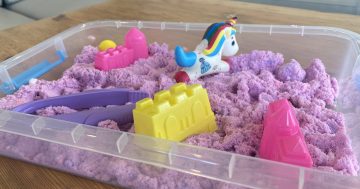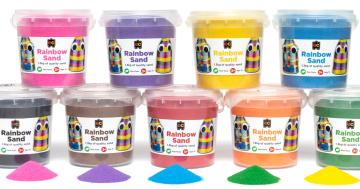

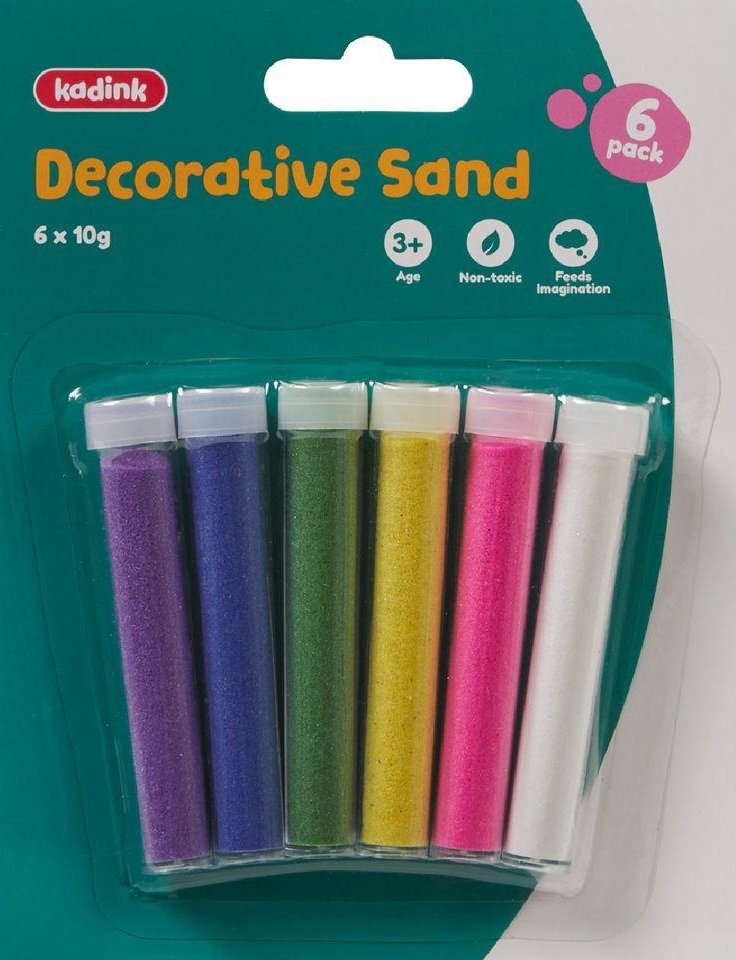
WorkSafe ACT has thus far tested Kadink decorative sand found in Canberra, confirming the presence of asbestos. Photo: ACCC.
Canberrans concerned they have potentially contaminated coloured sand in their homes are now allowed to dispose of it themselves – under certain conditions.
Amendments to the Work Health and Safety Regulations 2011 and a subsequent Ministerial Declaration, effective from 3 December, deemed “the removal, cleaning and disposal of recalled coloured sand products” to be minor work that could be carried out by a competent person.
“A competent person is a person who has completed the training set out in section 445A of the regulation, a licensed asbestos removalist or a person who has completed equivalent or higher training,” according to a WorkSafe ACT statement.
But this is only for a person conducting a business or undertaking (PCBU) and when the product is found in a business.
Advice is to isolate and restrict access to the area containing the substance (isolation should include turning off air conditioners and ceiling fans in the potentially contaminated area and closing windows and doors), and to seek guidance from a competent person who can outline steps for a safe clean-up.
“This may require engaging a licensed professional (licensed asbestos assessor and/or licensed asbestos removalist) to ensure the process is carried out safely and correctly,” WorkSafe ACT stated.
For homeowners, the advice differs depending on if the sand product is sealed or has been opened.
Potentially contaminated products still sealed should remain unopened, put in a 200 micron plastic waste bag (or suitable container) clearly labelled with a warning sign indicating asbestos waste. It can be disposed of at an appropriate asbestos disposal facility.
To get rid of unsealed coloured sand, you can either contact a competent person for advice, or clean the potentially contaminated areas yourself.
If you choose to clean:
- wear disposable gloves tucked into elasticised cuffs of your clothing, or tape down the cuffs to create a proper seal
- wear a P2-rated face mask that fits snugly and covers half your face. Don’t use a standard dust mask
- wear protective eyewear such as safety glasses
- spray the area to minimise the potential to generate any dust and remove it with a wet cloth, wet wipes or wet paper towels
- remove your gloves and wipe your hands. Before removing the mask, wipe it with a wet towel or cloth to remove any potential fibres. Wash your hands again
- place all products, wet cloth/wipes/paper towel, gloves and mask into a 200 micron plastic bag (or suitable waste container) labelled appropriately and take to an approved disposal facility
Small quantities of asbestos can be disposed of at Mugga Lane and Mitchell resource management centres for no cost. Packages must be identified to facility operators at the weighbridges on arrival.
The 200-micron disposal bags are available from hardware and safety supply shops. WorkSafe ACT can also provide them to anyone who believes they may have bought the potentially contaminated product.
WorkSafe ACT has also provided more information about the testing of products taken from ACT public schools.
“Further testing of Kadink Decorative Sand (10 g, six-pack), via transmission electron microscopy (TEM), has confirmed asbestos contamination in five coloured sand samples: purple, blue, green, yellow and pink … [it] contains tremolite and chrysotile asbestos,” a statement read.
“The risk of harm due to exposure to traces of chrysotile and tremolite remains low. However, advice remains not to use the product and avoid any contact with potentially contaminated material.
“Testing on the white sand sample did not confirm the presence of asbestos. WorkSafe ACT has not conducted tests on any other brand or container size of decorative sand.”
The ACCC continues to issue recalls of coloured play sand products. The ministerial direction covers any coloured sand products recalled because it may contain asbestos. The recall concerns products that identify China as the manufacturing country.
If you have questions or need help acquiring disposal bags, email WorkSafe ACT: WorkSafe_Asbestos@worksafe.act.gov.au