5 November 2026

Canberra's EV numbers soar past 20,000, but can chargers keep up?

| By Naziya Alvi Rahman
Join the conversation
12
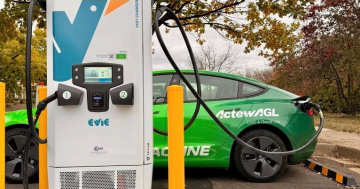
A new fast EV charging station at Emu Bank in Belconnen

A new fast EV charging station at Emu Bank in Belconnen. Photo: Naziya Alvi.

Nearly 7000 electric vehicles have been added to Canberra’s vehicle fleet in the past year, increasing the demand for public charging stations, particularly among apartment residents and renters who cannot easily charge their cars at home.

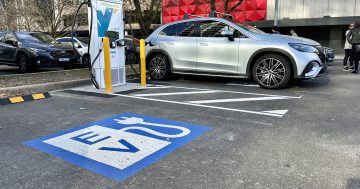
On Wednesday (4 November), the ACT government opened two new EV charging sites in Belconnen, bringing to 12 the total number of fast-charging bays across Emu Bank, Charnwood Shops and Lakeview Square.

The expansion comes as EV registrations in the ACT have passed 20,000, up from 13,300 a year ago.

More than 40 per cent of new vehicle registrations last month were electric, according to the ACT Government.

The government has promised another 90 public charging bays across Canberra over the next few years, but has yet to confirm when they will be ready or where they will be located.

Asked about the timeline, Climate Change, Environment, Energy and Water Minister Suzanne Orr said the government would consider demand, suitable locations and electricity network capacity.

“We’ll continue to work through where we roll out the chargers to, looking at where there is a geographic need, where we have capacity in the network, and where we have the sites,” she told Region.

READ ALSO Who pays to charge the car? Canberra apartment blocks grapple with the EV question

Canberra currently has about 330 public charging bays, but access remains a challenge for people living in apartments, particularly renters who cannot install their own chargers.

Under ACT laws, owners corporations cannot unreasonably refuse requests to install EV chargers. However, Ms Orr acknowledged that retrofitting existing buildings could be complicated, with each requiring different solutions.

She said the government is offering technical advice through its Sustainable Apartments Program.

Paul Wayper, from the ACT branch of the Australian Electric Vehicle Association, said the Emu Bank station would help residents who depend on public charging.

“Some of the apartment buildings in the area have more than 70 per cent of residents renting, and so EV charging may not be provided in these buildings for the foreseeable future,” he said.

Mr Wayper said the association had established a register of 39 apartment buildings and strata organisations that support EV charging, allowing others to learn from their experience.

He said some owners corporations were willing to install chargers but needed advice on managing electricity costs so individual residents paid for their own usage.

The association is also working towards organising an open day where strata representatives can see charging systems operating in other buildings.

While installing a charger at home remains the cheapest option, Mr Wayper said public fast charging could still save motorists money compared with petrol.

According to the association’s calculations, driving a typical petrol car costs about $14 per 100 kilometres, compared with approximately $12 using some of the most expensive public fast chargers. Charging an EV at home could reduce that cost to around $3 per 100 kilometres.

Mr Wayper said the savings were helping explain why more Canberrans were switching to electric vehicles despite higher electricity prices.

SolarHub chief executive officer Benn Masters also linked the rapid uptake to petrol prices, saying EV adoption had exceeded expectations over the past year, “driven primarily by the fuel price”.

Mr Wayper said Canberra needed more than fast chargers.

He also called for additional slower AC chargers at shopping centres, where motorists could leave their cars charging while running errands, and more highway charging facilities for longer trips.

Tired of getting taken for a ride at the dealership? Download our free car loans e-book

The new Belconnen sites include accessible charging bays developed in consultation with disability advocacy groups.

However, these bays are not reserved exclusively for people with disability parking permits. Any EV driver can use them, with signage asking motorists to give priority to those with disabilities.

This means drivers who need the additional space must rely on other motorists respecting that priority.

Despite the rapid growth in EV ownership, charging operator Evie Networks said its ACT network still had spare capacity.

Evie Networks chief operating officer Geoff Brady said the company was handling about 13,000 charging sessions a month, with chargers in use about 15 to 20 per cent of the time. Drivers typically spend 20 to 30 minutes at a fast charger, adding roughly 200 kilometres of range, depending on the vehicle.

However, he could not estimate how many vehicles each new Belconnen charging station would serve daily.


Free Daily Digest

Want the best Canberra news delivered daily? We package the most-read Canberra stories and send them to your inbox. Sign-up now for trusted local news that will never be behind a paywall.
Loading
By submitting your email address you are agreeing to Region Group's terms and conditions and privacy policy.

Join the conversation

12
All Comments
  • All Comments
  • Website Comments
LatestOldest
Bruce Churchill9:52 am 06 Nov 26

Bravo ACT Government. You have done a fine job of getting us off fossil fuels and you started the process well before the mad Trump war in the ME making fuel more expensive for everyone. Imagine if the entire country had started towards EVs a decade ago, then we would hardly be affected by world events. The short sightedness of those not wanting to transition is just sad. We have to start somewhere and our government started years ago. For that I think we can thank the Greens and Labor. They have had their incompetencies but overall they have been more positive for the future of this city than any other party.

Trying to save the world by being stupid

Another article complaining about apartment complexes and EV charging!

Owner’s Corporations seem to cop a lot of flack about their reluctance to allow EV charging. Unfairly.

Seriously, the issue is financial. Even the most basic trickle charger routed back to an owner’s electrical account would costs a few thousand dollars, and obviously the apartment owner would need to meet that cost. The bigger issue is that an OC would need to make proper provision for others to do the same?

It’s the upgrade to the complexes entire backhaul that costs the big money. From what I’ve read, it’s somewhere in the order of $5,000 per apartment (across the whole complex) and some would have other issues like gas boilers for not water and you’d need to make provision for both which could raise the costs further.

The costs to do all of this would need to be met via a Special Levy on all owners.

Realistically, those without an EV are unlikely to shell out – say $5,000 for the benefit of others. Landlords are unlikely to shell out, and in many complexes, half of the apartments could be rentals.

These decisions don’t get made by the Strata company or the Executive Committee on behalf of the Owner’s Corporation, as an entity. (Every apparent owner is part of the Owner’s Corporation).

Decisions are voted on by individual owners. It’s a majority rule situation.

It’s no different to swapping out has cooktops for Induction. Sure, one Induction cooktop isn’t going to cause an issue within the complexes electrical capacity, however a couple of hundred all drawing the higher current of an Induction during peak, and people might wonder why their lights are flickering.

I think even the concept of “free” loans are unlikely to sway many.

While we live in a complex, it’s part apartments and part townhouses. We are in a townhouse and potentially could disconnect our own gas and install Induction cooking and a heat pump style hotwater.
I enquired thru ACTEWAGL and discovered it’d cost me $1,000 to remove the gas line and $4-5,000 for a heat pump, then there’s the cost of the Induction and installation, and maybe upgrades to my circuit board?

The financial cost is simply out of reach. Sure, there is the “interest & free” loan scheme, but the way I look at it, it’s cheaper to just stay on gas. The financial savings are too far down the track to make it worth considering, assuming the new appliances don’t need replacing before we break even.

So yeah, people need to be realistic their expectations.

Retrofitting existing complexes is difficult and expensive. Maybe when 50% of owners drive an EV, they’ll have the numbers to
out-vote, and force non-EV owners to pay for the complex upgrade of their complexes.

Expect some very firey AGMs.

Capital Retro8:15 am 05 Nov 26

Why are EVs allowed to have their driver’s window heavily tinted?

You mean like other vehicles operating under exactly the same laws?

Why do your knees always jerk in that way?

A Nonny Mouse11:40 am 05 Nov 26

The design rules for things that have nothing to do with the drivetrain are exactly the same for electric and non-electric cars.
The Hyundai dealer we bought our electric car from suggested adding some tint to our front side windows. I am sure they would not have tinted them any darker than is allowed.

Capital Retro12:35 pm 05 Nov 26

Driver and front passenger side windows legally can have a LT of at least 35% in the ACT. The Access Canberra website used to say 20%.

New EVs have 35% but I am talking about after market fitting of much darker film.

Have a look next time you leave your bunker.

Daily Digest

Want the best Canberra news delivered daily? Every day we package the most popular Region Canberra stories and send them straight to your inbox. Sign-up now for trusted local news that will never be behind a paywall.

By submitting your email address you are agreeing to Region Group's terms and conditions and privacy policy.