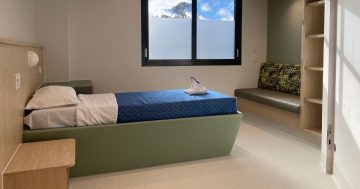
One of the residential rooms at the new Watson Health Precinct, which will provide accommodation for people receiving mental health and alcohol and other drug support. Photo: Naziya Alvi.
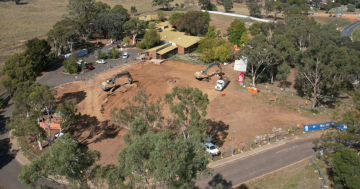
A new $49 million health precinct in Watson is weeks away from taking its first residents, with two of the services preparing to move in already operating at capacity.
The Watson Health Precinct will bring together residential mental health and drug and alcohol services for young Canberrans, as well as a new 24-bed rehabilitation service that will mean First Nations men no longer have to leave the ACT to access culturally safe residential treatment.
Ted Noffs Foundation and Marymead CatholicCare are aiming to move into their new buildings by the end of September.
But the opening comes as the ACT Government acknowledges demand for both youth mental health and alcohol and other drug services is growing.
“They’re built with capacity for expansion, as we see demand continue to grow, unfortunately, for these services,” Deputy Chief Minister and Health Infrastructure Minister Rachel Stephen-Smith said.
“So, we’ll continue as a government to work through how we can continue to expand funding for alcohol and other drug services and also mental health services for our young people.”
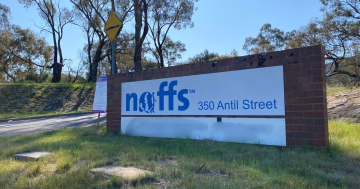
Ted Noffs has been operating in Canberra for about 26 years, providing residential rehabilitation for young people experiencing problems with drugs and alcohol.
Its new Watson site will have a 15-bed residential facility as well as six separate beds for young people who have completed rehabilitation but cannot immediately find somewhere suitable to live.
CEO Matt Noffs said both services were already operating elsewhere and were full.
“We’re already fully operational, also located on another site and at full capacity at the moment, fully staffed, ready to go,” he said.
The six transitional beds are intended to tackle a problem that can undermine recovery after rehabilitation – unstable housing.
Young people will be able to remain there while transitioning back into education, training, employment and independent life rather than completing treatment without somewhere stable to go.
Marymead CatholicCare will return its STEPS mental health program to Watson after operating elsewhere during construction.
The service supports 13 to 18-year-olds and currently has five funded residential places.
It operates as an alternative to hospital for some young people – allowing them to “step up” into more intensive support when their mental health deteriorates or “step down” into a supported residential environment after hospital treatment.
The buildings have been designed to allow the services to expand, although the government has not announced additional funded places beyond their existing capacity.
All three programs will receive ongoing government funding, but a recurrent funding figure has not been provided.
The biggest change to Canberra’s treatment system, however, will come from the third facility on the site.
Winnunga Nimmityjah Aboriginal Health and Community Services will operate a new 24-bed residential alcohol and other drug rehabilitation service for Aboriginal and Torres Strait Islander people.


Unlike Ted Noffs and Marymead, it is not simply moving an existing program into a new building. It is a new service intended to fill a gap that has previously forced ACT First Nations men seeking culturally safe residential rehabilitation to travel interstate.
“We now have a 24-bed purpose-built facility in Watson that will provide much-needed culturally safe rehabilitation for First Nations men, who will receive wraparound services,” Winnunga CEO Julie Tongs said.
Winnunga does not intend to open immediately.
Ms Tongs said the service was aiming to begin before the end of the year, with recruiting suitable staff one of the factors determining the timing.
“It’s about getting the right staff to actually come in and manage the service and not just open it for the sake of opening it,” she said.
The organisation was given control over the design and construction of its facility and went directly to some of the men likely to need it for advice.
Ms Tongs said architects accompanied her to the Alexander Maconochie Centre to ask men what they wanted in a rehabilitation facility. Their suggestions influenced the final design, including the addition of balconies.
The site also includes a yarning circle and spaces intended to strengthen connection to Country.
For Ms Tongs, keeping rehabilitation in Canberra could also address what happens after treatment.
Winnunga has previously sent people to The Glen rehabilitation service in NSW.
“They don’t have to go interstate,” she said. “It’s about taking people back to the Country, strengthening their identity … but also giving them strategies to manage triggers, so when they leave, for them to be able to reintegrate into the community.”
She also linked the service directly to efforts to keep Aboriginal men out of the justice system.
“The more men we can keep out of prison, or stop from going into prison, is a real achievement.”