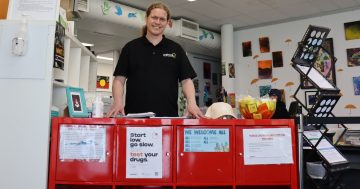
CanTEST is a source of local and global information about the changing drug market. Photo: CanTEST.
Six world-first detections, new drug identification methods and influencing United Nations discussions – these are just some of the impacts Canberra’s drug checking service has had in its three years of operation.
Its third-year report (21 July 2024 to 20 July 2025) showed that CanTEST, which is open for six hours a week, tested 2072 samples and issued more than 30 public health alerts about dangerous and unexpected substances.
Importantly, it detected potent synthetic opioid N-pyrrolidino isotonitazene (NPI) for the first time globally.
CanTEST chemistry lead Professor Malcolm McLeod said this underscored the role of drug checking in providing real-time data to support clinicians, policymakers and international agencies in responding to the drug market and its associated harms.
“The detection of new substances like NPI and isotocyanzene demonstrates how quickly the drug market is changing,” he said.
“Without services like CanTEST, these substances may go undetected until significant harm occurs.”
The discovery led to a peer-reviewed publication, and the substance is now on the agenda for international scheduling discussions by the United Nations Office on Drugs and Crime (UNODC) at the Commission on Narcotic Drugs (CND) this month.
The service also documented several significant market shifts, including an increased median purity of drugs such as MDMA, methamphetamine and heroin, and a decrease in substitution and adulteration across MDMA, cocaine, ketamine and methamphetamine.
Another major development in the past year was the rollout of CanTEST’s new method for identifying novel benzodiazepines (also known as benzos or downers), which led to more than 12 benzo-related community notices to Canberrans.
This was because many of the samples were presented as “convincing” counterfeit pharmaceuticals with branding and packaging, such as labelled bottles, blister packs and pill-presses mimicking real brands (such as Pfizer’s Xanax bars).
“By giving people clear, evidence-based information about what’s actually in the substances they’re using, CanTEST helps individuals make safer decisions,” Directions Health Services CEO Stephanie Stephens said.
“Importantly, the service reaches people who have never spoken to a healthcare professional about their drug use before, creating valuable opportunities for early intervention, brief support and connection to broader health services.”
The centre provided 2371 health and alcohol and drug interventions to clients in its third year, and 73 per cent of clients accepted an invitation to engage in harm reduction.
Canberra Alliance for Harm Minimisation & Advocacy (CAHMA) executive director Chris Gough said it was providing a vital public health service to a section of the public that previously went under the radar.
“Of the people engaging with CanTEST over the last 3 years, 70 per cent had never talked to a health professional about drug use before,” he said.
“This makes CanTEST a pivotal intervention in preventing drug-related harm and ensuring the safety of our community.”
The service increases its hours during major events, such as festivals, and is closed on public holidays.
Pill Testing Australia executive officer Stephanie Tzanetis said the demand showed how much the community valued accessible, confidential health services.
“The ACT’s mixed-model approach, with fixed-site and festival outreach, reaches different populations,” she said.
“Expanding access would allow us to reach more people and strengthen Australia’s early warning systems. We hope more jurisdictions follow the ACT’s lead.”
Discussions are ongoing between the CanTEST provider, Directions Health Services, and the ACT Government about potentially expanding the service’s offerings.
Health Minister Rachel Stephen-Smith said the current site was limiting what could occur.
“One of the things that we’re talking … about is whether there is an alternative site that would be more integrated with the other harm reduction services that are available, and would also be accessible for people with disabilities,” she said.
“Any expansion of hours would also be part of that conversation.”
Campaigning also continues for other drug-use harm-reduction measures such as safe injecting rooms.
Ms Stephen-Smith has said previously that she felt it would be difficult to justify a medically-supervised “consumption facility” in the ACT.
“A peer or nurse-led service might be appropriate, but it would need to be really developed as part of an integrated, harm reduction hub, not as a standalone service,” she said.
“A lot of consideration would be required to deliver that, including legislative service delivery and cost effectiveness, and what we saw through the examination of the cost effectiveness of our harm reduction services is that there are a range of other services such as take-home naloxone, needle and syringe programs that are a more cost-effective intervention at this point.”
If you or someone you know needs support, call Lifeline on 13 11 14 or the National 24/7 Alcohol and Other Drugs Hotline on 1800 250 015.