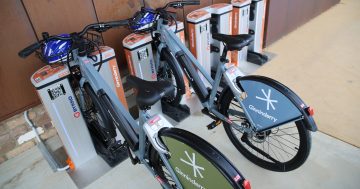
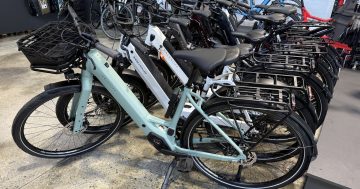
The SEE-Change Canberra Electric Bike Library has cargo bikes available for hire for those interested in giving them a go. Photo: Facebook/SEE-Change.
Musician Sam Hutchinson loved cycling but realised trying to move all his equipment to gigs on a regular bike wasn’t the way to go.
“I started doing more and more risky stuff … I was essentially riding without hands, it was getting dangerous, but I didn’t want to drive,” he said.
In late 2022 he found a cargo bike for sale on Gumtree and managed to convince the seller to give it to him for $3000 (as it didn’t have any electrics attached).
“They’re still kind of weird in Australia, so most get imported from places like Germany and the Netherlands,” Mr Hutchinson said.
“They’re usually quite expensive upfront if you want them new.”
And the costs add up if you then want to add larger batteries to help cart around all your gear.
Now, the ACT Government has committed to adding e-cargo bikes to its Sustainable Household Scheme – as well as other initiatives to make clean transport cheaper and more accessible.

Sam Hutchinson uses his cargo bike to transport all his equipment to gigs across the Territory. Photo: Supplied.
ACT Greens transport spokesperson Andrew Braddock moved a private members bill in the Legislative Assembly calling on the government to provide further assistance for the adoption of e-bikes and e-scooters, add cargo bikes to the Sustainable Household Scheme, trial low-cost pop-up cycle lanes, extend incentive schemes for electric vehicle uptake and to expand Canberra’s EV charging network.
“This is a win for Canberrans who are feeling the pinch at the pump, giving people real, practical and affordable alternatives to gas-guzzling cars,” he said.
“The fuel crisis is far from over and it’s the ACT Government’s responsibility to step up with tangible options that take pressure off household budgets.
“Based on Federal Government analysis, the worst impacts of the fuel crisis are still to come and governments at all levels have a responsibility to step up with tangible options that take pressure off household budgets while reducing our dependency on polluting fossil fuels.”
Mr Hutchinson said it’s fantastic the ACT Government was making the move, as e-cargo bikes can essentially replace a car.
“You can throw your bikes in there, throw shopping in there, throw people in there … you can move your whole life with your [cargo] bike,” he said.
“[With the right battery] you can get from Belconnen to Queanbeyan no problem.”
Mr Braddock said the ongoing conflict in the Middle East meant Canberrans were searching for other ways to travel, including electrified means of transport, but these options could be out of reach for many doing it tough.
He added that while electric vehicles were attractive options for home owners – who could then control what charging and other infrastructure could be installed on their properties – renters didn’t have as much flexibility.
“Cargo bikes are a smart alternative to cars – fast, efficient and significantly cheaper to run. Expanding the Sustainable Household Scheme will put them within reach for many more Canberrans,” Mr Braddock said.
Pedal Power ACT CEO Cecily Michaels said the upfront cost was often one of the biggest barriers stopping people from making the switch.
“Even though the long-term running costs are far lower than owning and operating a second car,” she said.
“Cargo bikes and e-bikes are no longer niche transport options. For many Canberra households they are becoming a practical alternative to a second car, particularly for local trips, school drop-offs and shopping.”
She added benefits went beyond environmental benefits, pointing out they could also improve household affordability, support healthier and more active lifestyles and reduce congestion and parking pressures across Canberra.
But there’s no use increasing the uptick of e-scooter and e-bike users if people didn’t feel safe using the current infrastructure.
That’s why trials of pop-up cycle lanes were included in the motion.
“Pop-up cycle lanes make riding a genuine option for more people, creating safer, dedicated space so cyclists of all ages and abilities can get from A to B with confidence,” Mr Braddock said.
Such infrastructure has already been trialled on Bowen Drive in Kingston, but some transport planners and advocates don’t consider it a true pop-up cycle lane when comparing it to the way that term has been used internationally.
Ms Michaels said Canberra hadn’t yet seen widespread use of deliberately trialled pop-up cycle lanes designed to test “latent” demand for cycling.
“Pop-up cycle lanes are a practical way to test demand quickly and at relatively low cost. International experience has shown that when safe cycling infrastructure is provided, more people choose to ride,” she said.
“We see this as a practical opportunity to quickly test demand, improve safety and gather evidence before committing to permanent infrastructure.
“Good cycling infrastructure is not just about transport. It also supports public health, affordability, congestion reduction and a more liveable city. Financial incentives can help people make the switch, but the long-term benefits come from creating safe, connected routes that make active travel an easy everyday choice.”
Mr Braddock’s motion was passed unanimously by all members.
The ACT Government has to report on progress to implement these measures by the second-last sitting day in September.