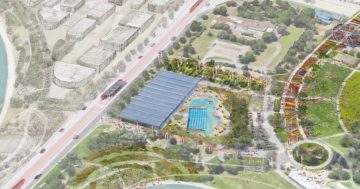
The stadium proposal draws inspiration from Christchurch’s Te Kaha Stadium. Photo: Populous.
Chief Minister Andrew Barr has given more oxygen to the Canberra Airport-led proposal for a 25,000/36,000-seat all-weather stadium in the city by praising the location and exploring its potential for the national capital.
The proposal was announced while Mr Barr was on a European trade mission, but on his return to Canberra the Chief Minister, who has previously rejected a city stadium in favour of the Bruce precinct, said the idea was worth looking at and flagged that a Public Private Partnership would be the best approach.
Significantly, Mr Barr acknowledged the site on Catholic church land at Regatta Place was a winner.
“The site’s light rail connection and easy 15-minute walk to the city centre are clear advantages,” he said.
But its location at the city’s southern gateway and its proximity to national institutions also raised expectations.
Mr Barr said a stadium built on this site should be a genuine national landmark, with the design quality and capacity expected of one of Canberra’s most important civic locations.
“It should be built for the long term, not just the next decade,” he said. “Any new stadium should have the seating capacity to meet Canberra’s needs for the next 50 years as the city continues to grow.
“It is appropriate that this proposal has been put to the Australian Government first, given Commonwealth Park is Commonwealth land and a nationally significant public asset.”
Mr Barr said the proposal would first need to go through Commonwealth assessment and approval processes, including Infrastructure Australia’s review framework for major national infrastructure projects.
If it progresses through these and is later put to the Territory for funding consideration, it may need to be assessed under the ACT Government’s Unsolicited Proposals Guidelines or through a Public Private Partnership (PPP) model.
“The business case should look at whether a MCG/SCG style membership-based model, overseen by an independent trust, delivered through a public-private partnership and managed by an experienced venue operator, would provide the strongest long-term outcome,” Mr Barr said.

Chief Minister Andrew Barr is keeping an open mind. Photo: Michelle Kroll.
In the meantime, his government would continue detailed work on the Canberra Aquatic Centre and Canberra Convention and Entertainment Centre projects while the stadium proponents develop their business case and progress through Commonwealth assessment and approval processes.
The proponents announced on Wednesday that global stadium architectural firm Populous had been appointed to deliver a design and feasibility study, including a price tag.
ACT Treasurer Chris Steel said the proponents were racing against time to complete their submission to government.
Mr Steel said he had been upfront with Airport boss Stephen Byron that the ACT Government’s infrastructure pipeline was full and that it was committed to the Canberra Aquatic Centre project nearby in Commonwealth Park.
“Planning is well underway for that, and that will be progressing next year, and so I’ve also been really clear to Stephen Byron that this new study needs to happen really quickly if they want to help to inform future decisions of government,” he said.
“They’ve presented some high-level concepts, but they haven’t yet done the work to actually show why a stadium might be feasible on this site.”
But like Mr Barr, Mr Steel hasn’t dismissed the idea out of hand, saying the government was certainly interested.
Mr Steel said the images were incredible, but a lot of questions remained to be answered.

Time is also on Mr Byron’s mind.
At the Canberra Business Chamber event Grow the Pie on Thursday, he pitched the case to a receptive audience, other than economists worried about the cost to the taxpayer, as a defibrillator for the city’s sluggish heart.
Mr Byron said that Canberra needed a new stadium at some stage and it was probably 15 years overdue.
He warned that on the potential $500 million cost, “the longer we wait, the more it costs”.
“That was true even when we didn’t have an inflation economy,” he said.
“At some point this city, the national capital of Australia, is going to have a first-class stadium. I reckon we should do it now.”
Former federal Labor opposition leader and minister, now University of Canberra Vice-Chancellor Bill Shorten, said Canberra, like Melbourne, should be an events-driven city.
“If you put the stadium in the context of a vision of Canberra being a destination, I think there is a weight of argument there which needs to be taken incredibly seriously,” he said.
“And you don’t necessarily have to have massive cost overruns. It is completely possible and definitely needs to move up the charts and not be put in the too-hard basket.”