


Melissa Healy delves into recently proposed changes to superannuation income tax, which are likely to come into effect next year. Photo: DFK Everalls.
There’s been plenty of noise around the potential Division 296 tax, also known as the $3 million superannuation tax.
It’s easy to get lost in all the jargon, but behind the technical label is a fairly straightforward idea: higher super balances could soon be hit with an extra layer of tax.
First introduced in 2023, the original Division 296 proposed to increase the effective tax rate on super fund earnings attributable to balances of more than $3 million from 15 to 30 per cent.
This would be billed personally to the account owner rather than coming out of their fund.
But here’s the kicker. The original proposal didn’t just apply to cash brought in — unrealised gains (increases to the value of an asset that hasn’t been sold) were also in the firing line.
Unsurprisingly, this was met with strong criticism from the superannuation industry, tax professionals, and investors, particularly for members holding illiquid assets such as property, private equity or unlisted investments.
Fellow chartered accountant Melissa Healy specialises in risk management, asset protection, and expert financial planning. As a senior manager at DFK Everalls, she boasts more than two decades of experience in the local market.
According to Melissa, taxing unrealised gains would cause major liquidity and cash-flow issues across the board.
“For example, someone with most or all of their super tied up in property or share portfolios could have major issues,” Melissa says.
“There was a significant risk that SMSF account owners would be forced to sell assets just to cover their tax bill.”
Though the government estimated less than half a per cent of Australians would be affected, concerns grew over valuation complexities, liquidity risks, and the precedent such a tax might set.
In response to the feedback, a range of major policy changes were confirmed in October this year.
“The most important change is that unrealised gains are no longer on the table,” Melissa says.
“Only realised earnings will be taxed now, like interest, dividends, rent, or capital gains from sold assets.”
The Federal Government also redesigned the structure of the tax. Instead of a single flat rate, it will follow a tiered system.
Superannuation earnings attributable to balances between $3 million and $10 million will be taxed at an effective rate of 30 per cent, while earnings attributable to balances above $10 million will face a 40 per cent rate.
The additional Division 296 tax will be billed directly to members, but they will have the choice to either pay personally or have their super fund pay it for them.
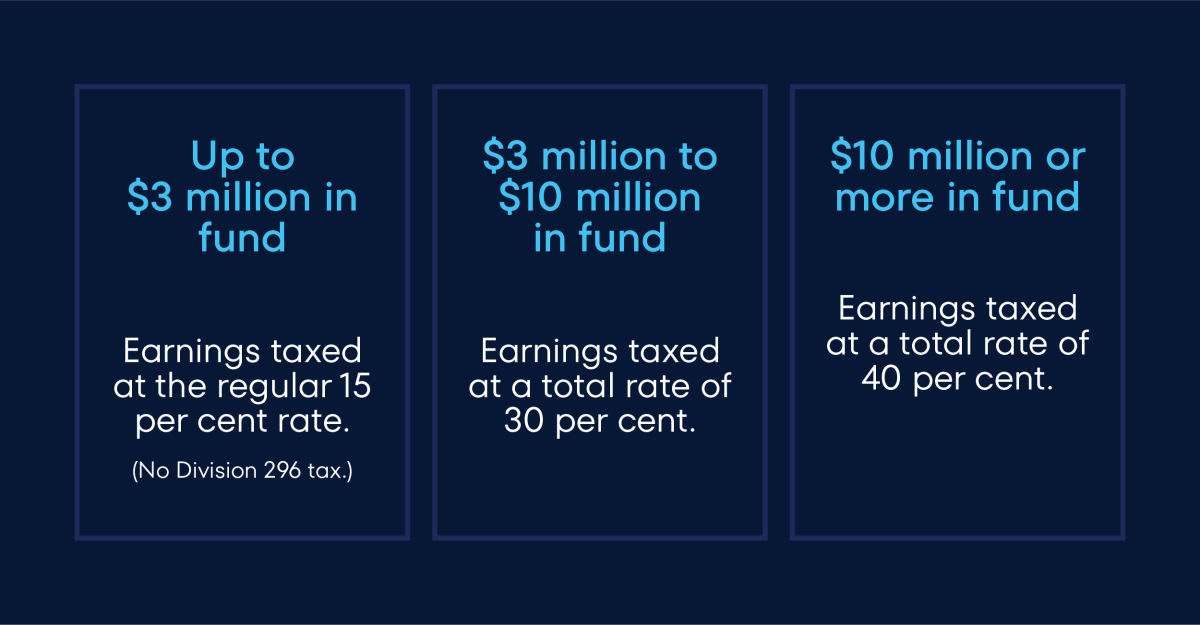
The new tax proposal will follow a tiered system. Image: Region Media.
To prevent inflation from gradually pushing more people into these categories, taxed tiers will increase each year in line with the Consumer Price Index. This reduces the risk of more people being pulled in as their balances grow over time.
The $3 million to $10 million threshold will increase in steps of $150,000, while the $10 million or more threshold will increase in steps of $500,000.
The proposed implementation date has also been pushed back to 1 July 2026, so first assessments won’t be expected until the 2027/28 financial year.
“Your super balance as of 30 June 2027 will be used to determine what threshold you fall under,” Melissa says.
“If it’s less than $3 million, Division 296 will not apply to you.
“We’re still waiting to find out how defined benefit pensions will be valued and how their deemed earnings will be calculated. Treasury has simply advised they will be taxed in a way that gives a similar outcome.”
While the Division 296 tax seems increasingly likely to become law, legislation still needs to be drafted and introduced to parliament.
Melissa recommends proactive investors start reviewing their super now, but warns against making any hasty decisions.
“Taking money out of super now may be completely unnecessary and could lead to tax consequences more significant than Division 296,” she says.
“If you’re in the firing line, what to do will depend on your specific financial circumstances. As a start, sit down with your financial advisor to review your balance and expected earnings.
“This will help you plan accordingly for if or when the new legislation passes.”
For more information visit DFK Everalls.