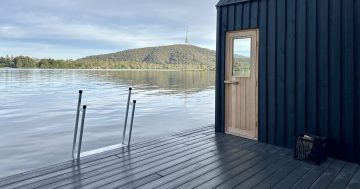
Lake Burley Griffin has experienced “extreme levels” of blue-green algae. Photo: Jye Crotty, Facebook.
Roses are red, violets are blue … and Lake Burley Griffin just turned green again.
Blue-green algae has been a scourge of Canberra’s jewel in the crown for decades – and it struck again recently, turning vast swathes of the water a near-lime hue.
It prompted authorities to warn Canberrans to stay out of the water, with risks of serious sickness for humans and pets exposed.
The National Capital Authority (NCA) blamed rainfall, saying it washed excess nutrients into the lake, triggering the bloom.
But is there a simple fix? Could more motorboats mix up the water and stop algae from forming – or just make things worse?
We decided to dive into the science …
How mixing water kills blue-green algae
As the NCA explains, blue-green algae (cyanobacteria) thrive in still or slow-moving water rich in nutrients such as nitrogen and phosphorus.
Add sunlight and warm temperatures, and blooms can quickly explode – sometimes producing toxins that damage the liver or nervous system.
A 2020 review led by the University of Canberra (UC) found that two of the main nutrients in the lake can produce both.
For now, the long-term focus is on reducing those nutrients at the source.
“The key driver for blue-green algae in Lake Burley Griffin is the amount of nutrients and quality of water flowing into the lake,” an NCA spokesperson said previously.

Blue-green algae have reached alarming levels in Lake Burley Griffin. Photo: Diane Falla, Facebook.
There’s a simple logic behind using boats to tackle the problem.
Scientific advice often points to aeration and mixing as key methods for controlling algae. CSIRO research shows algae thrive when lakes form a warm, stable surface layer where light and nutrients are easily available. Disrupt that layer, and you disrupt the bloom.
“In rivers, shallow surface layers are supported when the river flow decreases below a critical threshold required to completely mix the water column,” CSIRO says on a web page about blue-green algae management options.
Among the options scientists have assessed are “bottom-mounted bubblers or mechanical mixers to mix the water levels and ensure bottom waters remain oxygenated”.
Practical advice for farm dams from Agriculture Victoria also suggests using pumps or motors to “circulate oxygen through the water supply … to aerate the water source and disperse the algal scum”.
And Water Quality Solutions lists water aeration as the first step in “how to get rid of blue-green algae from a dam”.
“This provides ideal conditions for ‘good’ aerobic bacteria to grow in number,” the website reads.
“Keep adequate aeration up and the cyanobacteria have a very difficult time returning – there simply isn’t enough food. These ‘good’ bacteria clean up dead blue-green algae, too. Without them, decaying algae will rot and sink to the floor, becoming fertiliser for next season’s bloom.”
So on paper, more movement sounds like a good thing.
Why it likely won’t work here
For a start, Lake Burley Griffin isn’t a farm dam.
UC’s Dr Rod Ubrihien has been leading research into how the lake behaves on behalf of the ACT Government. He says motorboats are unlikely to make a meaningful difference.
“I don’t think motorboats will significantly … help the situation.”
He says the real problem isn’t at the surface, but much deeper.
“The lake is stratified into thermal layers, and it’s in the bottom waters … where the chemical conditions that cause the release of nutrients are created.”

It’s unlikely boats would stir the water enough to disrupt the algae. Photo: James Coleman.
Those nutrients build up out of sight, near the lakebed.
Then, as the weather cools and the lake “turns over”, they’re brought to the surface all at once – right when conditions are still warm enough for algae to thrive.
“Those nutrients come up to the surface … and that leads to your problem.”
It also explains why Canberra often sees its worst blooms right now – in autumn.
This is where the motorboat idea runs into trouble.
“You would mix the top layer, but you wouldn’t mix it significantly enough … to stop that release of nutrients from the sediment,” Dr Ubrihien said.
In other words, boats might stir the surface, but they won’t reach deep enough to fix the underlying cause.
There’s also a risk they could make things worse.
“Around the edges of some kind of disturbance, sometimes you actually actively bring some of those nutrients to the surface when you don’t want to.”
Where does this leave the lake?
Dr Ubrihien says this is why most research has been focused on the catchment and controlling what ends up in the lake.
He says reducing the flow of nutrients into the lake – from stormwater, pollution and the wider catchment – remains the most effective long-term fix.
UC is currently reviewing the Lake Burley Griffin water quality management plan, with a report due soon.
An NCA spokesperson said powerboats on the lake was “not desirable”.
“It is not clear that aeration from powerboats on the lake would improve the water quality,” they said.
“Further, there is a risk that additional powered vessels on the lake could cause damage to the natural shorelines of the lake.”