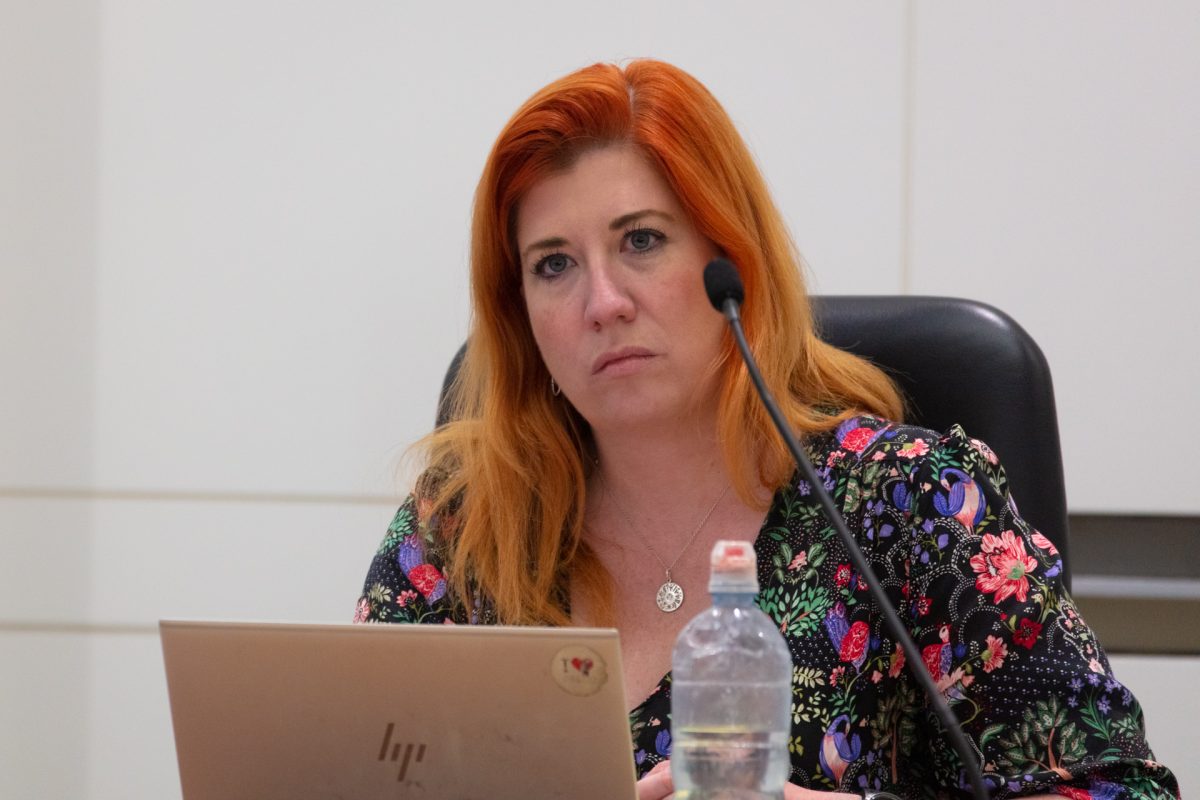
Tara Cheyne said while the government accepted the financial pressure caused by overlapping bonds, portability was not necessarily the only solution. Photo: Thomas Lucraft.
Canberra renters could eventually be spared the financial strain of paying two bonds when they move, with the ACT Government agreeing to explore portable rental bonds, but it wants nine months to figure out the best way forward.
Faster refunds, bridging arrangements and improvements to its existing Rental Bond Help scheme are among other options on the table.
The debate came to the Legislative Assembly after Greens MLA Rebecca Vassarotti moved that the government begin work on a scheme allowing renters to transfer their existing bond to a new property, rather than finding thousands of dollars for another while waiting for the first to be released.
Around one-third of Canberra households rent, with median weekly rents approaching $710 for a house and $580 for a unit at the end of the last financial year, Ms Vassarotti told the Assembly.
“The current system forces renters to pull together money for a new bond while their money is still tied up from a previous rental,” she said.
“And we’re not talking about small amounts of money. We’re talking about thousands of dollars.”
The maximum rental bond amount a landlord can charge in the ACT is four weeks’ rent, meaning the average bond is between $2000 and $3000.
Ms Vassarotti wants the scheme to be free for renters and said it was reasonable to expect it could be operating before the end of the parliamentary term.
But Attorney-General Tara Cheyne said while the government accepted the financial pressure caused by overlapping bonds, portability was not necessarily the only solution.
“The concept is simple; the scheme is not,” she said.
Ms Cheyne said questions remained about who would carry the financial risk if a landlord successfully claimed against an old bond after it had been transferred, what would happen if the renter could not repay the money, and how a scheme would handle share houses, family violence, disputes and government-assisted bonds.
“Once you get beyond the slogan, someone has to decide what happens when the first landlord makes a claim. Somebody has to decide who carries that financial risk. Somebody has to build the IT system.”
Preliminary government advice indicates changes to the ACT’s rental bond IT system alone could cost more than $1 million and require an external vendor. Ms Cheyne said NSW had invested $6.6 million in its scheme, while South Australia had committed $7 million over four years.
She also pointed to limitations in the recently introduced NSW and Victorian models, including a $25 fee and restrictions affecting some share-house moves and government-assisted bonds.
Canberra Liberals MLA Ed Cocks also questioned whether portable bonds would provide the greatest benefit to renters under the most financial pressure.
He pointed to the ACT’s existing Rental Bond Help program, which provides eligible renters with interest-free loans. He argued the longer-term focus should be increasing housing supply to put downward pressure on rents.
“That means planning and regulatory reform. It means tax reform, and it means land release.”
Ms Vassarotti argued the ACT already had a potential funding source, with the government earning almost $5.5 million in interest from its rental bond account in 2024-25. That money funds services including tenancy advice, bond administration and dispute resolution.
Mr Cocks moved amendments to broaden the proposed review beyond portable bonds to consider other ways to prevent renters from having to finance two bonds simultaneously.
Ms Cheyne supported that approach but sought nine months for the government to report back rather than the six months proposed in the Liberal amendment.
“Portable bonds may form part of the answer. But it might not,” she said.
“We shouldn’t decide the architecture of a scheme before understanding who it will help, who it may exclude, what risks it creates and what it will cost.”
Housing and financial advocacy groups, however, backed portable bonds, arguing the overlap between old and new bonds could hit renters with little capacity to build savings particularly hard.
ACT Shelter chief executive Corinne Dobson described the proposal as a “practical, sensible measure” that would not solve Canberra’s broader rental affordability problem but could ease the financial burden of moving.
“We know renters are often really struggling,” she said.
“People aren’t necessarily able to generate the savings buffer because all that money’s going into rent … and moving already costs a lot of money.”
Ms Dobson said disputes over an old bond should not make portability unworkable. Under interstate models, if a claim against the original bond is upheld after it had been transferred, the government could pay the landlord and the renter would then owe the outstanding amount to the government.
CARE Financial chief executive Amy Kilpatrick said portable bonds could be particularly significant for women experiencing family and domestic violence, where access to bond money could become another means of financial control.
“Holding onto and refusing to agree to a bond being released is a tool that’s used by perpetrators in coercive control situations of family domestic violence,” she said.
“We think more women will benefit, and we think that it will no longer be a tool used by perpetrators of family and domestic violence.”