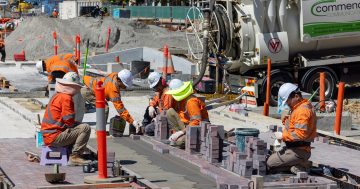
Local government representatives making their case at the Local Government National Assembly in Canberra. Photo: ALGA.
Representatives of 538 councils across the country have called on the Federal Government to restore a grant’s funding level so that they can keep water flowing, rubbish collected and roads smooth.
One signature was missing from their letter: the ACT Government.
The ACT Government functions as both a council and a Territory-level government, meaning it has to juggle streetlight issues all the way up to coordinating the capital’s public health system.
About 6 per cent of the Territory’s $10 billion budget is spent on municipal services each year.
ACT Greens municipal services spokesperson Andrew Braddock said the government needed to back the funding campaign to ensure Canberra was adequately funded for basic municipal services.
“The Federal Labor Government is short-changing local government services across the nation, including Canberra,” he said.
“But when 538 councils raised their voices calling for funding to be restored to historical levels, the ACT Labor Government was suspiciously quiet.”
The exact call from the Australian Local Government Association (which is behind the campaign) is for the Commonwealth Financial Assistance Grants to be restored to at least 1 per cent of federal taxation revenue and for secure, long-term, untied funding.
“The issue we are seeking to address is not simply the total amount of Commonwealth funding that may be available to, or open to, local government across a range of programs,” an ALGA spokesperson said.
“Many of those programs are tied, competitive, short-term or available to entities other than councils. They are valuable, but they do not provide the baseline certainty councils need to plan, maintain infrastructure, meet rising costs and respond to local priorities.
“For that reason, our preference is that the increase be delivered primarily through the existing FA [Financial Assistance] Grants framework. Our position is that any reform should increase the overall pool of funding, rather than redistribute existing funding between councils.”
In the 2026-27 ACT Budget, the Territory received $15.9 million from the Financial Assistance Grants pool.
The budget papers show the Capital receives about 2.2 per cent from the national pool. Over the forward estimates, the total revenue is expected to be $273.7 million.
The ACT Greens have calculated a shortfall of more than $284 million across the forward estimates as the grants aren’t tied to a percentage of Commonwealth taxation revenue.
Mr Braddock pointed to several examples he said made it clear that Canberra wasn’t receiving the level of municipal services funding it needed.
“Public libraries in Civic, Erindale and Kippax have all lost weekend hours. Suburban shopping centres at Kingston, Chisholm, Cooleman Court and Kippax are only now receiving basic upgrades that residents have needed for years,” he said.
“Cracked footpaths, worn-out playgrounds, ageing pools – these are the inevitable results of Labor’s funding shortfalls.
“[The funding’s] volatility makes it impossible to plan and maintain the roads, parks, pools and public facilities Canberrans rely on.”
The ALGA is a member-based organisation. As the ACT isn’t currently a member, it wasn’t a signatory to the letter.
“We appreciate that the ACT does not have the same local government structure as other jurisdictions, but it performs local government-type functions and faces many of the same pressures in maintaining community infrastructure and services,” an ALGA spokesperson said.
“The way any increased funding would be applied in the ACT through [Financial Assistance] Grants would need to reflect those arrangements.”
Chief Minister Andrew Barr spoke at the ALGA’s conference on this issue. The ACT Government said the ACT Greens had missed the point.
“The Greens claimed the ‘$284 million funding hole’ is based on money that doesn’t actually exist,” a spokesperson said.
“It is a hypothetical figure based on an ambitious proposal to increase Financial Assistance Grants nationally. It is not funding that has been cut from the ACT, nor funding that any Australian Government has committed to provide.”
The spokesperson said the government had “consistently advocated” for Canberra’s fair share of Commonwealth funding and had secured “real investment” in local infrastructure and community facility projects across the city.
These include Roads to Recovery and Black Spot funding for roads, urban renewal and place-making projects through the National Capital Investment Framework, and the jointly funded new Canberra Aquatic Centre at Commonwealth Park.
“As the government responsible for both state and local government functions in the ACT, we will continue advocating for funding arrangements that recognise Canberra’s unique circumstances and support the services and infrastructure Canberrans rely on every day,” the spokesperson said.

Federal Local Government Minister Catherine King at the Local Government Conference in Canberra. Photo: ALGA.
Federal Local Government Minister Catherine King previously rejected suggestions the Commonwealth had stepped back from supporting local government.
She said the Albanese Government had increased the grants by 35 per cent, from $2.6 billion in 2021–22 to $3.6 billion in 2026–27, and local government funding was projected to exceed $4 billion annually by 2029-30.
“In total, $16 billion in Financial Assistance Grants has been delivered to local councils under this government,” Ms King said.