CPSU members at Housing ACT will be the first group to strike, but there are plenty more in the wings. Photo: Claire Fenwicke.
More than 95 per cent of public service union members have voted to strike after rejecting the ACT Government’s 3 per cent pay rise offer.
Industrial action will occur across admin and health professional enterprise bargaining agreements, starting with Housing ACT next Thursday (14 May).
“Members who voted yes to strike action, to work bans, to overtime bans, [have done so] because they’ve had enough of this government disrespecting them and their colleagues,” Community and Public Sector Union (CPSU) ACT regional secretary Maddy Northam said.
“This government is offering 3 per cent per year over three years. We know that CPI is running at 4.6 per cent.
“They are asking these hardworking members to take a real wage cut. That isn’t something a Labor Party should be doing. That’s not something a Labor government should be doing.”
The admin and health enterprise agreements cover areas such as Housing ACT, Clare Holland House, Canberra’s hospitals, some workers at Bimberi Youth Justice Centre, non-custodial workers at the Alexander Maconochie Centre, and policy officers.
The Housing ACT strike will last for one hour, but that service is just the first cab off the rank.
“They do so much work for our community, they house some of our most vulnerable community members, they are subject to frequent occupational violence and threats, and they do it all because they love the work they do and they care about our community,” Ms Northam said.
“And this government is showing them complete disrespect by asking them and their families to go backwards.”
Some protected action applications still haven’t been submitted to the Fair Work Commission, which approves whether such actions take place.
Ms Northam said there were more sectors that were planning to do so unless the ACT Government came up with a better offer.
“We have members across every workplace in government … we are going to keep going and going, and it doesn’t stop with health and admin,” she said.
“We’re going to lodge protected action ballots in other agreements as well, like support services and, really importantly, corrections.
“I’d suggest to the government that they come to the table before those people come online too.”

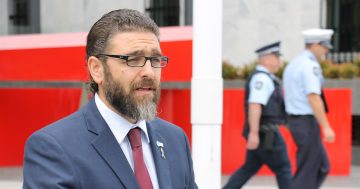
CPSU ACT regional secretary Maddy Northam said even more services would see staff strike if the ACT Government didn’t come back with a better offer. Photo: Claire Fenwicke.
The CPSU is calling for a pay rise of 5 per cent in the first year, 4 per cent in the second and 3 per cent in the third, plus a measure to address the scenario where CPI exceeds the pay offer.
Ms Northam said it was about making sure public servants could cope with rising costs, especially in the wake of yet another interest rate rise.
“This government is full of excuses as to why they can’t come to the table with a better pay offer; they blame the budget,” she said.
“The ACT Labor Government is fine with spending so much money on labour hire, consultants, executive recruitment panels.
“But they’re trying to send our members backwards. It’s not OK, they need to reprioritise, because if our members go backwards, all of Canberra goes backwards.”
ACT Greens public service transformation spokesperson Andrew Braddock asked Chief Minister Andrew Barr why negotiations couldn’t at least endeavour to match CPI.
Mr Barr responded that that could potentially be achieved across the length of an agreement, and other benefits were also under consideration.
“We are in a volatile time, at the moment, and there will be a need to make some forecasts about what inflation will look like over the next 12 months, and beyond,” he said.
“We certainly know the Reserve Bank is taking quite considerable action to seek to bring inflation back within the 2 to 3 per cent band.
“We also need to be conscious of the government’s own budget and fiscal position, and the reality that any … extra money that we need to find will come from ACT taxpayers.
“There is no magic pot of money, sitting out there. If there were, we would access it. There isn’t, and so we need to put forward an offer that addresses, as best we can, the range of claims that are made, but [it] also needs to be affordable for the territory and territory taxpayers.”