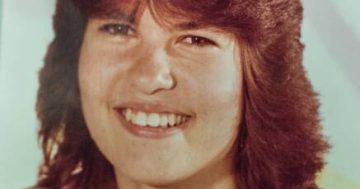
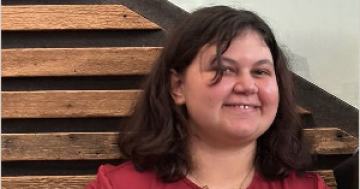
Portraits of missing Canberra teenagers Elizabeth Herfort, Megan Mulquiney and Amelia Hausia, unveiled as part of ACT Policing’s National Missing Persons Week campaign, Still Missing, Still Loved. Photo: Naziya Alvi.
For decades, the faces of three missing Canberra teenagers have existed only in old photographs and police files.
This week, they have been brought back to life through a series of commissioned portraits as ACT Policing makes a fresh appeal for information into three of the Territory’s oldest missing persons cases.
The artworks will eventually be gifted to the families of Elizabeth Herfort, Megan Mulquiney and Amelia Hausia – families still waiting for answers decades after the teenagers disappeared.
The portraits, painted by Canberra artist Harriet Mitchell, form the centrepiece of the ACT’s National Missing Persons Week campaign, Still Missing, Still Loved. Police hope they will do more than honour the young women — they hope they will spark memories, conversations and perhaps the one piece of information that finally helps solve investigations spanning more than four decades.
Deputy Chief Police Officer Richard Chin said while the portraits were deeply meaningful for the families, they also served a practical purpose.
“These young women and seven others are still missing, but they are not forgotten,” he said.
“We hope this campaign encourages people to reflect on their stories and come forward with any information that may assist police.”
ACT Policing currently has 10 long-term missing persons cases that remain unresolved. While most missing people are located within days, police say these older investigations remain active and continue to be reviewed as new information and investigative techniques become available.
Police, Fire and Emergency Services Minister Marisa Paterson said National Missing Persons Week was a reminder that behind every long-term missing persons case was a family still living with uncertainty.
“Every missing person’s story leaves a lasting impact on families, friends and our wider community,” Dr Paterson said.
“This campaign is about ensuring these young women are remembered and reminding the community that even the smallest piece of information could help bring answers to families who have waited for decades.”
She urged anyone with information, no matter how insignificant it might seem, to contact police.
For investigators, however, the biggest challenge is not technology.
It is time.
“The passage of time is our greatest enemy,” Deputy Chief Police Officer Chin said.
“But it’s also why campaigns like this matter. People may remember something today that they didn’t think was important 20 or 30 years ago.”
He said even the smallest detail could help investigators piece together events that had remained unresolved for decades.
“We don’t know what we don’t know. It may be the most innocuous piece of information that gives us a lead.”
Police hope the portraits themselves will prompt those conversations.
“We hope that the portraits will encourage members of the community to stop and look again and reconnect with these cases,” Deputy Chief Police Officer Chin said.
“We’ve had limited information in recent years about all three girls, so we’d really encourage the community to come forward with any information that may help us progress these matters to resolution.”
For Mitchell, the challenge was to paint three young women she had never met in a way that people could immediately connect with.
Rather than focusing on the mystery surrounding their disappearances, she wanted people to see them as daughters, sisters and teenagers whose lives were interrupted.
“The emotion is the number one thing,” she said.
“I know there’s a darkness to the story, but it’s that positive emotion that is going to help people empathise immediately with the portraits.”
The portraits will be displayed throughout National Missing Persons Week before being presented to each family — a gesture of remembrance for loved ones who have spent decades living with uncertainty rather than closure.
For leading senior constable Colleen McKillop, one of ACT Policing’s long-term missing persons coordinators, one of the hardest parts of the job is calling families every three months – not with answers, but simply to let them know they have not been forgotten.
Police say they remain hopeful that someone, somewhere, still holds the missing piece.
And that is why, despite the passing years, they continue asking the community to look again.
Because while these young women remain missing, they are still loved – and they are still being searched for.