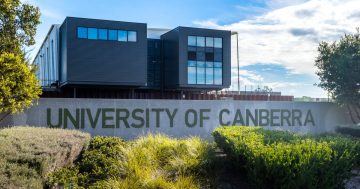
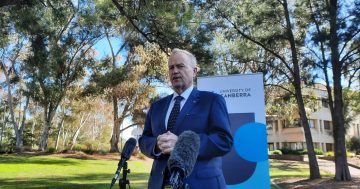
Bill Shorten is 14 months into the job as University of Canberra vice-chancellor and staff are disappointed. Photos: James Coleman.
CORRECTION: The original story said hundreds of staff members participated in the rally. This has been updated to 61. It also said Bill Shorten had been vice-chancellor for 14 months; this has been updated to 15 months.
“Many had high hopes for Bill Shorten as vice-chancellor and we’re disappointed it has come to this.”
Dr Lachlan Clohesy was among 61 staff members at the University of Canberra (UC) this week to demand healthier workloads, better job security and fairer salaries.
Their main target was their own VC, who’s only 15 months into the job.
“There may well be further strikes unless he engages with staff concerns on workloads, job security and pay,” Dr Clohesy, secretary of the National Tertiary Education Union’s ACT Branch said.
“Classes may be impacted, but the longer-term consequences of failing to address things like excessive workloads would be far more problematic.”

Staff say workloads are excessive and pay has failed to keep pace with inflation.
Former Australian Labor Party leader Bill Shorten took the role of UC’s vice-chancellor in January 2025, after Paddy Nixon resigned at the end of 2023.
This week’s rally, organised by the National Tertiary Education Union (NTEU), highlighted a line from his valedictory speech, in which he said: “I choose to be on the side of lecturers, tutors and researchers.”
Various speakers claimed Mr Shorten had gone back on his word due to changes he’s overseen as VC.
“You deserve much better than for excessive workloads to turn UC into Shorten’s sweatshop,” Dr Clohesy told the crowd.
“Unfortunately, UC’s often framed their approach as student first … but they don’t seem to understand that staff working conditions are student learning conditions,” he added in a subsequent interview.
“Workloads are already out of control. People have been asked to take on responsibilities of not just their own jobs and that hasn’t been fixed. And the proposals we see put forward make the problem worse, not better.”
As a measure of getting back on track financially, the university announced voluntary redundancies across academic staff over the course of 2025. By April 2025, 190 positions had already been “disestablished” and 150 staff had left the university.
Earlier this year, Mr Shorten announced UC had turned a corner, from the $41 million loss when he took the job to $4.3 million in 2025, and now with a “small surplus” expected for 2026. Enrolments were also up by about 1000, or 11 per cent.
Mr Shorten has since said the days of redundancies were over, but staff are still feeling the pain.

Hundreds of staff members attended the rally.
Bethany Lincoln is a IT engagement specialist at the university and also vice president of the NTEU’s UC branch.
“I feel like management tends to put [workloads] to one side because professional staff just have work – they don’t have research like the academics do on top of their teaching,” she told Region.
“Because of that, the academics end up slipping through the cracks and we have people who are working in excess of the hours they’re supposed to work, late at night, on weekends.”
Staff did receive a pay raise at the 2026, but Ms Lincoln said this was in line with the Consumer Price Index (CPI) for December 2024 which had failed to keep pace with inflation.
“Staff now are earning less than they were the previous year. And then you add onto that the issues of the ongoing war in Iran, staff are earning less and less and people are really feeling that on their bottom line.”
Adding insult to injury was what’s being described as the university’s “biggest rebrand in more than a decade”.
The new $1.6 million brand campaign, called ‘U CAN @ UC’ – went live on Sunday, 5 April, across TV, social-media and billboards, bus wraps and street signage across the ACT. This had previously been approved under the 2025 and 2026 budget allocations.
“So there seems to be money for other things that they can find when they need to,” Dr Clohesy has previously said.
The university previously rejected a call for an immediate 1.4 per cent cost-of-living increase, but Mr Shorten has promised a pay raise – even if not according to the timing the union wants.
“Fair enough, that’s their job to ask for it,” he said in April.
“We will weigh up the needs of our staff, but I can guarantee there will be a pay rise.”
Staff received their last annual pay rise of 2.4 per cent on 16 January, 2025.

Staff are angry about increased workloads.
Dr Clohesy, however, described the progress as “treacle”.
“The progress we’re seeing is so slow it’s like treacle, but we need a significant shift on some of those key issues around workloads, job security and pay in order for us to get to agreement.”
Ms Lincoln added she also had high hopes for Mr Shorten, due to his 30-year history in unions (including several years as national secretary of the Australian Workers’ Union).
“We were hoping that this would be someone who understands the process – that workers make the product, that workers make teaching work, research work,” she said.
“But it’s … become clear to myself and my colleagues that he’s more concerned with the University of Canberra’s brand image rather than the people who make it.”
Bargaining for the next UC Enterprise Agreement is ongoing.
In a statement, Mr Shorten reiterated that employees “do have the right to a pay rise” and “a fair offer” is only weeks away.
“We’ll work it through. This is a negotiation that will get to a mutually beneficial outcome, I am very confident of that.”