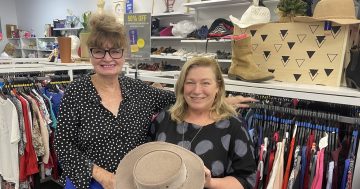
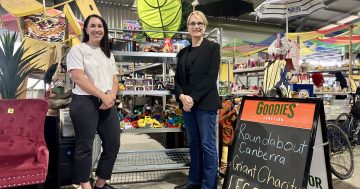
Vinnies is reminding donors to be cautious about what they are donating to ensure all products can be re-homed. Photo: Thomas Lucraft.
St Vincent de Paul is reminding donors to be mindful of the quality of donations and the times at which they’re dropped off.
Because of safety and quality measures, the volunteer organisation often has to dispose of food and clothing donated to its sites after hours.
According to Vinnies, staff can’t monitor donations left outside overnight, meaning clothes can be spoiled by weather and items may be damaged if people rummage through bags and boxes.
Retail operations manager for Vinnies Canberra/Goulburn Jason Hitchick explained that while not all donations that are left overnight are disposed of, the only guaranteed way for donations to be accepted is if they are given during each store’s operating hours.
“Most people donating after hours are trying to do the right thing. We just want to help them donate in a way that gives their items the best chance of being reused,” he said.
“Our team assesses what it finds. The problem is that when something is left outside overnight, no one is there to receive it, secure it or protect it.
“A good bag of clothes can be left outside at night and be soaked, dirty or scattered by morning. Food can spoil or attract pests.
“Boxes can be rummaged through, and household goods can be smashed or damaged. Closed bags may also contain needles, broken glass, leaking batteries, chemicals or other hidden hazards.
“Donations that have been rummaged through present a hazard to our volunteers and staff, and are often then soiled or rendered unusable. Leaving items after hours can turn a good donation into an unusable one overnight.”
Mr Hitchick said Vinnies also needs to assess the quality of donated products.
He explained that many of the support services Vinnies provides, whether that be food hampers, emergency relief or otherwise, are funded by money made when selling donated goods, and poor quality products are harder to sell.
“Before donating, ask yourself: Is it clean and dry? Is it safe? Does it work? Is it complete and would I be happy to give it to a friend?” he said.
“Recently, we have seen pressure on clothing quality. The rise of fast fashion means more low-cost clothing is circulating, and some garments reach us heavily worn or with very little useful life left.
“That doesn’t mean we reject something because it comes from a lower-cost brand.
“Affordable clothing has an important place in our shops when it is clean, presentable and wearable.
“The issue is condition, not the label. The same test applies to household goods. A puzzle missing pieces, chipped crockery, a damaged chair, unsafe electrical equipment or heavily worn homewares may look like donations, but they may not have a safe or realistic second life.”
Mr Hitchick outlined the best way to ensure donations are accepted.
“For clothing and household goods, bring them to a Vinnies shop during its advertised donation hours,” he said.
“Hand them directly to the team where possible. Use a donation bin only when one is provided, there is room inside, and the goods fit securely.
“Never leave bags beside a full bin or outside a closed store. Goodies Junction reuse facilities at Mitchell and Mugga Lane are also options for reusable goods.
“If something is broken, unsafe or genuinely unusable, an appropriate recycling, e-waste or council disposal service may be more suitable than a charity shop.
“Donate what someone needs, not simply what you no longer want.”
To learn more about how to best donate, visit St Vincent de Paul.