

The blocks in question include the Forrest Hotel and Apartments and the Italian Cultural Centre. Photo: Claire Fenwicke.
A committee inquiry has chosen to neither endorse nor reject a proposed major amendment to the Territory Plan, meaning it’s up to the government to decide if part of Forrest will be rezoned for higher-density homes and commercial spaces.
Draft Plan Amendment B (DPA-B) proposes to rezone Forrest, Section 19, blocks 5, 6, 9, 11 and 12.
It’s a section of land in Forrest bordered by Dominion Circuit, Franklin Street, National Circuit, and the Forrest Tennis Club, across the road from Forrest Primary School and the National Jewish Memorial Centre.
It’s currently home to the Italian Cultural Centre, a Wilson carpark and Forrest Hotel and Apartments.
The amendment proposed changing the zoning of these blocks from Commercial CZ6 Leisure and Accommodation zone and Residential RZ1 Suburban zone to Commercial CZ5 Mixed Use Zone.
It would also alter the Inner South District Policy to introduce site-specific outcomes to limit vehicular access from the current carpark to Dominion Circuit, mitigate noise and overlooking impacts, and specify setbacks and building height controls.
The rezoning would allow existing community uses on the site, such as the Italian Cultural Centre, to continue.
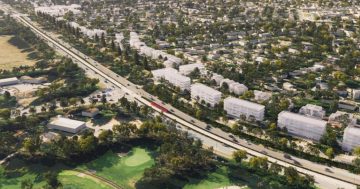
There have been a few iterations of DPA-B, but the final version includes limiting building heights on the blocks to 26 metres. This is expected to allow for buildings ranging from six to eight storeys.
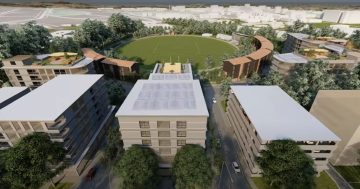
Owners of Forrest Hotel and Apartments, Waldren Holdings, already has a master plan for its land (blocks 5, 6 and 11) should the amendment be accepted.
It would replace the existing buildings with apartments up to eight storeys, with blocks 5 and 6 being lower in height than block 11 to “facilitate access to natural light” on Dominion Circuit.
“Waldren Holdings stated that the plan to develop apartments would ‘allow older residents of Forrest and surrounds to downsize, freeing up larger suburban dwellings for families’,” the inquiry report noted.
A cafe is also part of the plan.
But this could change should it progress to a development application.
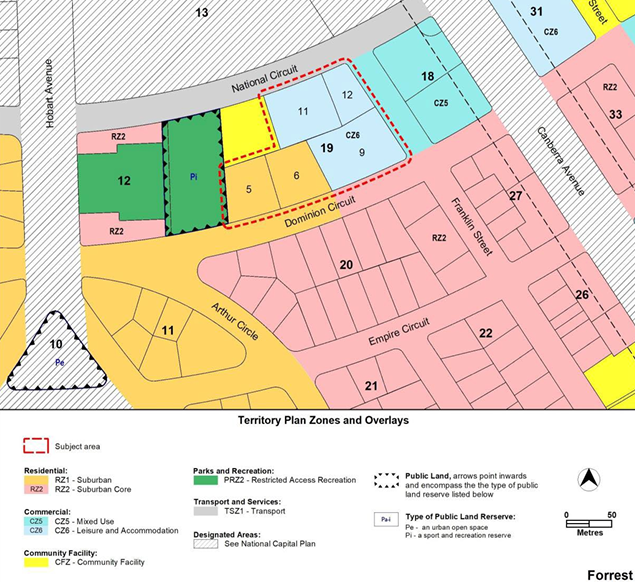
The draft major amendment concerns several blocks in Forrest. Photo: ACT Government.
Other concerns expressed about the change included traffic and noise impacts, overshadowing, impacts on existing trees, lack of controls for planting and tree canopy coverage, heritage impacts, building impacts, precedent-setting, impact on property values, broader community and housing needs, and broader planning considerations.
The ACT Government noted that some issues, such as traffic, planting and canopy cover, would be assessed in the context of a future development application.
The committee noted that this was the first time it had scrutinised a proposed amendment to the Territory Plan (since the new planning system began in 2023) and expressed concern about a “lack of clarity” regarding the potential future uses of the blocks being rezoned.
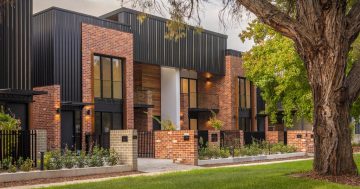
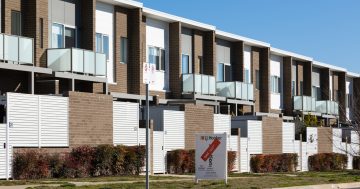
But it offered the chance to densify an established, inner suburb that was close to amenities and employment hubs.
“The need for additional, well-located housing in Canberra is clear,” the committee stated.
“The key question that emerged in relation to DPA-B was, rather, whether to use CZ5 zoning and thus open a large range of potential land uses, or to use a mix of residential zones to limit potential land use to support the construction of housing.”
The committee did not make a final recommendation on which rezoning stance to adopt. Still, it noted that CZ5 zoning offers “far greater flexibility for future land use and provides for potential local employment and housing”.
“DPA-B does not approve any immediate changes to the current character of Forrest, but it does set the parameters for development applications that will lead to changes,” it stated.
Instead, it recommended that, whenever the ACT Government considers or initiates Major Plan Amendments (MPAs), it should make sure there’s enough accompanying information in publicly notified documents that then allow the community to “see the implications on key issues such as security, traffic management, parking, solar access, trees and green space, and environmental considerations”.
The next stage in the process is for the appropriate minister to review the report before deciding to approve, refuse or return the amendment to the Territory Planning Authority for revision.
Once approved, it’s presented to the Legislative Assembly. If it’s not rejected within five sitting days, the draft MPA takes effect and becomes part of the Territory Plan.