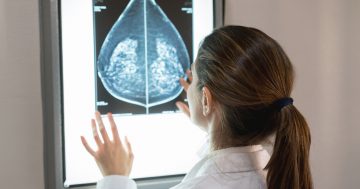
Young woman. Part of ‘Life with Endometriosis’ art photography project. Image by Margaret Kalms, used with permission.
More Australian women and girls are ending up in hospital with endometriosis, but for those living in Canberra, getting the right diagnosis and treatment can come with another hurdle: finding specialist care close to home.
Endometriosis is a chronic condition where tissue similar to the lining of the uterus grows outside the uterus, often causing severe pelvic pain and, for some, fertility problems.
New Australian Institute of Health and Welfare (AIHW) data shows the rate of hospitalisation for endometriosis has jumped 23 per cent over the past decade, far outstripping the 5 per cent increase in hospitalisations among females overall.
There were 24,700 endometriosis hospitalisations across Australia in 2024-25, with more than nine in 10 involving a procedure. Seven in 10 admissions were in private hospitals.
AIHW spokesperson Amy Young said the condition could have a significant impact on people’s everyday lives.
“Endometriosis is a chronic condition that affects many Australian girls, women and people assigned female at birth, and can have a significant impact on their daily lives and overall wellbeing,” she said.
The figures come as the ACT Legislative Assembly initiated an inquiry to examine endometriosis and other pelvic pain conditions, with submissions to the inquiry in April arguing that some of the problems being seen nationally are compounded in Canberra by the size and structure of the territory’s health system.
The Health Care Consumers’ Association (HCCA) said ACT patients faced many of the same problems reported elsewhere in Australia – including delayed diagnosis, gender bias and fragmented pathways through the health system.
But it said Canberra patients could face additional difficulties due to reduced access to local specialists, higher costs and increased reliance on travelling interstate for care.
The organisation has called for a coordinated ACT response, including an integrated, publicly funded women’s health system covering everything from early identification and community assessment through to specialist and multidisciplinary hospital treatment.
Among its recommendations are longer funded GP consultations for complex pelvic pain, more gynaecologists, pain specialists and pelvic health physiotherapists, increased public surgical capacity and better access to advanced diagnostic imaging in Canberra.
It also wants changes to the Interstate Patient Travel Assistance Scheme to make it easier for patients forced to seek treatment outside the ACT.
When contacted by Region, the ACT Government said information about endometriosis and pelvic pain was being considered through the Assembly inquiry.
However, exactly how many Canberra patients are waiting for endometriosis surgery is not known. Canberra Health Services reports elective surgery waiting lists by clinical specialty rather than individual conditions.
A Canberra Health Services spokesperson said the health service recognised the “significant impact” endometriosis and chronic pelvic pain could have and had been strengthening its approach to treatment.
People referred for pelvic pain currently join a single gynaecology waiting list, with referrals reviewed by a specialist to determine the appropriate treatment.
Since July 2025, CHS has also operated an Endometriosis Pelvic Pain pathway aimed at getting patients assessed earlier and coordinating different parts of their care.
Depending on individual needs, patients can be referred to nursing, physiotherapy, psychology, pain management, allied health or specialist medical services.
CHS said it had also increased specialised nursing, physiotherapy and psychology support and would continue evaluating the pathway.
The pressure being examined in Canberra sits within a much larger national shift in how endometriosis is treated.
Almost two-thirds – 62 per cent – of endometriosis hospitalisations in 2024-25 involved laparoscopic excision or ablation, compared with 58 per cent a decade earlier.
The rate of laparoscopic excision rose substantially, from 57 to 93 hospitalisations per 100,000 females over the decade, while the rate of diathermy procedures declined.
Hormonal treatments, including the contraceptive pill and intrauterine devices, are recommended as first-line treatment for people who are not trying to conceive.
Hospital IUD insertions for endometriosis increased from 19 to 29 per 100,000 females over the decade.
“This aligns with clinical guidelines which recommend the use of hormonal treatments after laparoscopic surgery to help reduce the recurrence of symptoms,” Ms Young said.
But the national figures also reveal a substantial number of patients are still undergoing major surgery.
There were 3200 hysterectomies associated with endometriosis in 2024-25. More than nine in 10 were performed on women aged over 35, while fewer than 10 a year involved patients under 25.
The rate of abdominal hysterectomy for endometriosis has doubled over the past decade, from 11 to 23 procedures per 100,000 females.
Cost is another part of the problem.
Sexual Health Advocates for Reproductive Equity (SHARE), a group of young Australians campaigning for free access to contraception, told the ACT inquiry that financial barriers could restrict treatment choices for people managing endometriosis and pelvic pain.
Its national survey found two in five respondents said cost had limited their contraceptive choices, while more than one in three could not afford their preferred method. The group cited research estimating the lifetime burden of endometriosis at almost $130,000 per person, excluding associated conditions.
For HCCA, improving care in Canberra therefore requires more than simply increasing the number of procedures performed.
It wants earlier identification, clearer referral pathways, greater specialist capacity, better pain management, financial support and improved coordination between the different health professionals a patient may encounter.
It has also called for ACT-specific data on how long people wait for a diagnosis, how easily they can access treatment and their eventual health outcomes.