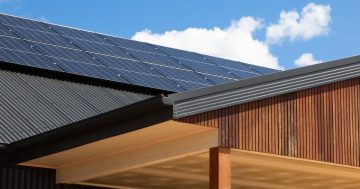
Canberra commercial rooftops decked out in solar, like this one in Mitchell, could act like a collective, decentralised power station, improving stability and reliability across the national electricity market. Photo: EPC Renewables.
Flying into Canberra, you look down on vast stretches of commercial and industrial rooftops that remain largely free of solar panels. That picture is about to change significantly, thanks to an expansion of Australia’s Small-scale Renewable Energy Scheme.
On 1 October, the Federal Government upped the eligibility cap for the scheme tenfold, expanding rebate support from 100 kW systems up to 1 MW (1000 kW).
The policy targets a long-overlooked market segment dubbed the “missing middle”: small-to-medium enterprises whose energy demands outstripped household solar rebate limits, but for whom large-scale industrial incentives were out of reach.
“The expanded scheme reduces the biggest barrier to installing the optimal solar system for businesses — the upfront outlay,” EPC Renewables CFO Steve Carter says.
“At times we had seen some installations where a 300, 400 or 500 kW system would have been more ideal, but clients have elected for a smaller 100kW system to get the rebate than to try and eliminate their bills with a bigger system, because the higher upfront capital cost put it out of reach. This has really opened the door to solar for a whole new market.”
For many businesses, the expansion unlocks tens of thousands of dollars in upfront savings, with some operational models able to offset daytime energy costs entirely, depending on usage and generation.
“Typically, what we find is the payback period for these systems is four to five years,” Steve says.
“The life expectancy of these systems is 25 years. So you’re effectively looking at 20 years of free energy usage. Businesses also stand to gain a lot more than residential properties, because they require the bulk of their energy during the day, when it’s being generated, which makes consumption really efficient.
“It’s a bit of a no-brainer. The upfront costs may still seem high, but we’ve got a range of solutions for that, and this rebate goes a long way to reducing it.”


A broad range of commercial assets stands to benefit from reduced grid dependence, including warehouses, factories, shopping centres, schools and agricultural holdings.
Deployment options are equally diverse, ranging from standard rooftops and ground mounts to agrivoltaic systems where livestock graze beneath elevated panels.
“What we’ve actually seen is the pasture is improved in those situations as well, so it’s a win-win for agriculture,” Steve says.
Similarly, commercial solar carparks serve a dual purpose by shading vehicles while actively feeding the facility’s load.
However, in all systems, hardware selection remains a critical variable in long-term performance.
“Higher-end products may give you slightly better returns over the longer term and have better warranties,” Steve says. “Tindo, an Australian-made product, is our high-end panel of choice. They cost more but again, this rebate potentially enables people to opt for a system with greater longevity and returns.”
Holding rare triple ISO and OFSC accreditations, EPC Renewables combines top-tier compliance and high-spec engineering to ensure these expanding commercial builds meet rigid national standards. Through its ongoing expansion and a dedicated foundation supporting Indigenous employment, the Canberra-founded, Supply Nation-registered firm is actively bridging project execution with social impact to drive Australia’s energy transition.
Because the business case is only half the story. Zooming out from the individual warehouse or shopping centre, scaling up commercial solar plays a critical role in strengthening Australia’s national energy architecture.
By generating power at the point of consumption, Canberra adds vital redundancy to the grid and builds resilience against global supply chain vulnerabilities, reducing dependence on foreign oil routes and shifting towards total domestic energy self-reliance.
“It means our energy network becomes much more robust through a distributed energy mix, making the entire National Electricity Market more stable and reliable,” Steve says.
“In the bigger picture, it just makes sense. It’s about achieving greater energy independence — not having to rely on oil coming through the Strait of Hormuz or external agreements with Singapore or Korea. Having our own energy generated right here, coupled over time with commercial EV transport and battery storage, means genuine self-reliance.”
For more information, visit EPC Renewables.
Region Media Partner Content