
24 November 2025

Experts warn this carbon-cutting policy could backfire

| By Dione David
Join the conversation
18
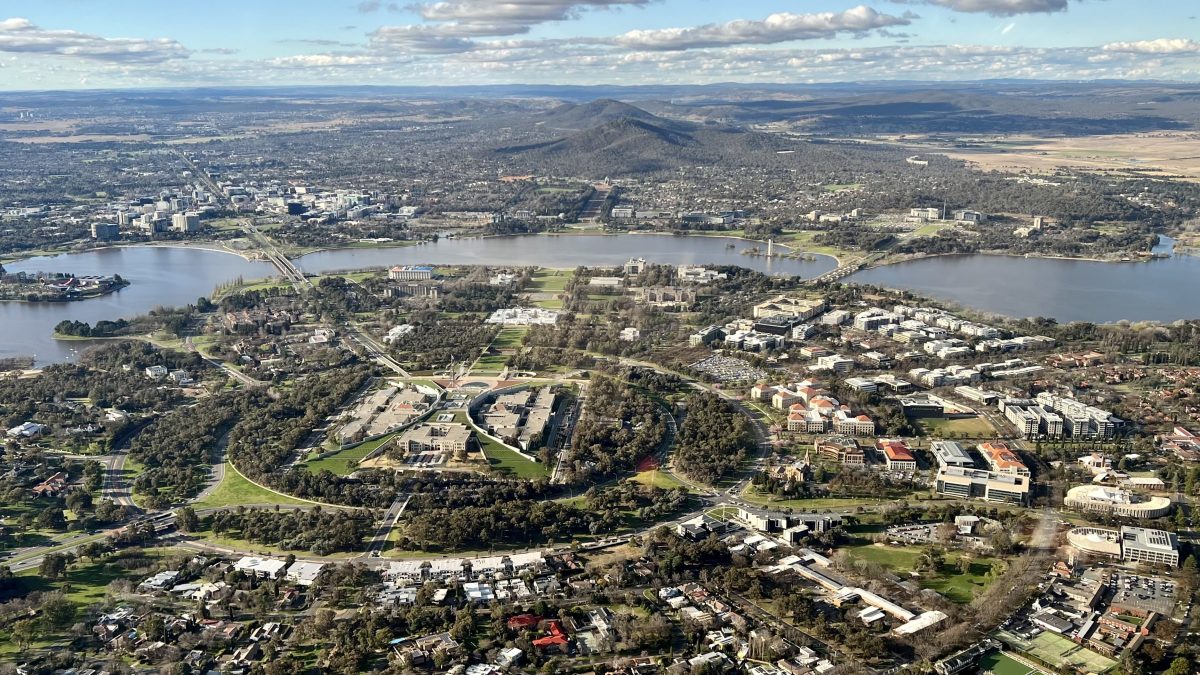
Aerial view of Canberra city and Parliament House

As the government pushes for greener offices, property advisors warn embodied carbon is a missing piece in Australia’s net zero puzzle. Photo: James Coleman.

A policy designed to cut emissions could end up creating them, with property advisors urging the Federal Government to address critical gaps in its new energy standards before unintended consequences take hold.

Since July, federal agencies have observed a strict policy that new office leases for spaces over 1000 sqm must achieve a minimum 5.5-star National Australian Built Environment Rating System (NABERS) score, as part of their net zero commitment.

But even as a high NABERS score becomes the hot ticket to securing government tenants, the Australian Strategic Property Advisors (ASPA) warns the move could inadvertently generate hundreds of thousands of unnecessary tonnes of carbon, as entities abandon purpose-built offices for new builds.

ASPA managing director Stephen Oxford said while the policy embodied the best of intentions, it overlooked a critical component — embodied carbon, the emissions released during the construction of a building and in the materials that make it.

“The government policy says that if you move from a 4.5 NABERS-rated building to a 5.5, you can cut carbon in half on an operating basis,” he said. “What’s absent from the policy is the impact of the embodied carbon — not only in constructing a new building, but also in the building that’s left behind.”

READ ALSO Are we witnessing the quiet death of the Canberra CBD?

That embodied cost, he said, can be staggering.

He pointed to the RG Casey Building — a building above 40,000 sqm, with a four on the NABERS scale.

“Typically, to upgrade a building of this scale from 4.5 to 5.5 could cost as little as 70 kg of carbon per square metre, as opposed to 650 kg per square metre for a new build,” he said. “That’s 2800 tonnes of carbon to upgrade versus 26,000 tonnes to build new, so about 10 per cent of the carbon cost.”

Mr Oxford said some of the government’s largest office footprints were particularly concerning.

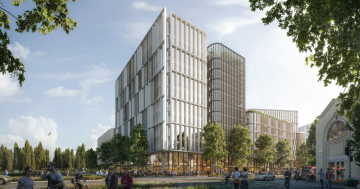
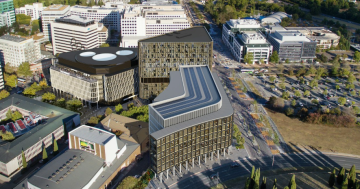
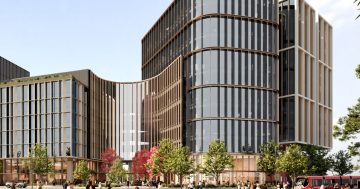
With multiple buildings totalling about 100,000 sqm of floor space, the National Security Office precinct would cost a staggering 65,000 tonnes of carbon to build, according to industry estimates.

“That’s an astronomical amount of carbon to be releasing at a time when there are 5.5 NABERS-rated buildings available to lease in our city,” he said.

“Number 50 Marcus Clark is still fully leased by the Department of Education, but it’s rumoured they’ll vacate that building and move into a new build in the city in the next couple of years. And 21 Genge Street is the address the ATO left behind for Barton.

“I understand there are specific requirements for security, but on one hand, you’re saying you’re committed to net zero and on the other, making decisions that are literally contributing tens of thousands of tonnes of carbon into our environment.”

Man standing in front of computer desks and looking at the camera

ASPA’s Stephen Oxford said the government needed to rethink its office procurement practices. Photo: Michelle Kroll.

In a territory that Mr Oxford said had “the greenest office sector on the planet”, it was also hard to justify the cost to taxpayers.

ASPA calculations indicate new builds are a third more expensive to lease than existing.

Furthermore, while a 5.5-star NABERS building may halve operational emissions, those environmental gains were erased once the carbon cost of a new build was factored in.

“It’s simple to work out,” Mr Oxford said. “For a 40,000 sqm building with a 15-year lease term, you’ve eroded any impact of the operational carbon savings, because of that upfront carbon in its construction. And that’s not even considering the carbon embedded in the building you’ve left behind.”

READ ALSO Commonwealth urged to act now on office leases to unlock millions in savings

ASPA is calling for a rethink on what sustainable development means, starting with a shake-up of procurement practices.

It would require a shift away from “monolithic” purpose-built government buildings of tens of thousands of square metres of floorspace.

“They have one use for life and pose an environmental scenario no government in the world should consider optimal,” Mr Oxford said.

“Buildings should be built to live multiple lives — as offices, schools, housing, hotels and student accommodation. Extending the life of an asset is always a more environmentally friendly outcome.

“Instead of a 40,000 sqm building, why not four 10,000 sqm properties all in close proximity, so you can retain that co-location feel, but make it easier to convert those buildings into hotels or schools when you’re ready to move on? It would require compromise, but consider the financial and environmental gains.”

ASPA also wants to see embodied carbon factored into the government’s leasing decisions.

“That would encourage the use of existing buildings over new builds,” Mr Oxford said. “We all like seeing beautiful new buildings, but redundant assets in our CBD and scattered across the country are no good for anyone.”

For more information, visit ASPA.

REGION MEDIA PARTNER CONTENT

Join the conversation

18
All Comments
  • All Comments
  • Website Comments
LatestOldest

I have a 20+ year old ICE car. Based on it’s age, it’s not worth a lot, however, mechanically it’s fine.

There are many who would scawl at me for driving an emission belching ICE, and would passionately argue that I should be saving the planet, and buying an EV. Yes, I’ve had those discussions.

The problem however, is the same one that the government is creating with it’s policy of only leasing 5.5 star buildings; that is, the real carbon cost!

The carbon cost on the manufacturing of my old car was spent 20+ years ago, and is now part of the environment. I can’t undo that. If I buy an EV (which actually have higher upfront carbon-costs than the manufacturing of an ICE), I’m spending that carbon again.

On the upside, I may over time recoup some of that new carbon-cost. The question then is for how many years and for how many kilometres, do I need to drive before I break even? I don’t do a lot of kilometres per year, so I expect it’ll take many years.

What about the original carbon cost of my old car? By scraping it, has those costs been wasted?

As much as I’d like to buy a new car, I can’t help feeling that ecologically, it makes more sense to drive every last kilometre my old car can muster, before starting that carbon-burn cycle again.

It’s really no different to housing. A significant number of houses in Canberra are not aligned to catch the northerly sun, and have thin single pane windows. We certainly can make efforts to improve the energy efficiency of our homes, however, changing their design and how they are aligned on the block, are things we can’t change.

Governments State and Federally, really should be considering the true carbon costs of the projects they embark on. Personally, I think a lot of decisions are made for idealogical and symbolic reasons.

They’re talking about new leases not necessarily replacing old ones just to improve the carbon footprint. Similarly with your car, when you replace it consider an EV.

Capital Retro9:29 am 18 Nov 25

You too can become a virtue signaller Colin Wood when you finally scrap your fossil fuel burner because at least 70% of it is recyclable.

What percentage of an EV is recyclable?

Yeah, my old car is not yet worn out so I will not be replacing it quite yet. Besides there is not an EV out there yet that does what I expect. I jumped in once and bought a beta VCR and was lonely in the video store.

That’d be the 95% of most batteries in EV is recyclable CR (whether we have the systems in Australia yet to do so is another story), and the rest of the car is similar, if not better than a fossil fuel burner.

Nice try with your fact free dribbling however.

“What percentage of an EV is recyclable?” What a silly question, nearly all of it…much like with an ICE vehicle.

https://www.vesr.gov.au/news/batteries-and-recycling

“You too can become a virtue signaller….” as EVs are reaching price parity with comparable ICE vehicles and are cheaper to maintain, cheaper to run (even cheaper for those with solar panels), faster, quieter, have less air and noise pollution and lower emissions who is going to be the virtue signaller when you’re ignoring the data and evidence to justify buying an ICE vehicle, Capital?

Leon Arundell3:56 pm 17 Nov 25

The ACT’s so-called “net zero by 2045” policy has similar issues. It applies only to direct emissions.
The Commissioner for Sustainability and the Environment concluded that 94% of our carbon footprint is indirect (Scope 3) emissions such as those embodied in steel and concrete.
Those emissions put Canberrans in the top 10% of climate polluters who cause 30% of the world’s greenhouse emissions.
The Conservation Council ACT Region thinks that’s a good thing. It says, “Canberrans are proud to live in a city that is leading the world on climate change.”

Stephen Saunders1:57 pm 17 Nov 25

A carbon-cutting policy could backfire, who knew? In Albanese-Bowen world, unicorns are everywhere, and Superpower Australia can lead the world in carbon-cutting policies.

Ah it hasn’t “backfired” the calculations are complex, with many variables in play there is not likely to be a one size fits all calculation, as no two situations are likely to be the same.

It doesn’t hurt to discuss how to make a policy better though, rather than take an extremely negative, uncharitable and partisan view in every circumstance….maybe give it a go.

chrisjeanemery1:17 pm 17 Nov 25

The embedded cost of light rail is staggering.

Just to be clear here – to save the planet we’re going to build more buildings ?

More concrete, more steel, more heating, more cooling.

Commercial vacancy rates have gone from 9.2% last year to 10.7% this year so there’s not even the demand to support this.

What brainiacs come up with this stuff ? Though one suspects a certain climate and energy Minister might have his brilliance involved here.

The one suffering from the Net Zero mind virus. Actually, most of them

“Just to be clear here – to save the planet we’re going to build more buildings ?”

No where does it stay that. The ASPA have suggested that embodied carbon costs should be a consideration in the new rules, for new leases. Glad I could help.

Your partisan attempt to turn this into something it’s not is as ever hysterical and vacuous.

Agreed FP, there does seem to be a real cognitive blocker around this topic much like covid. Take seano for example, rallying here every day defending the kraziness around climate zealotry. Yet appears unable to process even the first sentence of the article:

“A policy designed to cut emissions could end up creating them” …. yet is unable to link higher CO2 emission with saving the planet …. “No where does it stay that.” (sic)

Makes you wonder whether a remedy exists. Surely the notion of constructing unrequired buildings – with the housing shortage being a national debacle – is a clear example of this zealotry. Shouldn’t we be prioritising planning, funding, resourcing, and providing materials and infrastructure in a national effort into building places for people to live ?

Your insult and incoherent posturing as ever means little Penfold.

If you actually read the story and seek to understand the issue, rather than hysterically promote culture wars nonsense you would see a reasonable point raised about the consideration of embodied carbon costs in the NABERS calculation.

But given such calculations are complicated by may factors, only a fool would jump from a suggestion to amend the calculations to “Just to be clear here – to save the planet we’re going to build more buildings”.

Daily Digest

Want the best Canberra news delivered daily? Every day we package the most popular Region Canberra stories and send them straight to your inbox. Sign-up now for trusted local news that will never be behind a paywall.

By submitting your email address you are agreeing to Region Group's terms and conditions and privacy policy.